Learning social theory through everyday conversations
Students make complex concepts relatable through collaborative scripting an everyday conversation that explains or illustrates social theory or a key sociological concept from a required reading.
Snapshot
- Educator: Associate Professor Liz Dean
- Subject: SOCI10003 Inequalities: Future Challenges
- Discipline: Sociology
- Study Level: Undergraduate, Level One
- Class Size: 260 students
- Delivery Mode: Combination of on-campus lectures and tutorials
Design
Why?
Foundational sociological texts and theory can be challenging for first year Bachelor of Arts students to grasp and apply. This design builds on the demonstrated effectiveness of drama-based activities in making theory more relatable, increasing class participation and building students’ capacity to articulate and apply social theory (Hardy, 1989; Scarboro, 2004; Holtzman, 2005). Having students work in pairs to write a short dialogue as a conversation between two people, deepens their communication skills and understanding of key concepts from a reading (Pelak & Duncan, 2017). When students work in pairs or small groups to write a short script based on a sociological text discussed in class, this co-writing of dialogue builds their capacities to explain and apply key concepts (Eglitis, 2010). Students can share ideas with peers and reflect on their thinking by reading their script out loud to class. This activity, then, also builds confidence. Moreover, this short and easy-to-implement scripting exercise supports opportunities for students to belong to a community of engaged embodied learners (Hegna & Orbaek, 2024). This design could also be further adapted to extend the embodied elements through performance of dialogues and incorporated into reflective assessments, in-class secure forms of assessment, to maximise experiential dimension through reflection.
How?
Preparation and resources
Students write a sample dialogue script to demonstrate their understanding of the task, then read through it with tutors to practise. They discuss how to communicate one central concept from the assigned text and use questions and prompts to brainstorm ideas for their scripts.
The resources required for the activity are minimal, students are supplied with pens and paper to draft their dialogues, but they can also choose to use their laptops.
Activity sequence
A week before the activity, students were:
- paired up and assigned one required reading in their pair
- instructed to do the reading and take notes of key concepts, independently
- instructed to be ready to share their understanding of the reading in their pairs
In tutorial, students were:
- asked to think about how to illustrate and best communicate their understandings, for example, of bell hook’s Feminism is for Everybody
- instructed to write a short one-page dialogue and given about 30 minutes to do that;
- given a starting point of identifying two positions: who is in conversation and what are their social locations?
- provided minimal instructions in a form of prompts, such as ‘think about how this relates to you, something you have observed, experienced or thought about’ to encourage creativity and multiple ways of interpreting the task;
- encouraged to read their dialogues out loud in pairs, as a form of listening, and edit their script on the back of that;
- Invited to read their script to the whole class or ask another student pair to read their script out loud in class.
Reflection
Reflection was embedded throughout the activity by getting students to reflect on what they were reading and transfer that to the everyday conversation. The reading of the scripts out loud was another point of reflection where students were able to consider the authenticity of their dialogue and the interlocuters’ social locations. This activity could be extended with a reflective assessment where students reflect on what they learned through the practice of dialogue writing and reading, and how the activity deepened or changed their understanding of the concepts from their assigned required reading. The capacity of this design to present students with these opportunities for meta-learning have been reflected in the evaluation of the first iteration of the activity.
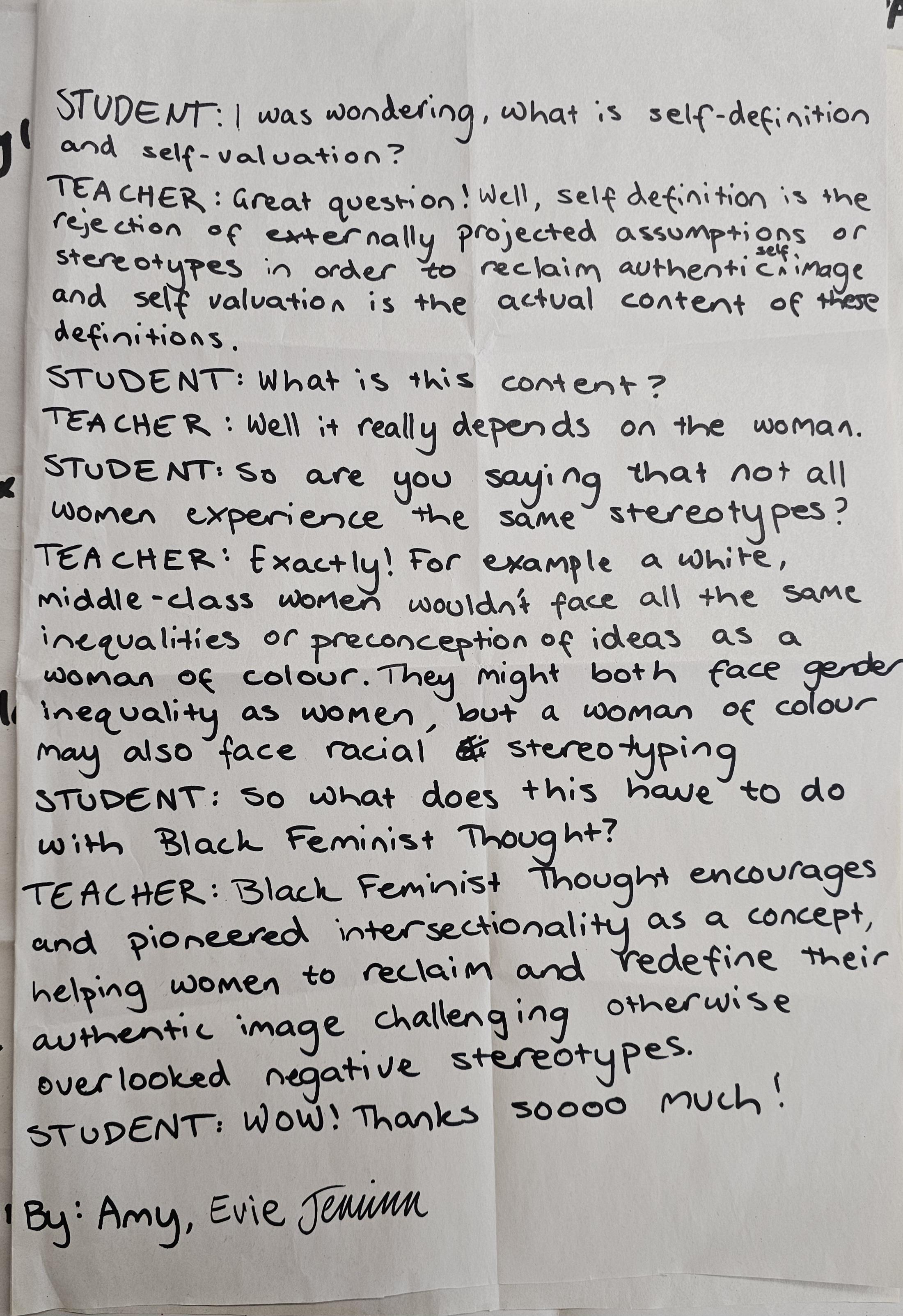
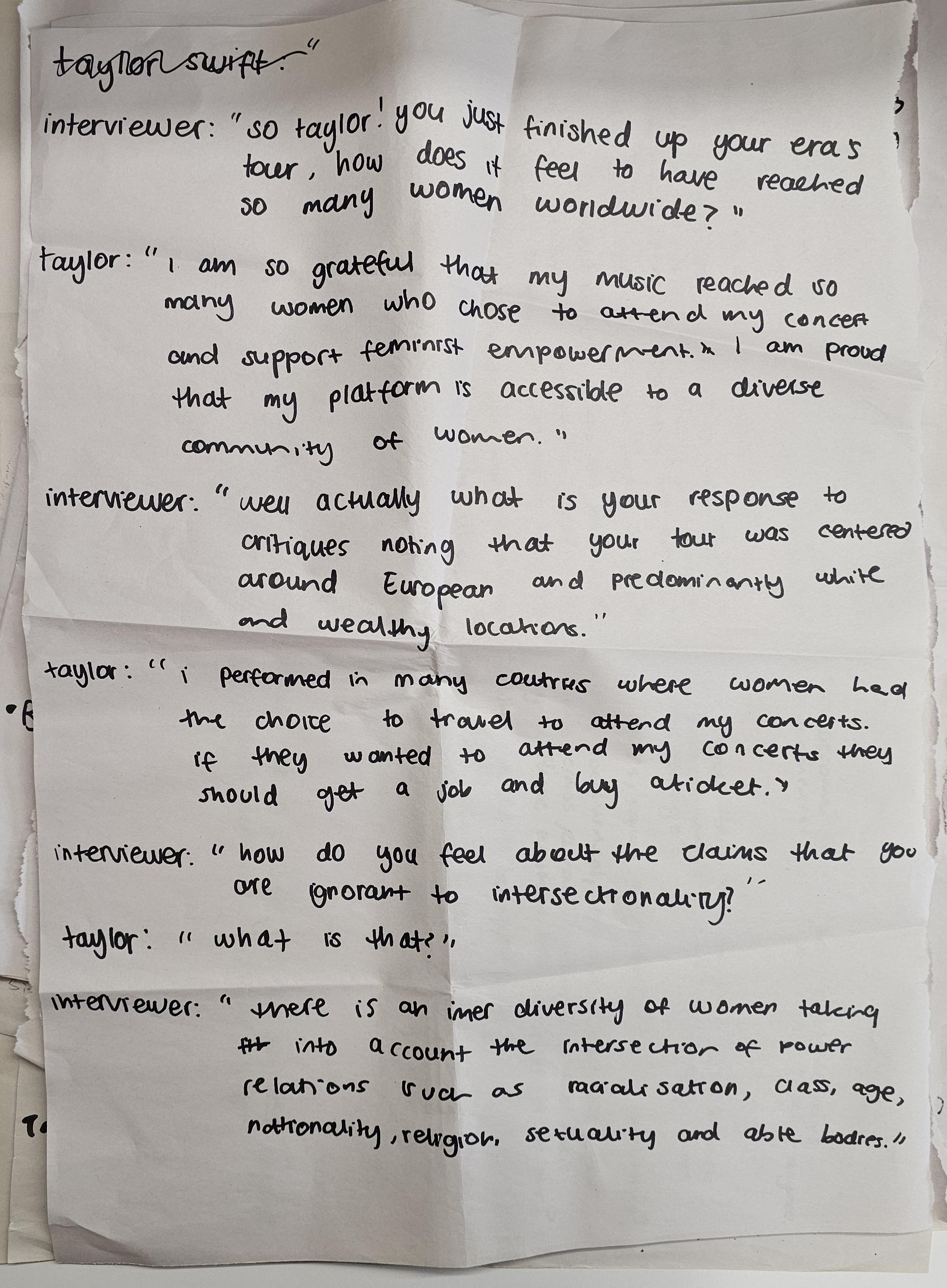
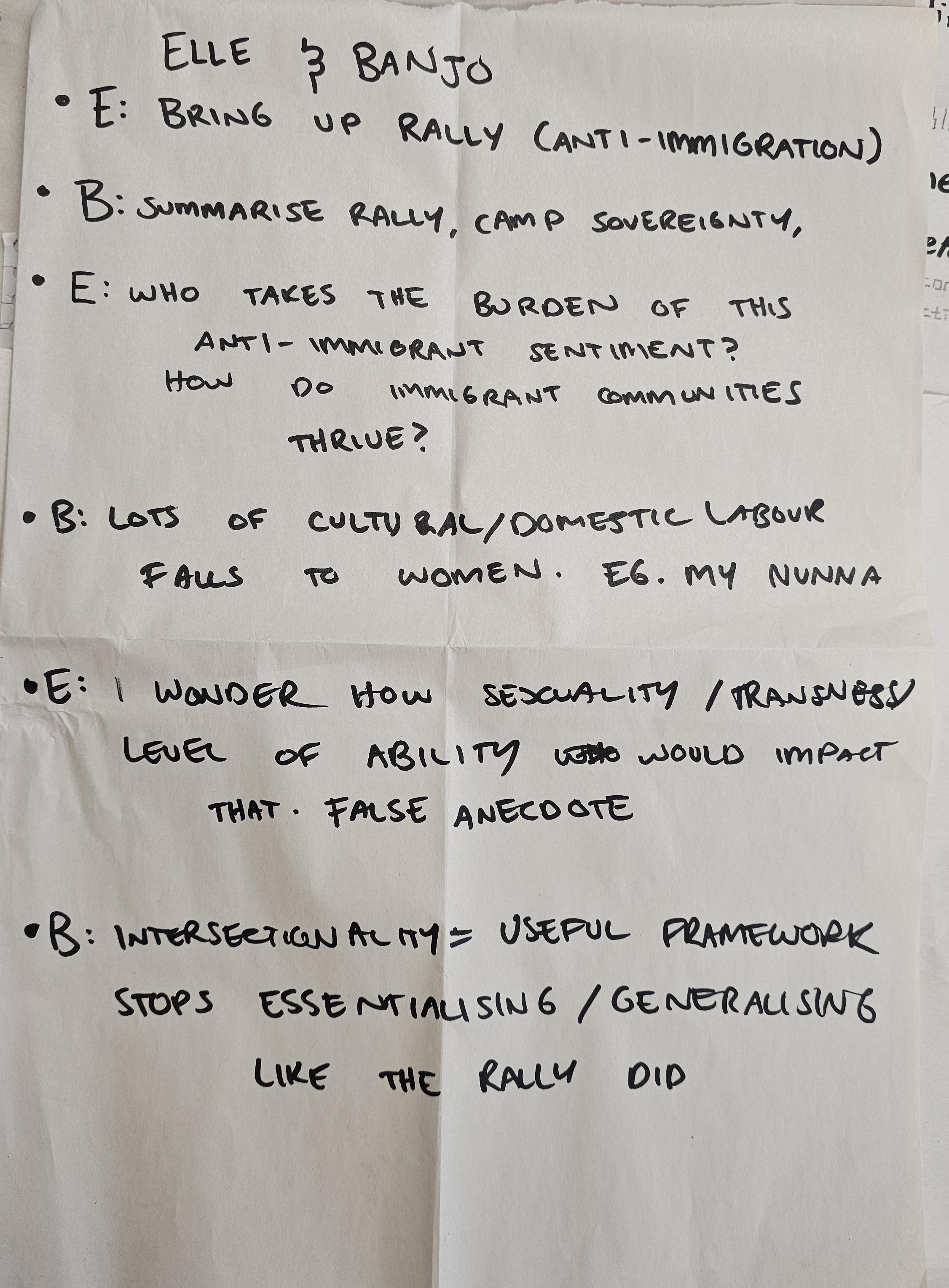
Many students chose to handwrite their dialogue scripts
Insights
A post-activity student survey included four qualitative open-ended questions which invited written responses. Analysis shows that the activity provided motivation to engage with set readings, as students ‘felt accountable’ to their groups, and allowed deeper and more memorable understandings. Applying theory to practice in everyday contexts and real-world language was seen as a key aspect that allowed students to relate to ‘other peoples’ perspectives’, ‘contextualise the reading in the real world’, ‘capture the essential aspects of the reading and explain them’. These responses demonstrate a high degree of metacognition through understanding of the way activity contributed to their learning.
Associate Professor Liz Dean had the following reflections after piloting this activity with her first year sociology undegraduates:

Writing a dialogue as a conversation grounded in one week's content created engaging learning activity with students. This extremely successful praxis brought students together to discuss and clearly communicate their understandings in a joyful way where, to quote two students, they also ‘made friends’.
Resources
No technologies (other than a laptop for some students with their reading on screen), were used in this exercise. This was to assist students with having the opportunity to speak together, and work through ideas on paper, and to embody the listening and dialogical elements of learning.
Contribute
Tell us if you have tried this design or something similar.
Click here to share your design
References
Eglitis, D. S. (2010). Performing theory: Dramatic learning in the theory classroom. Teaching Sociology, 38(4),340-349.
Hardy, T. (1989). Toward a Critical Pedagogy in Sociology through the Use of Drama. Teaching Sociology, 17(2), 226–231.
Hegna, H. M., & Orbaek, T. (2024). Traces of embodied teaching and learning: A review of empirical studies in higher education. Teaching in Higher Education, 29(2), 420-441.
Holtzman, M. (2005). Teaching Sociological Theory Through Active Learning: The Irrigation Exercise. Teaching Sociology, 33(2), 206-212.
Scarboro, A. (2004). Bringing Theory Closer to Home through Active Learning and Online Discussion. Teaching Sociology, 32(2), 222–231.
Pelak, C. F., & Duncan, S. (2017). Using a social science fictional play to teach about global capitalism and macro-structural systems in Introduction to Sociology. Teaching Sociology 45(4), 334-346.