How do you teach collaboration, problem-solving, and adaptability in a way that's fun, immersive, and deeply impactful? ATI’s Maxx Schmitz explores ways to develop students’ transferable skills through digital simulations and games. Here is how an escape room activity was implemented in the ARTS30001 Industry Project subject to enhance students’ capacity for collaboration and problem solving.
The electronic escape room is a digital simulation that presents students with a series of interconnected puzzles and challenges. Each task requires critical thinking, creativity, and effective communication to progress. The immersive and time-sensitive nature of these tasks transform the traditional learning environment into a dynamic, interactive experience. Success demands collaboration, problem-solving, adaptability and effective communication.

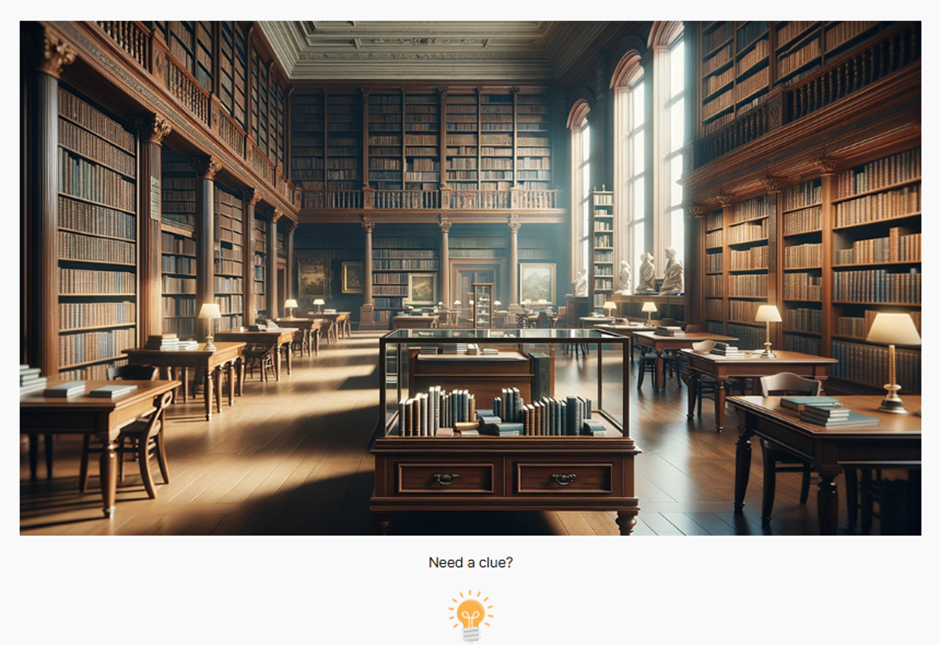
Images from inside the electronic escape room: on the left, students engage with historical code-breaking tools, and on the right, they search for hidden clues in an old library.
The escape room is integrated into the Industry Project curriculum as a core component of its experiential learning approach. This activity is designed to foster teamwork and problem-solving skills that are essential for both the successful completion of the subject and students’ futures. Over the semester, students collaborate in small teams on projects commissioned by industry partners. To support effective team collaboration and reflexive practice, the subject introduces students to key theories of teamwork and team roles through a traditional lecture. In the following week, these project teams navigate the escape room within a set timeframe and reflect on the experience immediately upon completion. This critical reflection contributes towards the learning outcomes by clarifying the purpose of the escape room and giving students’ a chance to candidly assess their team’s performance. This process gives students the opportunity to learn from mistakes and foster a culture of openness and continuous improvement within their teams.
Feedback from students supports the activity’s integration of academic knowledge, experience and critical reflection. Students appreciate an opportunity to test their teamwork in a safe-to-fail environment. Many report that the experience has enhanced their confidence in problem-solving and teamwork, skills that are essential in professional settings.
As digital simulations and games like escape rooms gain traction, they offer a powerful means of blending theory and practice. These activities not only prepare students for academic success but also equip them with skills essential for thriving in today’s dynamic workplaces. To explore how such innovations can enhance your subject, reach out to Maxx Schmitz.
Further Reading
Clarke, S., Peel, D. J., Arnab, S., Morini, L., Keegan, H., and Wood, O. (2017). Escaped: a framework for creating educational escape rooms and interactive games to for higher/further education. International Journal of Serious Games, 4(3).
Pan, R., Lo, H., and Neustaedter, C. (2017). Collaboration, Awareness, and Communication in Real-Life Escape Rooms. Proceedings of the 2017 Conference on Designing Interactive Systems.
Zhang, X. C., Lee, H., Rodríguez, C. L., Rudner, J., Chan, T. M., and Papanagnou, D. (2018). Trapped as a group, escape as a team: applying gamification to incorporate team-building skills through an ‘escape room’ experience. Cureus, 10(3).