From Listeners to Content Creators: Developing Italian Language Proficiency, Understanding of Culture and Research Skills through Podcasting
Elisabetta Ferrari
Language instructors often use topical podcasts to bring excitement into language classes. But what if instead of simply listening to podcasts students stepped into the role of content creators and produced their own podcasts? In this guest blog, Elisabetta Ferrari, Senior Lecturer in Italian Studies, reflects on the process of reimagining traditional oral tasks as a student-led podcast project, which has since been featured on SBS Italian Radio.
As a language instructor, one of my major concerns is ensuring that students can communicate and use the language they are learning in the most efficient and stress-free manner. What may seem like a very natural progression – learning a language and using it – is, in fact, a very complex process that involves cognitive and affective interactions (Özdemir & Seçkin 2025). Not surprisingly, speaking tasks intimidate students (Özdemir & Seçkin 2025). Feelings of anxiety are heightened when these oral tasks are assessed, performed in front of peers and timed, negatively impacting students’ overall learning experience (Kim, 2009).
Over the years, I have reconsidered the format of traditional oral assessment tasks used in language teaching – particularly in-class presentations – with the aim of reducing associated anxieties and, thus, improving the overall learning experience.
One of the changes I have implemented and refined over the last seven years is an assessed podcast project in the subject ITAL10002 / ITAL20008 Italian 4 (second-year post-beginner level). For this project, students work in small groups to research, write, produce, and record short podcasts entirely in Italian. This has been facilitated by access to the on-campus Horwood Recording Studio and by the help of sound engineer Gavin Nebauer.
The project is scaffolded throughout the semester. In the first few weeks, students are introduced to the podcast medium and its linguistic features; several examples are listened to and discussed in class, with particular attention to language use and register. Then, working in small groups, students select a podcast topic, conduct research, and write a script for the recording. Topics and scripts are submitted to their instructor for feedback on ideas, language and content – similar to a pitch and review process. Once the script is finalised, each team records their podcast at the Horwood Recording Studio, where I am also present to assist with pronunciation and style. Podcasts are then professionally edited (with music and other audio adjustments) and shared in class. The finished products become part of the course material and, comprehension and class discussion activities are designed around each podcast.
Students are encouraged to produce podcasts related to Italian topics and events happening in the Italian community in Melbourne and beyond. A key requirement is that the podcasts relate to authentic events or topics and are meaningful and engaging for listeners. Students must consider their target audience and the potential impact of their content. Over the years, topics have ranged from festival and cultural event coverage to interviews with members of the Italian community, and reflections on language learning. During the COVID-19 pandemic – when the project was successfully recorded remotely – podcasts became an important outlet for students to share their personal struggles and coping mechanisms.
To add real-world relevance to the project, I have partnered with SBS Italian Radio in Melbourne since 2019. They have generously welcomed the opportunity to collaborate with the students and feature students’ podcasts on air. This partnership transformed the project into a purposeful experiential learning activity, allowing students to share and showcase their work with the wider community while receiving feedback from industry professionals.
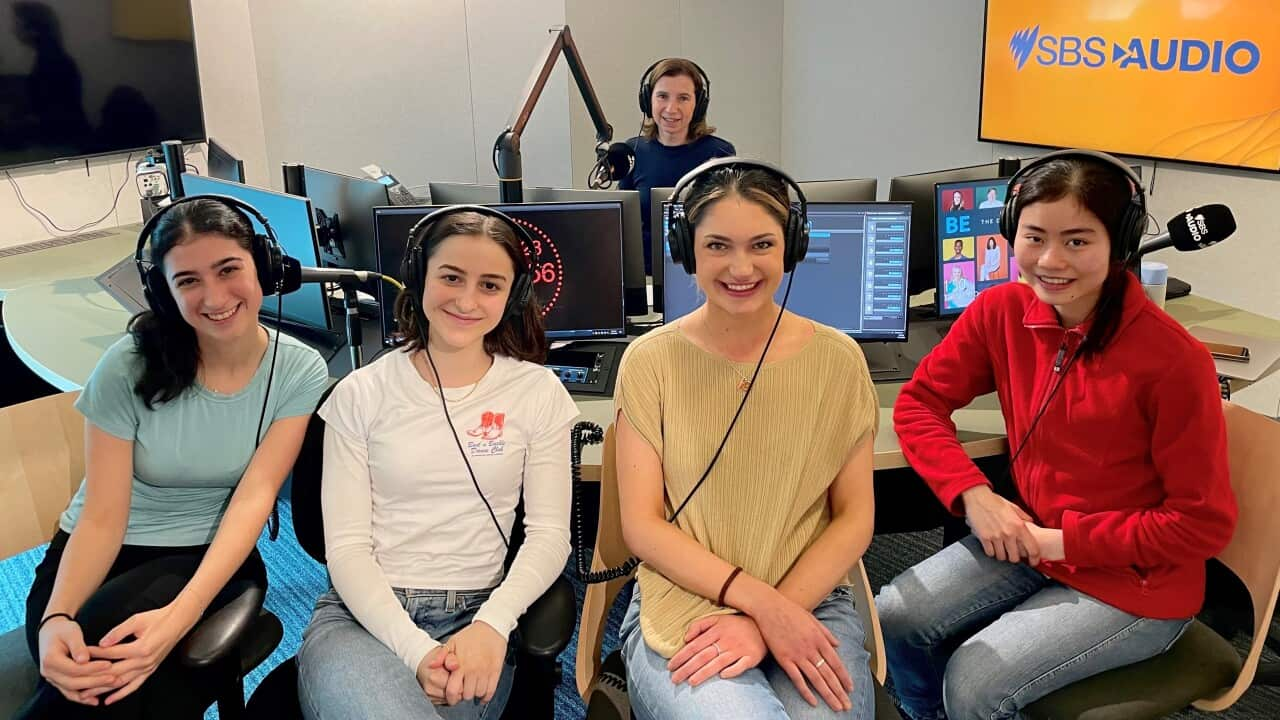 Credit: SBS Italian
Students’ podcasts vary in their linguistic proficiency and quality of research. This mirrors other assessment tasks and does not detract from the overall value of the material produced. In fact, this variation in quality enhances the authenticity of the project.
Students’ enthusiasm in producing and sharing their works, with its creative and collaborative dimensions, has been a consistent feature of this assignment. For me, as their instructor, there are also great rewards as I observe their language progression and the wider benefits of their learning journey, including engagement with the local Italian community. Most importantly, it enables me to guide and mentor students in developing some fundamental skills, such as teamwork and peer-to-peer learning. Students invariably support one another during recordings and take pride in presenting their accomplishments to the whole class. Their peers are, without a doubt, their best evaluators and motivators.
There is a large body of research on the use of podcasts in additional language teaching and learning. Much of this literature focuses on the use of externally produced professional podcasts which are accessible and easily integrated into course material. Asking students to produce their own podcasts, however, is transformative and dynamic. It allows students to create authentic material and share it within their cohort – transforming them from passive consumers into active language users (Ferrari, Amorati & Hajek, 2024; Amorati, Ferrari & Hajek, 2022; 2025)
References
Amorati, R., Ferrari, E., & Hajek, J. (2022). Podcasting as project-based learning and its effect on the acquisition of linguistic and non-linguistic skills. Language Learning in Higher Education, 12(1).
Amorati, R., Ferrari, E., & Hajek, J. (2025). ‘It wasn’t like getting up in front of the class to speak': Promoting L2 motivation and reducing L2 speaking anxiety through a podcasting project. In A. Díaz, B. E. Hanna, S. Disbray, A. Mikhaylova, G. Yue Qi, Disrupting, Decentring and Diversifying Languages and Cultures in Australian Universities. ANU Press.
Ferrari, E., Amorati, R., & Hajek, J. (2024). Teaching Italian Through Podcasting: Pedagogical Rationale, Implementation, and Student Evaluation of the Podcast Project Dagli Inviati Sul Campus. In G. Guarnieri (Ed.), The Art of Teaching Italian. Georgetown University Press.
Kim, S. Y. (2009). Questioning the stability of foreign language classroom anxiety and motivation across different classroom contexts. Foreign Language Annals, 42(1), 138–157.
Özdemir, O. and Seçkin, H. (2025) Exploring foreign language anxiety in higher education: Multifaceted insights into causes, impacts, and coping strategies, Social Sciences & Humanities Open, 11.