Reflections on the Indigenous Higher Education Curriculum Conference
Tahlia Birnbaum and Jacqueline Dutton
In November 2024, Dr Tahlia Birnbaum, Dr Scott Welsh and Professor Jacqueline Dutton participated in the Indigenous Higher Education Curriculum Conference (IHECC) at the University of Canberra, ACT. In this entry, Tahlia and Jackie share some of their highlights.
The IHECC conference took place on Ngunnawal Country (ACT) from 25-28 November 2024. The event was organised through the Indigenous Curriculum in Higher Education Community of Practice, founded in 2022 by academics at UTS, bringing together over 100 tertiary educators from Indigenous and non-Indigenous backgrounds. Themes for the conference included reflective practice on Indigenous curriculum development, embedding Indigenous perspectives and knowledges in curriculum, and research-informed Indigenous teaching and learning practices.
On the first day of the conference, delegates were immersed in an embodied on-Country experience, grounded in place and story. We met at Mulligan’s Flat, a bushland restoration project managed by Traditional Owners from Ngunnawal elder Aunty Violet Sheridan’s family. Aunty Violet shared stories from her past and told us of her hopes for the future following the ‘No’ vote in the 2023 Australian Indigenous Voice Referendum. She was comforted by the ACT ‘yes’ vote and wanted to further unite the community by sharing music and culture through a festival. We were then taken on a guided tour of the grasslands by Aunty Violet's children and grandchildren. We tried Boomerang throwing and weaving – with varying degrees of success. This On-Country experience set the scene for a discursive and respectful conference.
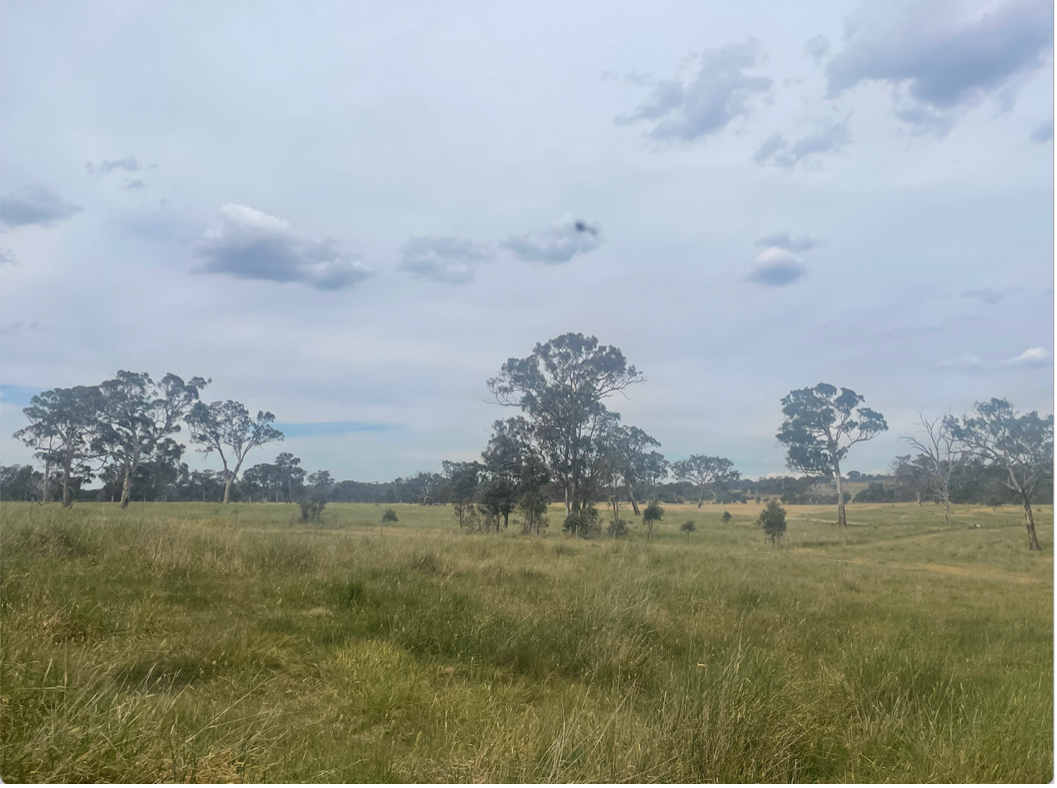 Looking across the grasslands at Mulligan’s Flat photo by Tahlia Birnbaum
Many of the conference presentations were given by members of the UTS Indigenous Teaching and Learning Team. This team, led by Wiradjuri academic Professor Annette Gainsford, Associate Dean Indigenous Teaching and Learning in the Office of the Pro Vice-Chancellor Indigenous Leadership and Engagement, are working towards systematically embedding their Indigenous Graduate Attribute in core subjects across each major/program. This work will ensure that Indigenous knowledges and perspectives are encountered by all UTS graduates. The team emphasised the need to be ‘a curator, not a creator’ to enable broad participation from both Indigenous and non-Indigenous academics. The success they have had so far (2022-2024) in embedding the Graduate Attribute in over 250 course plans and facilitating workshops for over 600 staff is inspiring.
Our paper, ‘Acknowledging Country: Experiences from a foundation subject at the University of Melbourne’, was based on a collective autoethnography drawing on our experiences teaching Arts Discovery, including reflections from Dr Rikke Bundgaard-Nielsen, Dr Andrea Dodo-Balu, Natalie Lynch as well as our own. We found that our ideas and findings resonated with others’ research and experiences, confirming the need for non-Indigenous educators to consult and foreground First Nations voices when approaching Indigenous materials in their teaching.
We both felt very privileged to attend the concluding workshops held at the Arboretum, with beautiful views over Ngunnawal Country. Tahlia chose a workshop run by Jagera academic Associate Professor Ben Wilson, ‘Country as Teacher’. This was a unique experience, with Benny sharing stories from his elders about learning from Country, and how this can be applied to educational practice and life-long learning. This was very much an experience where ‘you just had to be there’, with Benny passing on knowledge he had been granted special permission to use only in this unique face-to-face session. Fortunately, Benny has published extensively on his work already, so his research is available to those who are interested (see Further Reading below).
Jackie went to the object-based learning session with Dr Wendy Somerville, Jeerinja academic, teaching in the Culture and Heritage degree at the University of Canberra and inaugural First Nations Post-Graduate Research Fellow in the Centre for Cultural and Creative Research. We learnt about the processes for acquiring, preserving, and labelling items in the Aboriginal and Torres Strait Islander Arts and Artefact Teaching Collection, then selected one to research and present to the others. There were gourds and jewellery, woven bags and sculptures, tools and trinkets. It was interesting to note how much or how little information was available based on the labels and what we could find on the internet about the materials, the patterns, and the makers or artists, if and when they were named. It was a gentle sharing of our collaborative learning, about the objects themselves but also the world in which they were made and collected. For further insights into the ways that people are engaging with these objects, you can watch the videos that Wendy and her colleagues made for the groundbreaking “Voicing the Living Archive” event in July 2024.
Finally, a workshop run by IHECC co-founder Professor Annette Gainsford, entitled ‘Developing Culturally Safe Teaching and Learning Practices’ brought together the learnings from various UTS presentations. We were encouraged to share our own ideas and classroom experiences of working with First Nations authored teaching materials, making time and space for yarning, and devising assessments for success. Our discussions were wide-ranging, and covered such topics as selecting appropriate resources, consent and intellectual property, positive communication and deficit discourse, and student reflection. For an example of Professor Gainsford’s work, please see ‘Further Reading’ below.
We are grateful for the support and advice of Professor Sandra Phillips, Associate Dean Indigenous for the Faculty of Arts, and our professional development and experience in Arts Discovery, which allowed us to contribute our research respectfully, from our own reflections and positionalities as non-Indigenous academics. The outcomes of our research on Acknowledging Country will be available as an Educator Guide and short video as part of the Learning and Teaching Initiative grant-funded project ‘Learning and Teaching Resource Bank for First-Year Arts Educators’ to be launched on the Arts Teaching Innovation website later in 2025. We have also submitted an article on the subject which is currently under review with Higher Education Research and Development journal.
Further Reading
Gainsford, A., Gerard, A. & Bailey, K. (2020). “Yindyamarra in Action”: Indigenous cultural competence as core business within legal education and law schools. In B. Hill, J. Harris, & R. Bacchus (eds) Teaching Aboriginal Cultural Competence (pp. 61-74). Springer.
Wilson, B., & Spillman, D. (2021). Country as Teacher: Using stories from and for Country in Australian education for social and ecological renewal. In S. Riddle, A. Heffernan, & D. Bright (Eds.), New Perspectives on Education for Democracy: Creative Responses to Local and Global Challenges (pp. 53-63). Routledge.