Imagining sustainable futures through sociological practice
SOCI30016 Social Sustainability is the Sociology capstone in the Bachelor of Arts. Building on students’ sociological knowledge, the subject invites them to imagine sustainable futures through collaborative problem-based learning.
Dr Liz Dean, Senior Lecturer in Sociology, grounded the subject in literatures and ideas of climate racism, waste colonialism, decoloniality, feminism, Indigenous relationality and queer theory. The subject’s intellectual development coincided with Dr Dean’s work on teaching and learning resources on decoloniality, First Nations and global south thinkers and social theory (Decoloniality, First Nations Thinkers and Thought and Practices from the Global South and Mapping Social Theory). Liz grounded the subject in cutting-edge Sociological thought to not only give students an opportunity to integrate their existing sociological knowledge in their project work but also, in the spirit of a capstone experience, extend their thinking and achieve mastery of their discipline.
Referencing Pierre Bourdieu, Dr Dean likens Sociology to a ‘martial art’ and explains that the discipline’s eternal responsibility is to ask critical questions. This is the underlying premise of the capstone’s design, which combines problem-based learning and elements of project-based learning with sociological inquiry. The problem-based component engages students in group work to deconstruct complex sustainability challenges while the project-based component organises their learning around sequential project milestones (Wiek et al. 2013).
Liz Dean invites students to take ownership of their learning by organising the subject around authentic problems related to the crises of today. Applying theoretical knowledge to current real-world problems enables soon-to-be sociology graduates to recognise the relevance of their sociological training.
In the video below, Liz reflects on the first iteration of the subject.
For the first iteration of the subject in 2023, Liz Dean developed a set of topic prompts grounded in real-world problems and oriented towards sustainable futures. At the start of the semester, students were invited to select three topics that interested them and were then placed into small peer groups based on their preferences. It was up to the students to reshape their topic prompt into a critical question and work together as a group to formulate a response and develop a solution. For example, a group, who chose the topic prompt of sustainable cities, focused on the example of Hong Kong. Their research connected issues of rising temperatures, ageing population, population density and colonial legacy of land management and recommended a range of carefully crafted solutions around urban green spaces and elderly empowerment through education.
The topic prompts not only presented a broad problem statement to explore but also gave students direction regarding the format of their project output. Some students worked on podcasts for 3CR community radio while others produced blog posts, zines or posters. The end-of-semester exhibition showcased the diversity of on-campus and off-campus activities and students’ practical skillsets that contributed towards the development of these project outputs.
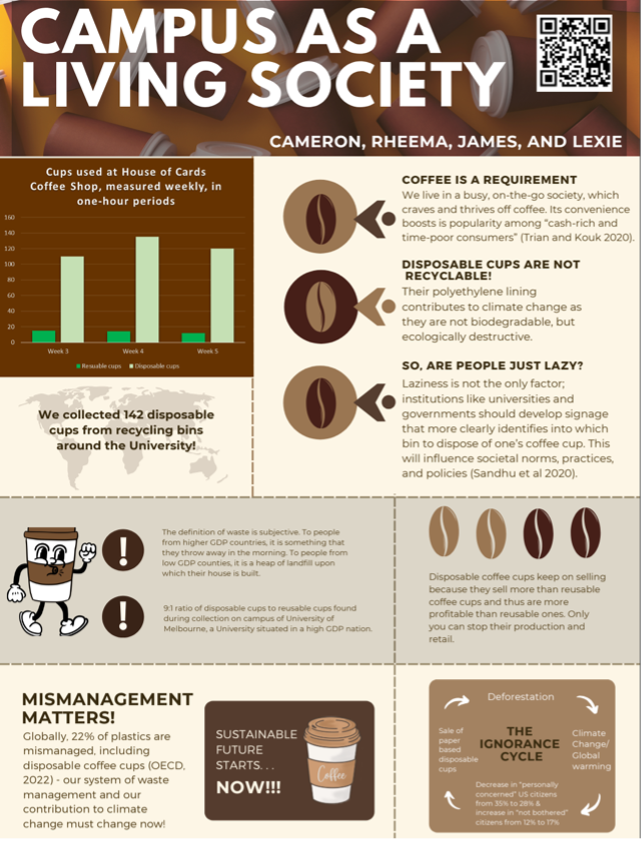
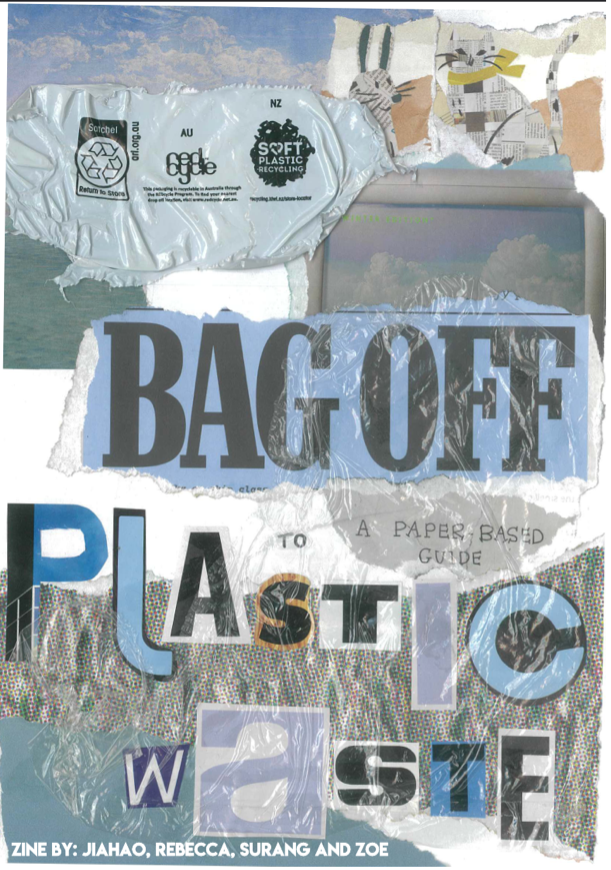
Examples of student project outputs. On the left: Campus as a Living Society poster by Cameron Roper, Rheema Sarkar, Xianjie James He and Lexie Jiayi Cao. On the right: a cover page of Bag Off: A Paper Based Guide to Plastic Waste zine by Zoe Borger, Jiahao Li, Surang Ma and Rebecca Pay.
Most of the topic prompts were determined in collaboration with University-based or community partners. For example, Dr Dean arranged for a few student groups to conduct their project research at the University’s archives. One of these groups sieved through the archival material of the anti-nuclear movement in Australia of the late 20th century. Through the lens of these historical debates, the group’s project considered whether nuclear energy can be a sustainable solution to the climate crisis.
While initially there was some pushback and reluctance to engage in group work, the students soon realised that they could reshape their topic prompt into a question of their own. Peer groups set up their own meetings and organised their project work around assessments, which marked different project milestones. Students first had to use their prompt to develop a short project proposal, then they immersed themselves in the relevant literature and delved deeper into their topic to formulate a clear question to tackle. All this work was then combined to develop future-oriented solutions and produce project outputs.
Liz Dean’s goal was to empower students to work as peers. This meant that while students were working collaboratively in small groups towards a joint outcome, the process of sharing different perspectives and insights was equally, if not more, important. Each group member was also assigned a fair portion of the task, allowing for individual assessment. Groups that worked effectively together understood the value of different perspectives each member brought to the process, which showed in the project output.
References
Dean, L. with Quiroga, M. (2023) Decoloniality, First Nations Thinkers and Thought and Practices from the Global South. Omeka Cloud, University of Melbourne.
Dean, L. with Belton, A. (2023) Mapping Social Theory. Omeka Cloud, University of Melbourne.
Wiek, A., Xiong, A., Brundiers, K., and van der Leeuw (2014). Integrating problem- and project-based learning into sustainability programs. International Journal of Sustainability in Higher Education, 15(4), 431-449.