Albrecht Dürer’s Material Renaissance
exhibition labels
All website and exhibition texts copyright exhibition curators Jenny Spinks, Matthew Champion, Shannon Gilmore-Kuziow and Charles Zika. Use without prior permission is not permitted. For queries, please contact the curators.
ALBRECHT DÜRER’S MATERIAL RENAISSANCE
Albrecht Dürer (1471-1528) shaped the German Renaissance with his unforgettable images. He travelled widely, but belonged to a vibrant network of artists and craftspeople in Nuremberg, a key trading city in the Holy Roman Empire and a centre for religious and intellectual life. Book and print production developed there from the late fifteenth century alongside constant innovation in the city’s craft and manufacturing trades. Dürer first trained as a goldsmith. When he turned to making visual art, his metalworking skills helped him to push printmaking techniques – for engravings, etchings and woodcuts – to new levels of detail and inventiveness, dazzling his contemporaries.
Dürer’s interest in the natural world has long been acknowledged, but his fascination with manufactured and designed objects forms a vibrant and newer area of research. Depictions of contemporary cloth and clothing, featherwork, armour, precious metal vessels, measuring instruments, liturgical objects, hourglasses, and books – all objects made in Nuremberg – form part of the ‘material Renaissance’ that is a hallmark of his work and a feature of early print culture.
This exhibition invites you to peer into Dürer and his contemporaries’ prints and books – objects in their own right – to explore how and why materiality mattered in early modern Europe.
DÜRER’S NUREMBERG
During Dürer’s lifetime, the city of Nuremberg reached the height of its political, economic, territorial, and cultural power, to become a leading city in the Holy Roman Empire. It had won independence from neighbouring princes, was subject to the emperor alone, and considerably expanded the number of villages under its control.
Nuremberg’s economic wealth was based on its metalworking, textile, and timber production, as well as long-distance trade and innovative print workshops. In this dynamic craft environment, intense specialization developed, including for craftsmen working in different metals such as bronze, iron, or silver. The city also began to regulate the production of goods considered critical for its reputation. Objects such as armaments, trumpets, and scientific instruments were stamped with an ‘N’ or the Nuremberg eagle, as assurance of their high quality (just as Dürer stamped his prints with a monogram).
Given Nuremberg’s many churches and ecclesiastical institutions, as well as its deep investment in religious culture and ritual through its safeguarding of the Imperial Relics and Regalia, much of its artistic and economic energies were directed towards sacred artefacts and religious piety. Religious faith and practice remained integral to Nuremberg’s material Renaissance, even as it confronted and adopted religious reform.
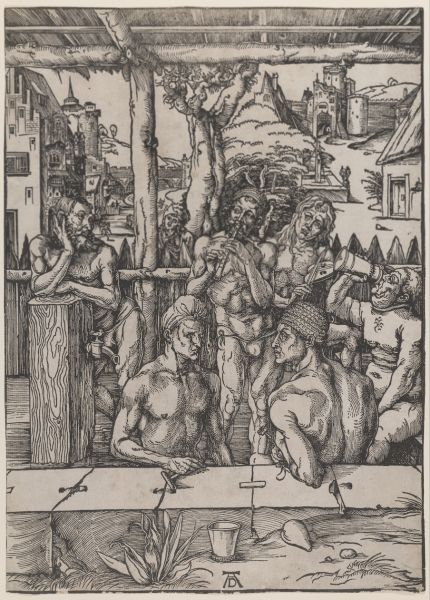
Albrecht Dürer
Germany, 1471-1528
The bath house c.1496
woodcut
Gift of Dr J. Orde Poynton 1959.
Prints and Drawings Collection, Archives and Special Collections.
University of Melbourne.
1959.2141.000.000
This depiction of an open-air bath house in a setting featuring typical south German architecture in both town and castle displays Dürer’s interest in nudes in different poses after his return from Italy in 1495. The representation of male sociability and homoerotic pleasure (suggested by the careful positioning and linguistic innuendo of the cock-shaped tap at left) also possibly relates to the closure of bath houses in Nuremberg in 1496 to guard against the new epidemic of syphilis.
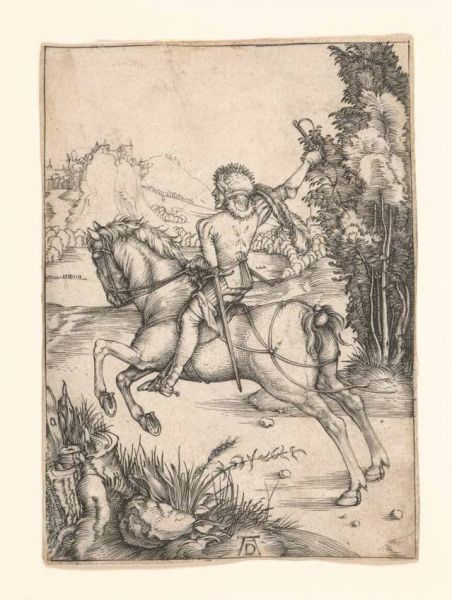
Albrecht Dürer
Germany, 1471-1528
The small courier c.1496
engraving
Gift of Dr J. Orde Poynton 1959.
Prints and Drawings Collection, Archives and Special Collections.
University of Melbourne.
1959.2075.000.000
Early modern Europe was crossed at speed by couriers, who would transport letters and other precious portable objects. This energetic horse and rider are shown with metalwork spurs, sword, dagger, and horseshoes, alongside a raft of animal products: leather boots and whip, fur hat, and fashionable ostrich feather, traded into Europe from sub-Saharan Africa. The tree stump in the foreground, and distant stonework of the city, round out this remarkable distillation of the multiple materials of Dürer’s mobile, networked Europe.
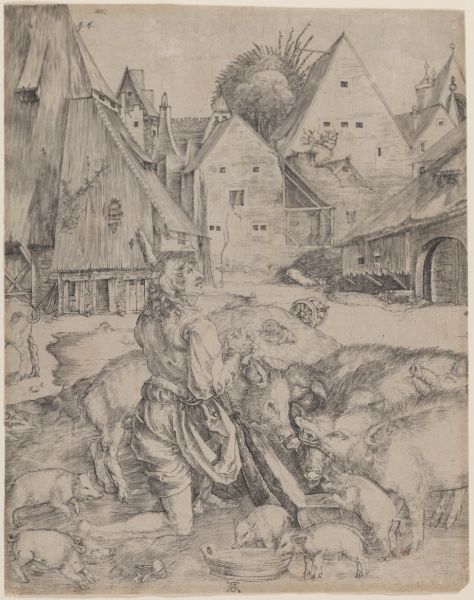
Unknown (printmaker)
after Albrecht Dürer (artist)
Germany, 1471-1528
The prodigal son and the swine (c.1496), copy printed c.19th century
engraving
Gift of Dr J. Orde Poynton 1959.
Prints and Drawings Collection, Archives and Special Collections.
University of Melbourne.
1959.5554.000.000
Dürer’s setting for this biblical story, depicting the Prodigal Son’s misery as he kneels before a dung heap and feeding trough in a bleak farmyard, was a novel one. The detailed attention to the environment – wooden shingles, steep gables, brick masonry of the village wall, puddles of water, ducks, a cow, and swine – locate the story in Nuremberg’s country environs and Dürer’s contemporary present, while the penitent’s gaze towards the church at top right suggests a broader spiritual meaning.
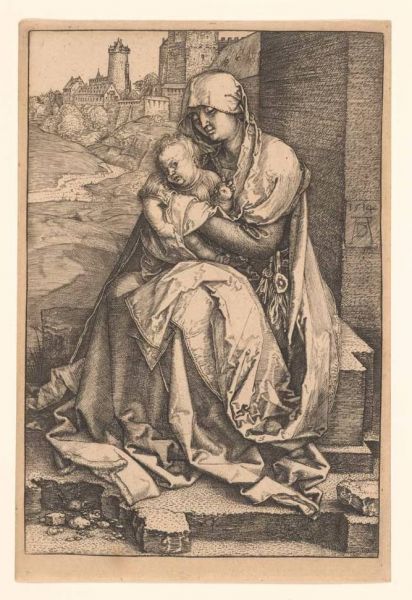
after Albrecht Dürer (artist)
Germany, 1471-1528
Charles Amand-Durand (publisher)
France, 1831-1905
Madonna by the wall (1514), copy printed c.1869
photogravure
Gift of Dr J. Orde Poynton 1959.
Prints and Drawings Collection, Archives and Special Collections.
University of Melbourne.
1959.2099.000.000
The Madonna appears in this print as a woman of Dürer’s city, without halo or aureole, as she anxiously clutches her child. The customary bunch of keys and contemporary bag hang from her belt and the Nuremberg castle, wall, towers, and imperial stables are shown behind – a cityscape that was also visible (in reverse) from the third-floor balcony of Dürer’s house. Mary’s deep melancholy may relate to the death of Dürer’s mother in May 1514.
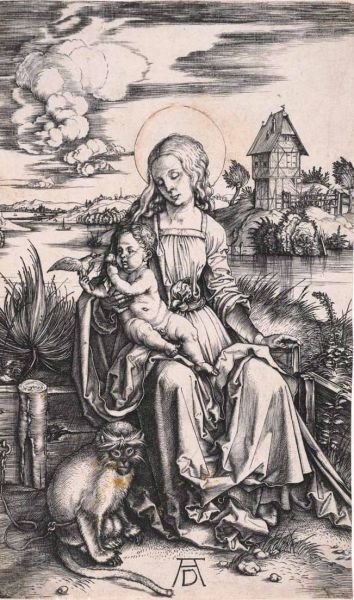
Albrecht Dürer
Germany, 1471-1528
Madonna with the monkey c.1498
engraving
Gift of Dr J. Orde Poynton 1959.
Prints and Drawings Collection, Archives and Special Collections.
University of Melbourne.
1959.2107.000.000
While the Madonna and child seated on a grassy bank follow Italian iconography in representing a haloed Mary as mother of God and baby Jesus displaying his genitals as God incarnate, this scene is set firmly within a Nuremberg regional landscape. This is well established by the timber-framed lake-house, a building found in Nuremberg’s environs. The grass tufts, pollarded trees, dark billowing clouds, and even the symbolic monkey, demonstrate Dürer’s close attention to the world of nature.
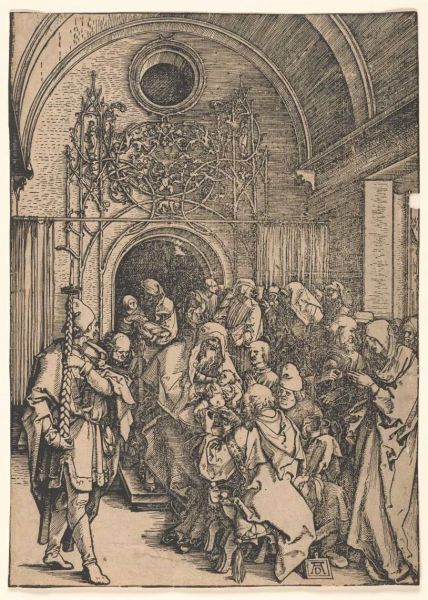
Albrecht Dürer
Germany, 1471-1528
The circumcision of Christ c.1505
from The Life of the Virgin, 1511
woodcut
Gift of Dr J. Orde Poynton 1959.
Prints and Drawings Collection, Archives and Special Collections.
University of Melbourne.
1959.2098.000.000
In this woodcut from Dürer’s landmark Life of the Virgin series of 1511, Christ is being circumcised in the temple which resembles a Romanesque-style church. Dürer’s realistic rendering of architectural space exhibits his burgeoning interest in linear perspective following his first trip to Italy in 1494-1495. The delicate metal filigree above the arch and the intricately wrought candlestick being carried across the scene speak to his personal involvement in Nuremberg’s metalworking industry.
Albrecht Dürer
Germany, 1471-1528
St. Eustace c.1501
engraving
Gift of Dr J. Orde Poynton 1959.
Prints and Drawings Collection, Archives and Special Collections.
University of Melbourne.
1959.2142.000.000
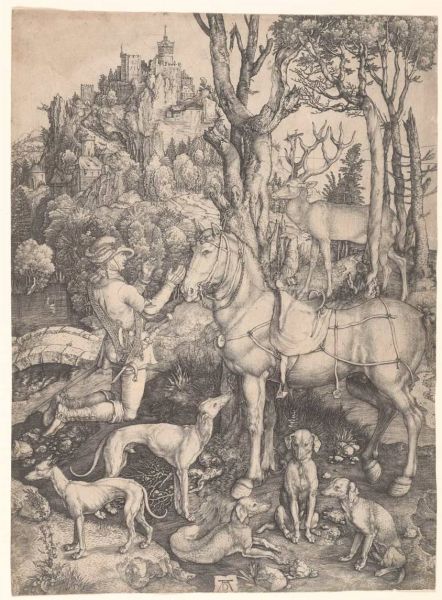
Dürer’s largest engraving depicts the conversion to Christianity of a Roman general Placidus while out hunting, through a vision of the crucified Christ between the antlers of a stag. The story of this popular saint, shown here in a stunning contemporary hunting outfit, also allowed Dürer to display his intense interest and virtuosity in depicting nature, both in the landscape – grass, foliage, bark, stone – and animals – horse, grey hounds, stag, swans, even the birds swarming around the castle.
Michael Wolgemut (artist)
Germany, 1434-1519
Wilhelm Pleydenwurff (artist)
Germany, c.1458-1494
View of the city of Nuremberg
in Hartmann Schedel, Liber chronicarum (Nuremberg Chronicle; Latin edition)
(Nuremberg: Anton Koberger, 1493), fols 99 verso-100 recto
woodcut
Gift of Dr J. Orde Poynton 1959.
Rare Books, Archives and Special Collections.
UniM Bail SpC/RB MBA/7
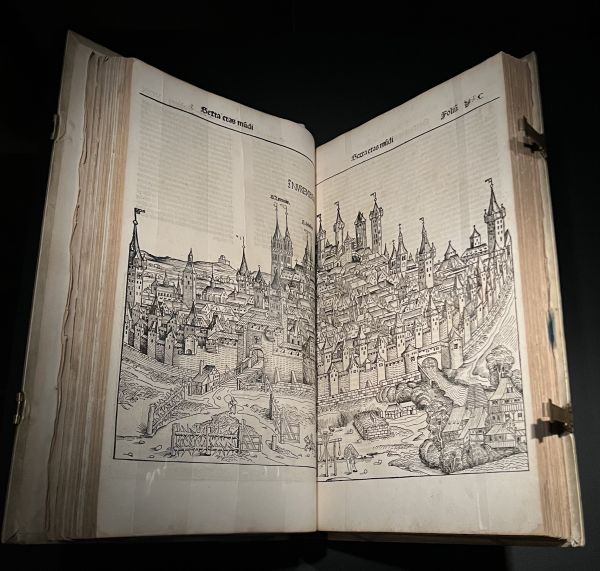
The Nuremberg Chronicle – a history of the world and a landmark early printed book – included cityscapes. Dürer’s local church of St Sebald can be seen just below the old castle at Nuremberg’s summit, alongside evidence of activities such as execution that took place outside the city’s walls. Former goldsmith turned printing impresario Anton Koberger, Dürer’s godfather, set up a consortium to fund the book’s production. Over 1,800 closely guarded woodcut images appeared in the book, many designed by Dürer’s teacher Michael Wolgemut.
Peter Lombard, Sentences
(Nuremberg: Anton Koberger, 1491)
Tooled pigskin on wood covers, with brass clasps, bosses and chain (iron?)
Purchased 2017.
Rare Books, Archives and Special Collections.
UniM Bail RTB/1 Incunabula
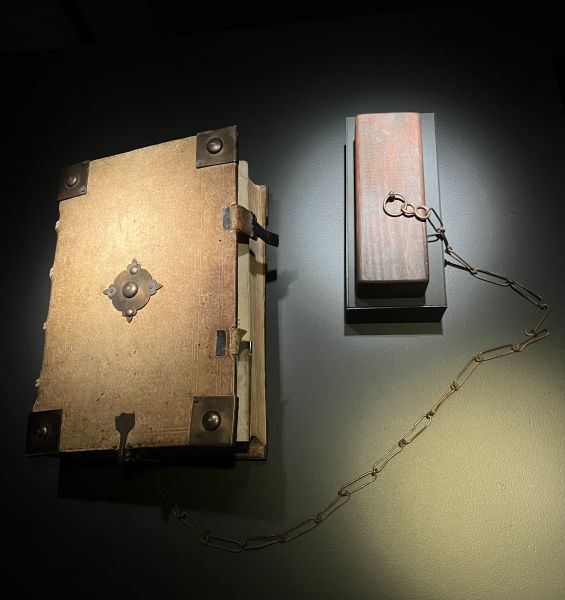
Renaissance religious houses were sites of innovative material knowledge and practice. This book was bound by Carmelite friars in Bamberg, a prince-bishopric to which Nuremberg’s churches were subject. Pigskin has been stamped by metal dies to create repeated patterns and then placed over wooden covers. On the inside covers, no-longer-valued manuscripts were pasted down to provide additional strength and protection. Brass clasps, bosses, and a chain complete the binding. Books were often chained in institutional libraries to prevent them wandering.
Unknown artist
Calvary c.1460
woodcut
Gift of Dr J. Orde Poynton 1959.
Prints and Drawings Collection, Archives and Special Collections.
University of Melbourne.
1959.4277.000.000
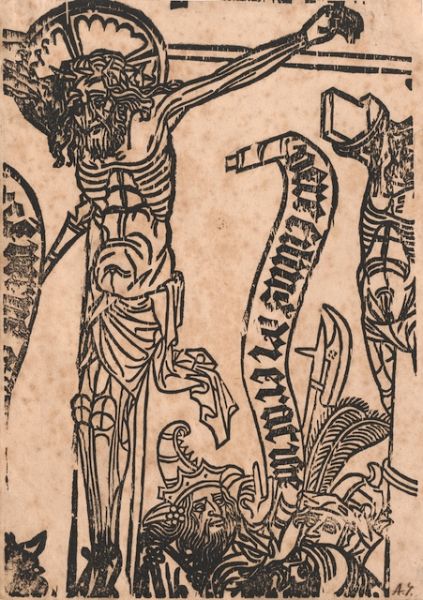
This compelling, fragmentary crucifixion scene emerges from the European printing techniques of the generations before Dürer. Making prints was physical work: perhaps the metal spear entering Christ’s side even echoes the artist’s metal tool carving the woodblock for the print. Notice the feathers, weaponry and elaborately stylised ‘Jewish’ headdress of those who gather at the foot of the cross. Devotional images such as this were the most popular form of early printing, a market that Dürer would exploit and expand.
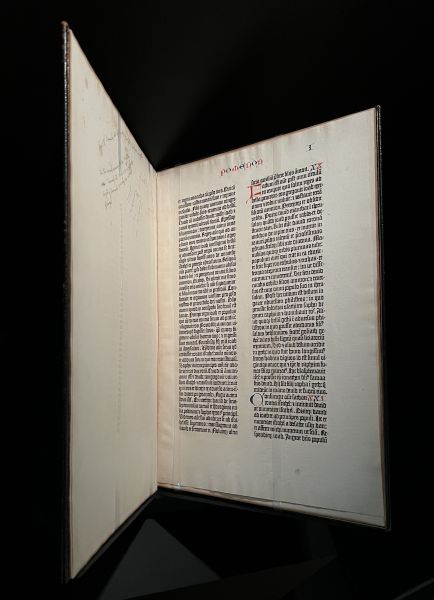
Leaf from the 42-line Gutenberg Bible
(Mainz: Johann Gutenberg, 1455)
Purchased 2011 with assistance from the Ivy May Pendlebury Bequest.
Rare Books, Archives and Special Collections.
UniM Bail SpC/RB MBA/4
The Gutenberg (Latin or Vulgate) Bible was the first large-scale book created using movable metal type. About 160 to 180 copies were printed in Mainz by Johann Gutenberg (assisted by Johann Fust) between 1452 and 1455 – approximately one quarter on parchment, the rest on paper. Rubricators later added initial letters, headings and chapter numbers by hand and in coloured ink. The Baillieu Library paper leaf includes text from the First Book of Paralipomena or Chronicles, 19.7-21.26.
Michael Wolgemut (artist)
Germany, 1434-1519
Wilhelm Pleydenwurff (artist)
Germany, c.1458-1494
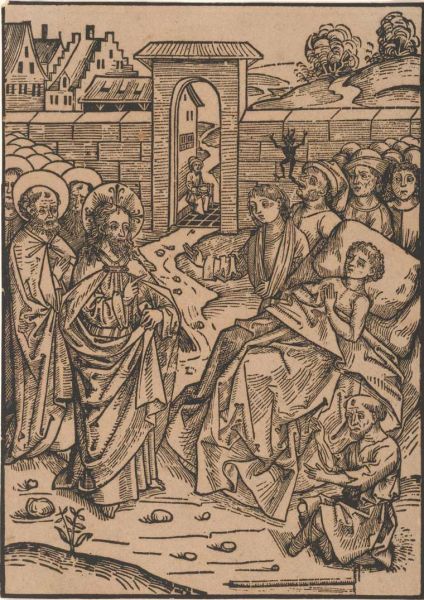
Christ healing the sick and crippled
from Stephan Fridolin, Schatzbehalter, oder, Schrein der waren
reichtumer des heils (Treasury of the True Riches of Salvation)
(Nuremberg: Anton Koberger, 1491), sig. p ii recto
woodcut
Gift of Dr J. Orde Poynton 1959.
Prints and Drawings Collection, Archives and Special Collections.
University of Melbourne.
1959.4263.000.000
In keeping with late medieval religious practices, the Treasury encouraged readers to reflect on Christ’s life. The German-language text and multiple illustrations maximised the appeal of this luxury item. Its author was spiritual guide to the Nuremberg Convent of the Poor Clares, which had an extensive library. The people tended to by Christ – including a man freed from demonic possession – are located in a recognisably German townscape, reminding viewers that care for the sick remained a Christian duty.
Unknown artist
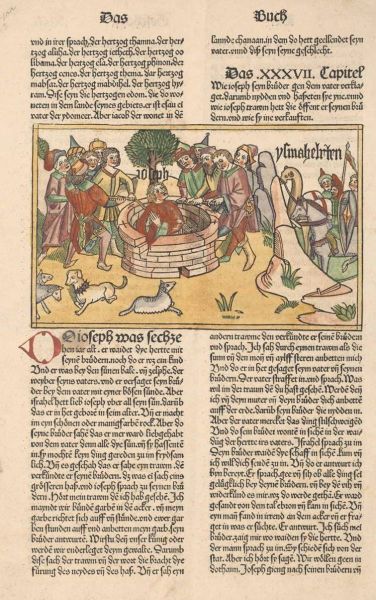
Joseph taken out of the well and sold by his brethren to the Midianites
from Disz durchleuchtigist werck der gantzen heyligen geschrifft, gennat dy bible (Koberger Bible)
(Nuremberg: Anton Koberger, 1483), fol. xxii verso
hand-coloured woodcut
Gift of Dr J. Orde Poynton 1959.
Prints and Drawings Collection, Archives and Special Collections.
University of Melbourne.
1959.4261.000.000
Joseph – thrown into a well by his jealous brothers – was pulled out to be sold to Midianite traders and into slavery in Egypt. This hand coloured leaf comes from the ninth printed German-language Bible, a richly illustrated Nuremberg volume published by Dürer’s godfather, Anton Koberger. It reused woodcuts created for a late 1470s Cologne Bible which Koberger had partially financed. The changing world of book printing offered commercial opportunities as well as newly accessible, up-close ways to encounter religious narratives.
Unknown artist
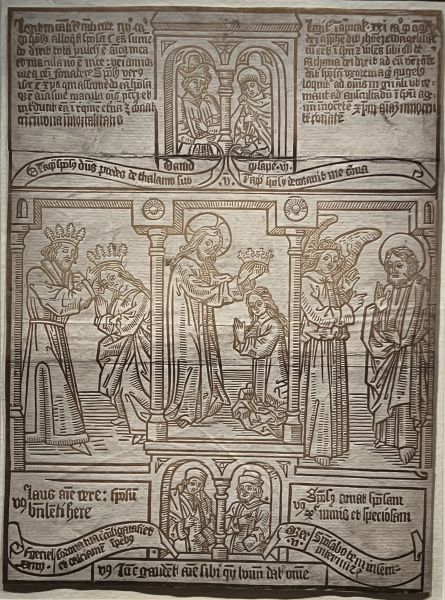
The crown of eternal life c.1465
from a Biblia pauperum (Pauper’s Bible)
woodcut
Donated through the Australian Government’s Cultural Gift Program
by Elizabeth Lane in memory of Richard Lane, 2021.
Prints and Drawings Collection, Archives and Special Collections.
University of Melbourne.
2021.0072.000.000
Printed ‘Pauper’s Bibles’ – actually rather expensive books – circulated widely in the late fifteenth century. On this folio, Christ crowns a soul with eternal life. To either side are Old and New Testament scenes relating to the crowning of a bride. In the upper and lower sections, King David, and the prophets Isaiah, Ezechiel and Hosea foretell various coronations with verses printed on banners. These early sparse images cast in relief Dürer’s carefully observed cloth, metalwork, and architecture.
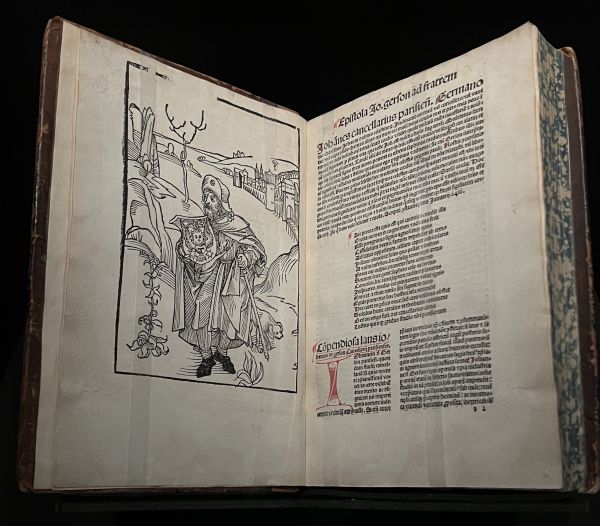
Albrecht Dürer [?]
Germany, 1471-1528
Jean Gerson as pilgrim
in Jean Gerson, Opera (Works)
(Nuremberg: Georg Stuchs, 1489), frontispiece
woodcut
Rare Books, Archives and Special Collections.
UniM Bail SpC/RB MTB/14 Incunabula
This representation of the French theologian and Chancellor of the University of Paris testifies to the interest in Gerson’s writings among early German humanists, not least in Nuremberg. Gerson as pilgrim carries a mystical coat of arms – a Tau cross inscribed on a flaming winged heart, surrounded by sun, moon and stars – signifying life as a pilgrim’s journey to heaven through the fire of love, ideas explained in Gerson’s letter opposite. The attribution to Albrecht Dürer remains uncertain.
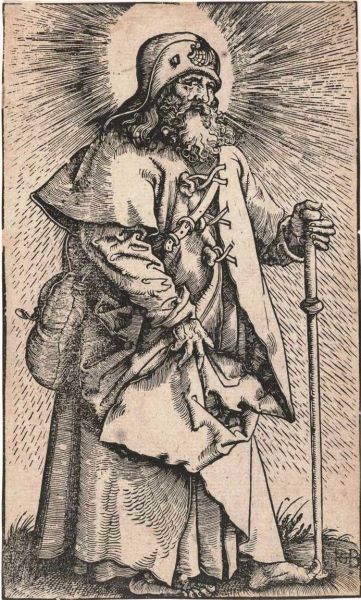
Hans Baldung
Germany, c.1476-1545
St. James Major 1519
woodcut
Gift of Dr J. Orde Poynton 1959.
Prints and Drawings Collection, Archives and Special Collections.
University of Melbourne.
1959.2201.000.000
Hans Baldung, also nicknamed Grien (green), was a journeyman and assistant in Dürer’s workshop 1503-c.1507, later becoming an established artist in Strasbourg. Baldung’s print follows the prevalent iconography of St James as pilgrim, given the popularity of pilgrimage to his supposed burial site in Santiago de Compostela. A hat decorated with scallop shell badges, a staff, shoulder bag, and cape with toggle and rope fastenings, comprised a pilgrim’s common dress – as in the frequent pilgrimages of Nuremberg residents.
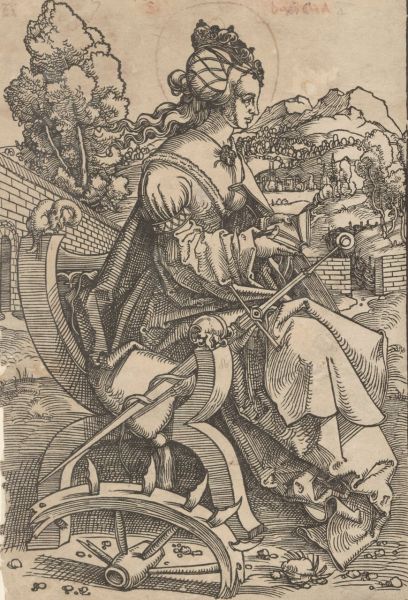
Hans Baldung
Germany, c.1476-1545
formerly attributed to
Albrecht Dürer
Germany, 1471-1528
St Catherine c.1505-1507
woodcut
Purchased 1980.
Prints and Drawings Collection, Archives and Special Collections.
University of Melbourne.
1980.2001.000.000
Catherine, an important saint in Nuremberg, is depicted with the spiked wheel of her torture, the sword used to behead her, and a book demonstrating her learned status.
Her image appeared across the city, including in the Katherinenkloster, a convent housing daughters of elite families. Hans Baldung was a journeyman in Dürer’s workshop at this time. A hand-drawn halo and the incorrect label ‘St Barbara’ added by later owners demonstrate how prints could be personalised.
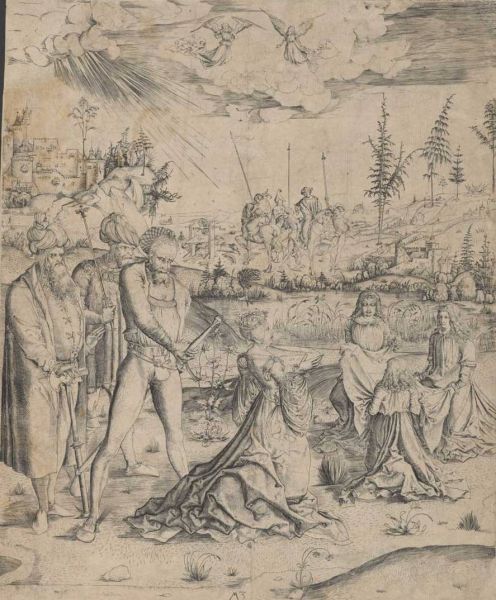
Master MZ
Germany, active early 16th century
The martyrdom of St Catherine c.1500-1503
engraving
Gift of Dr J. Orde Poynton 1959.
Prints and Drawings Collection, Archives and Special Collections.
University of Melbourne.
1959.2387.000.000
Legend held that the early Christian martyr Catherine was beheaded in Alexandria at the order of Roman emperor Maxentius after she converted fifty of his philosophers. Angels wait nearby to transport her body to Sinai as a relic. Some Nuremberg merchants with trading links to Alexandria made pilgrimages to Sinai, which had become the site of a monastery, dipping cloth in the oil oozing from her bones to take home as pious souvenirs.
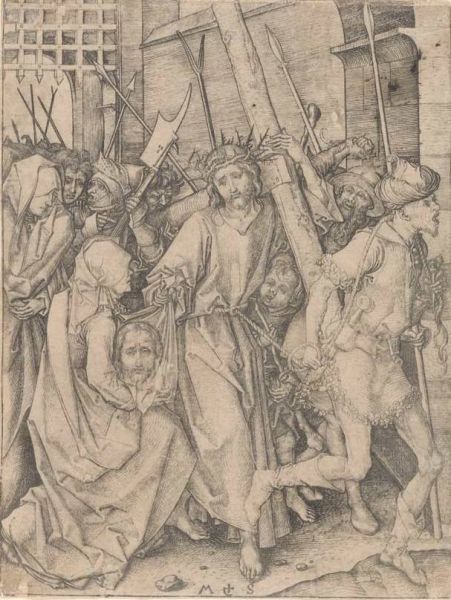
Martin Schongauer
Germany, c.1440/1453-1491
The bearing of the cross c.1480
engraving
Gift of Dr J. Orde Poynton 1959.
Prints and Drawings Collection, Archives and Special Collections.
University of Melbourne.
1959.3827.000.000
Dürer greatly admired Schongauer, even travelling to visit him in Colmar in 1492 while a journeyman. He was too late: Schongauer had died the previous year. Like Dürer, Schongauer came from a family of metalworkers. Attention to metalwork appears here in the depiction of armour, weaponry and portcullis. Schongauer also emphasises the softer clothing of Jesus’ female followers. Perhaps most startling is the devoted attention to the wood of the cross and Christ’s antler-like crown of thorns.
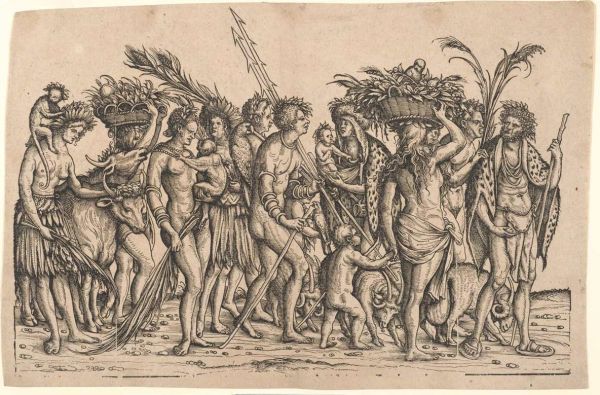
Hans Burgkmair the Elder
Germany, 1473-1531
The people of Calicut 1516-18
from the Triumphal Procession of Emperor Maximilian I, published 1526
woodcut
Gift of Dr J. Orde Poynton 1959.
Prints and Drawings Collection, Archives and Special Collections.
University of Melbourne.
1959.2377.000.000
Holy Roman Emperor Maximilian I commissioned artists, including Dürer and Hans Burgkmair, for a multi-part Triumphal Procession. Burgkmair – his initials visible on a cup hanging from one woman’s belt – depicts clothing, jewellery, flora, and fauna as well as the people of Calicut on the Indian coast, reached by Vasco da Gama in 1498. In this era of nascent colonialism and globalisation, Nuremberg merchants were amongst those to profit from global trade in cinnamon, pepper, and other commodities.
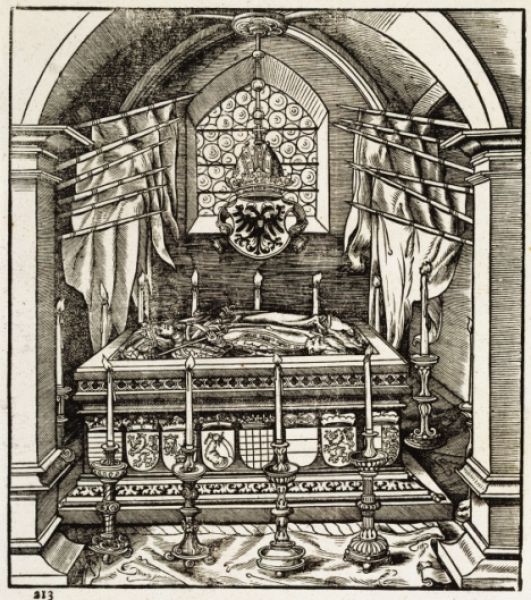
Leonhard Beck
Germany, c.1480-1542
A coffin surrounded by flags and candlestick, in a chapel c.1515
from Der Weiss Kunig (The White King), published 1775
woodcut
Purchased 1983.
Prints and Drawings Collection, Archives and Special Collections.
University of Melbourne.
1983.2004.000.000
Emperor Maximilian I was the first leader to exploit the medium of print as a vehicle for self-promotion. The White King was a narrative based on the emperor’s life accompanied by 257 woodcuts. Suspended inside the burial chapel of the Old White King is the shield bearing the eagles of the Holy Roman Empire. The delicate folds of the unfurled flags and the diverse array of ornate candlesticks frame the monument bearing the effigy of Maximilian’s father, Frederick III.
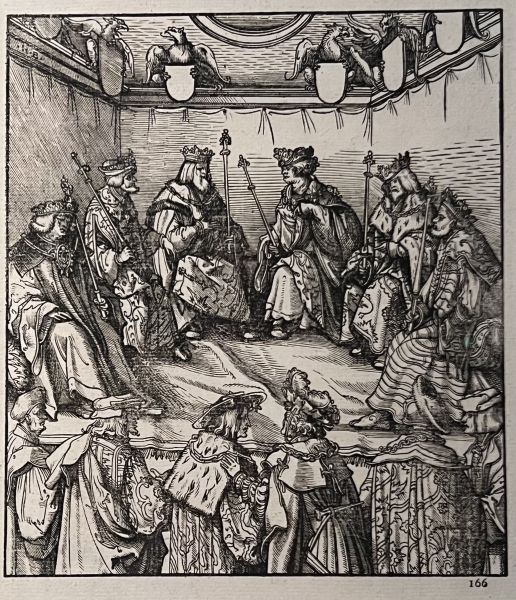
Hans Burgkmair the Elder
Germany, 1473-1531
The White King is elected as King of the Romans c.1515
from Der Weiss Kunig (The White King), published 1775
woodcut
Purchased 1983.
Prints and Drawings Collection, Archives and Special Collections.
University of Melbourne.
1983.2025.000.000
The prince-electors with their crowns and sceptres elect the White King as King of the Romans, a title Maximilian I held from 1486; he became Holy Roman Emperor in 1493. Roman eagles hold blank coats of arms likely intended to bear each elector’s heraldry. An election was an important moment for the imperial city of Nuremberg, which was conferred the privilege of holding the new Emperor’s first Diet (the meeting of imperial estates).