Albrecht Dürer’s Material Renaissance
exhibition labels
All website and exhibition texts copyright exhibition curators Jenny Spinks, Matthew Champion, Shannon Gilmore-Kuziow and Charles Zika. Use without prior permission is not permitted. For queries, please contact the curators.
FASHION
In Renaissance Germany, the materials and objects a person wore communicated important information about their gender, social station, and profession. Like those of many European cities, Nuremberg’s sumptuary laws attempted to police social boundaries by dictating the types of clothing worn by members of each class. As an external marker of identity, dress could also allow individuals to visually climb the social ladder. Dürer curated for himself a striking personal style that exploited and expanded fashion trends and elevated the status of the artist. In his artworks, clothing, shoes, headdresses, and jewellery offered opportunities to suggest the blurring or subversion of social and gender norms.
When travelling, Dürer’s numerous costume studies exhibit his fascination with regional dress. His two trips to Venice in 1494/95 and 1505/7 were pivotal moments in developing his interest in fashion. Coming from Nuremberg, which was known for its more conservative and modest style, Dürer was fascinated by Venetian women’s sumptuous gowns and high platform shoes. He was also inspired by Venetian artists’ interest in accurately documenting the clothing of the Islamicate world. His prints – including the Adoration of the Magi – exhibit his familiarity with the work of Venetian painter, Gentile Bellini, who studied Ottoman dress during his sojourn in Constantinople.
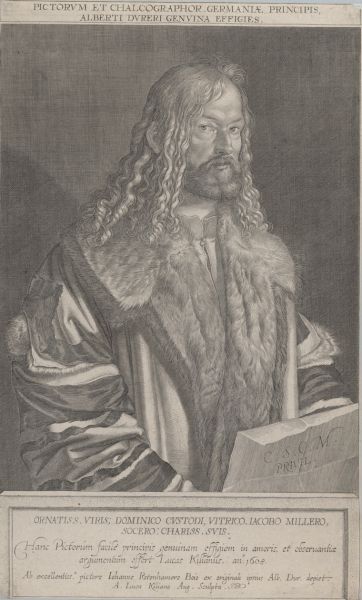
Lukas Kilian (engraver)
Germany, 1579-1637
after Johann Rottenhammer (engraver)
Germany, 1564-1623
after Albrecht Dürer (artist)
Germany, 1471-1528
Dominicus Custos (publisher)
Germany, c.1559-1615
Albrecht Dürer 1608
engraving
Gift of Dr J. Orde Poynton 1959.
Prints and Drawings Collection, Archives and Special Collections.
University of Melbourne.
1959.3135.000.000
This copy of Dürer’s self-portrait enjoyed wide circulation following the artist’s death. The careful rendering of the various textures – from his fur-trimmed coat to the heavy folds of his sleeves – highlights his sumptuous clothing and desire to be seen as a member of the urban elite. His long curls and luxurious beard did not conform to contemporary standards of fashion and transformed him into a Christ-like figure, evoking the Renaissance notion of the divinely inspired artist.
Albrecht Dürer
Germany, 1471-1528
The sea monster c.1498
engraving
Gift of Dr J. Orde Poynton 1959.
Prints and Drawings Collection, Archives and Special Collections.
University of Melbourne.
1959.2084.000.000
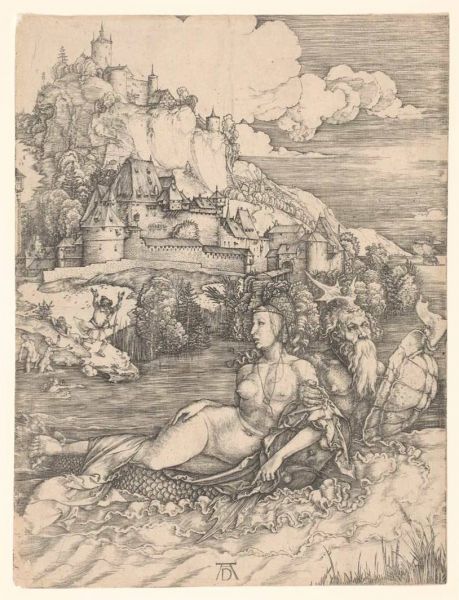
This unidentified mythological scene in a German landscape features a woman in a Milanese-style headdress being abducted by a merman. His horns and turtle shell shield recall sought-after curiosities that fascinated consumers, Dürer included. The print’s title is recorded in Dürer’s 1520-1521 Netherlandish travel diary, which demonstrates his attentiveness to materiality. In the same week, he saw a beached whale, was presented with six nuts from India, and his wife Agnes had her purse cut in an Antwerp church.
after Albrecht Dürer (artist)
Germany, 1471-1528
Charles Amand-Durand (publisher)
France, 1831-1905
Three peasants in conversation (c.1497), copy printed c.1869
photogravure
Gift of Dr J. Orde Poynton 1959.
Prints and Drawings Collection, Archives and Special Collections.
University of Melbourne.
1959.2102.000.000
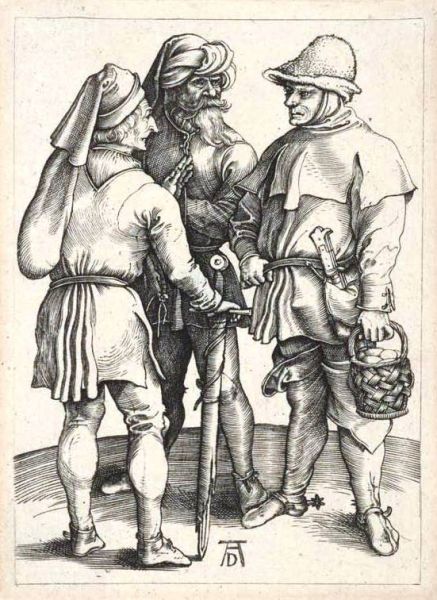
A longsword stands at the centre of this market scene. As a weapon reserved for the elite, the longsword’s possession by a peasant and its torn scabbard suggests a satirical reference to the transgressing of social boundaries. Similarly, spurs – accessories associated with knighthood – clash with the work clothes of the farm labourer holding a basket of produce. Some have argued that the engraving, executed after a peasant uprising, may suggest the presence of latent rebellious sentiments amongst the rural classes.
Daniel Hopfer (etcher/engraver)
Germany, active 1520-1535
David Funck (publisher)
Germany, active 1682-1709
Marcolfus and Bolikana 1505-1536, published 1684
etching and engraving
Gift of Dr J. Orde Poynton 1959.
Prints and Drawings Collection, Archives and Special Collections.
University of Melbourne.
1959.3036.000.000
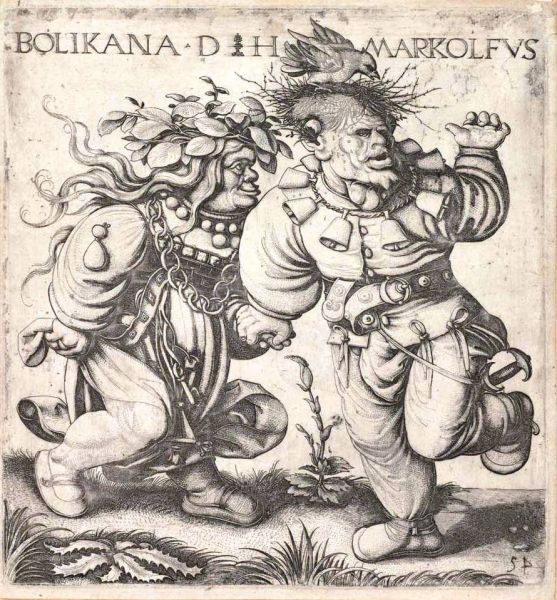
Marcolfus and his wife Bolikana embodied stereotypes associated with the rural classes. Compared to earlier depictions of dancing peasants, Daniel Hopfer has exaggerated the pair’s grotesque attributes: their vulgar nature is indicated by their gaudy clothing, Marcolfus’ collar of oversized fool’s bells, and Bolikana’s uncovered, swirling hair and lifted skirt. The coarse matter of Marcolfus’ body is demonstrated by the twigs of an unkempt hoopoe nest that grow from his ears and have fully merged with his hair.
Hieronymus Hopfer (etcher)
Germany, active 1520-1535
after Albrecht Dürer (artist)
Germany, 1471-1528
David Funck (publisher)
Germany, active 1682-1709
Peasants dancing 1528-1563, published later
etching
Gift of Dr J. Orde Poynton 1959.
Prints and Drawings Collection, Archives and Special Collections.
University of Melbourne.
1959.4570.000.000
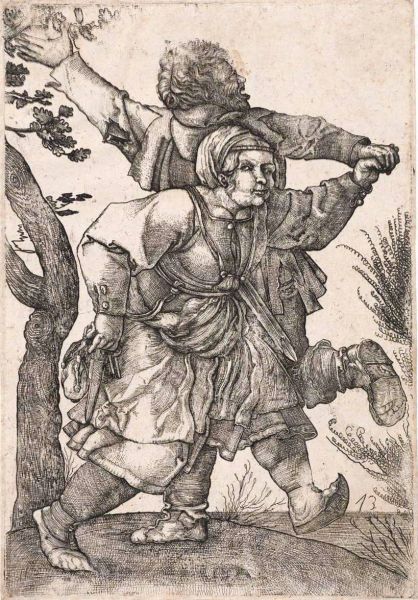
In this copy of Dürer’s famous image of dancing peasants, the folds in the woman’s apron express her fast, circular motion. The couple’s spirited dancing and the man’s broken leather shoe are markers of their lower social status. Dürer’s careful attention to detail in his rendering of their clothing, and his decision to focus his print on two peasants – rather than represent a larger festival scene – proclaims that even the lowliest members of society were worthy artistic subjects.
Hieronymus Hopfer (etcher)
Germany, active 1520-1535
David Funck (publisher)
Germany, active 1682-1709
Suleyman ain Kaiser der Tirckei (Soliman, Emperor of Turkey) c.1526, published later
etching
Purchased 2018.
Prints and Drawings Collection, Archives and Special Collections.
University of Melbourne.
2018.0014.000.000
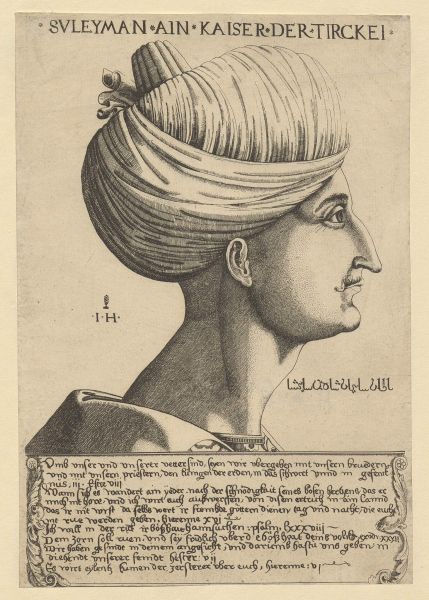
Soon after Sultan Süleyman I of the Ottoman Empire (known as the Magnificent) rose to power in 1520, he launched a series of invasions into Central Europe. Hieronymus Hopfer’s portrait was one of many that circulated throughout Europe in the 1520s. The Sultan’s turban dominates the composition. The faithful accuracy with which Hopfer documents the delicate folds and the tāj on top demonstrates how European fear of the Ottomans was mingled with fascination and respect.
Albrecht Dürer
Germany, 1471-1528
Friedrich the Wise, Elector of Saxony 1524
engraving
Gift of Dr J. Orde Poynton 1959.
Prints and Drawings Collection, Archives and Special Collections.
University of Melbourne.
1959.2071.000.000
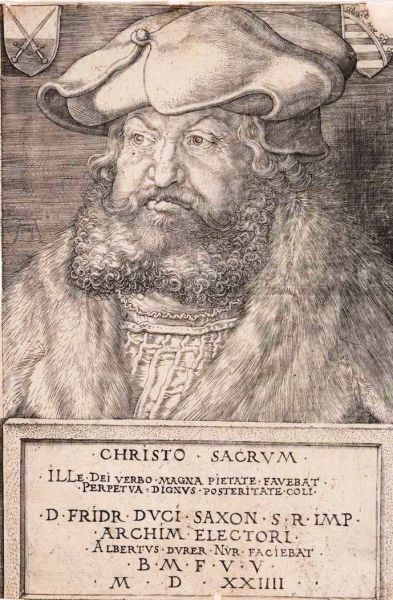
Friedrich the Wise was a protector of Protestant reformer Martin Luther, and a significant early patron of Dürer’s paintings. These included a 1496 portrait and his 1504 Adoration of the Magi altarpiece, featuring sumptuous clothing, for the Wittenberg castle church. Here, Friedrich’s curling beard and fleshy face are skilfully depicted with the same tactile detail as his fine linen shirt and luxuriously thick fur collar – an echo of the fur collar that Dürer’s hand caressed in his famous self-portrait of 1500.
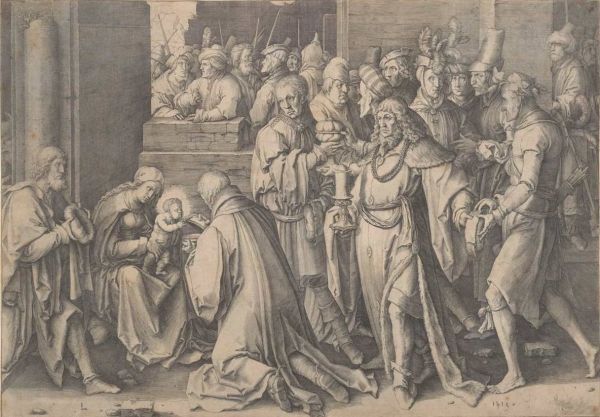
Lucas van Leyden
Netherlands, c.1494-1533
The adoration of the Magi 1513
engraving
Gift of Dr J. Orde Poynton 1959.
Prints and Drawings Collection, Archives and Special Collections.
University of Melbourne.
1959.4217.000.000
Three kings from foreign lands visited the Virgin Mary to offer gifts to the Christ-child following his birth. In the sixteenth century, the crowns conventionally worn by the Magi were often replaced by fantastical headdresses, such as those populating Lucas van Leyden’s scene. Interest in non-Europeans, their exotic clothing, and the inclusion of the finely wrought vessels carried by the Magi emphasises Christianity’s global reach and the arrival of foreign goods to European markets.
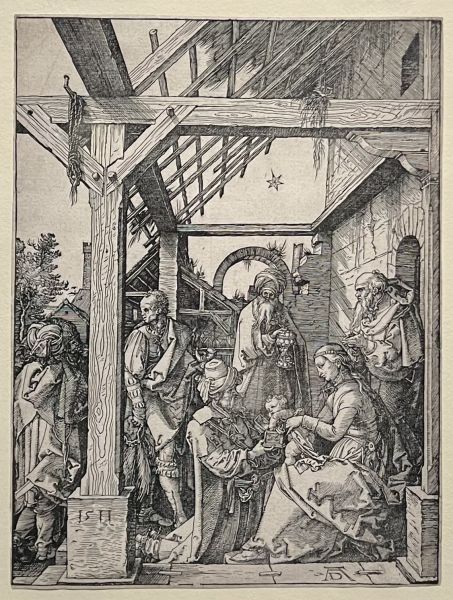
Albrecht Dürer
Germany, 1471-1528
Adoration of the Magi 1511
woodcut
Donated through the Australian Government’s Cultural Gift Program by Elizabeth Lane in memory of Richard Lane, 2021.
Prints and Drawings Collection, Archives and Special Collections.
University of Melbourne.
2021.0074.000.000
Rather than depicting the magi in vaguely exoticising clothing, Dürer instead represents the contemporary dress of the Islamicate world. The kneeling magus wears a faithful representation of a Mamluk turban, and an Ottoman turban covers the head of the first Magus, who offers an elaborate lidded cup, similar to vessels that appear in some of Dürer’s other prints. Dürer also includes an African Magus, who stands at the edge of the porch holding a feathered cap and wearing an earring.
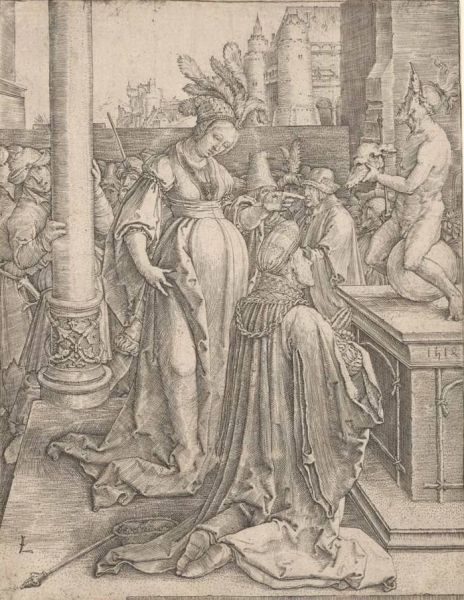
Lucas van Leyden
Netherlands, c.1494-1533
Solomon’s idolatry 1514
engraving
Gift of Dr J. Orde Poynton 1959.
Prints and Drawings Collection, Archives and Special Collections.
University of Melbourne.
1959.3202.000.000
The ‘power of women’ was a favourite theme in Northern art. Even King Solomon, renowned for his wisdom, could be swayed by his wife’s sexual powers to forsake God for false idols. Her rounded belly is echoed by the idol’s globe – a symbol of volatility. Solomon discards his sceptre and turns away from proper kingship to face the idol’s skull. The couple’s exotic headdresses and the heavy, sensuous fabrics represent the king’s descent into a hedonistic lifestyle.
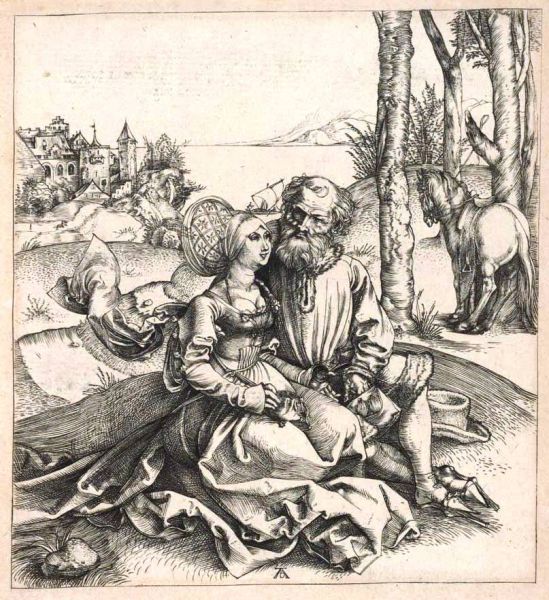
after Albrecht Dürer (artist)
Germany, 1471-1528
Charles Amand-Durand (publisher)
France, 1831-1905
The ill-assorted couple (c.1495), copy printed c.1869
photogravure
Gift of Dr J. Orde Poynton 1959.
Prints and Drawings Collection, Archives and Special Collections.
University of Melbourne.
1959.2067.000.000
The theme of unequal lovers – here, an older man and a younger woman – reveals anxieties surrounding men’s ability to foolishly squander their money by succumbing to women’s perceived sexual powers. In this print, the woman’s defiance of Nuremberg sumptuary laws – which required her to modestly cover her chest – advertises her lustful intentions. The couple’s hands reach inside the man’s coin purse, suggestively located just below his waist, to convey the transactional nature of their relationship.
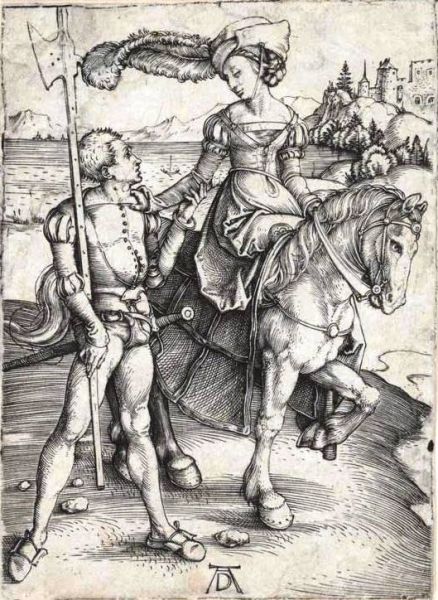
Albrecht Dürer
Germany, 1471-1528
The lady on horseback and lansquenet c.1497
engraving
Gift of Dr J. Orde Poynton 1959.
Prints and Drawings Collection, Archives and Special Collections.
University of Melbourne.
1959.2106.000.000
An elite woman bids farewell to her lover, a lansquenet or mercenary. These men were typically recruited from the rural populations, and their slashed, dandified uniforms were adaptations of an outdated patrician fashion. The woman’s social superiority is conveyed by her stylish gown and her position above him. The upright feathers of the plumed hat on her head – a hallmark of the mercenary’s uniform – suggest her reversal of the sexual order.
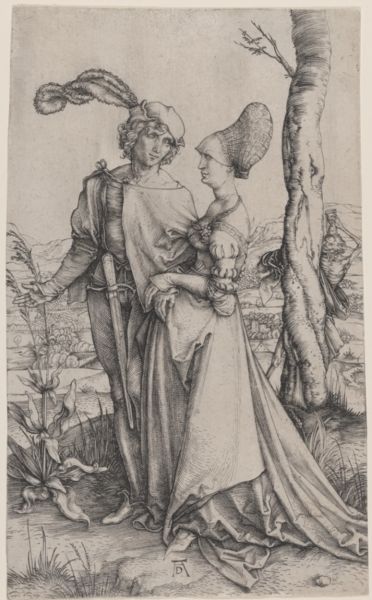
Albrecht Dürer
Germany, 1471-1528
The promenade c.1498
engraving
Gift of Dr J. Orde Poynton 1959.
Prints and Drawings Collection, Archives and Special Collections.
University of Melbourne.
1959.2105.000.000
In this remarkable image, every hat tells a story. The man’s ostrich feather is tucked in a stylish beret; the woman wears an elaborate headdress. In the background Death has a hat, too – a sandglass –unseen by the young couple, but warning the viewer that all adornments are material vanities. Even at the height of its growth, the grass will wither, and the flower fade away. Time is running out.
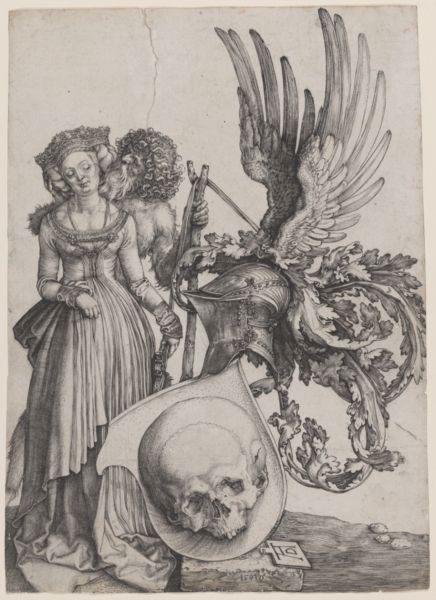
Albrecht Dürer
Germany, 1471-1528
Coat of arms with a skull 1503
engraving
Gift of Dr J. Orde Poynton 1959.
Prints and Drawings Collection, Archives and Special Collections.
University of Melbourne.
1959.2083.000.000
Coats of arms populated public spaces in Nuremberg, and self-glorification through excessive heraldic display attracted criticism. Rather than a vain projection of one’s identity, Dürer’s arms are instead an invitation for critical introspection and self-examination.
A patrician bride, who wears a fashionable Nuremberg-style gown and an elaborate bridal crown, has succumbed to the sensuous embrace of a wild man. The skull on his shield reveals his true identity as Death and cautions against the vices of vanity and lust.