Albrecht Dürer’s Material Renaissance
exhibition labels
All website and exhibition texts copyright exhibition curators Jenny Spinks, Matthew Champion, Shannon Gilmore-Kuziow and Charles Zika. Use without prior permission is not permitted. For queries, please contact the curators.
MASTER ENGRAVINGS
These three powerful works are Dürer’s most renowned, often referred to as his Meisterstiche (‘Master Engravings’). Produced from 1513 to 1514, their significance was swiftly recognised by contemporaries, who debated their meanings and described them as 'marvels', astonishing the whole world'.
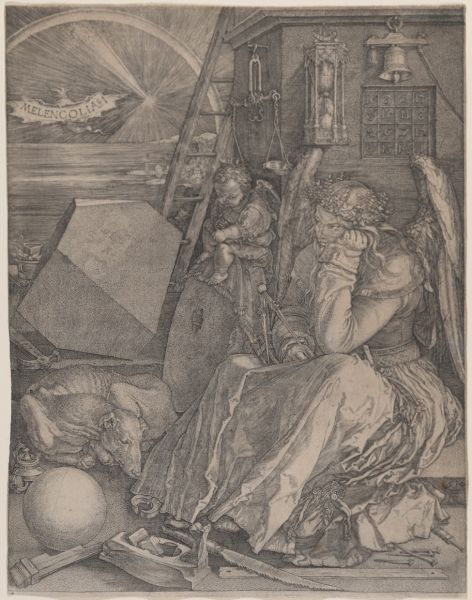
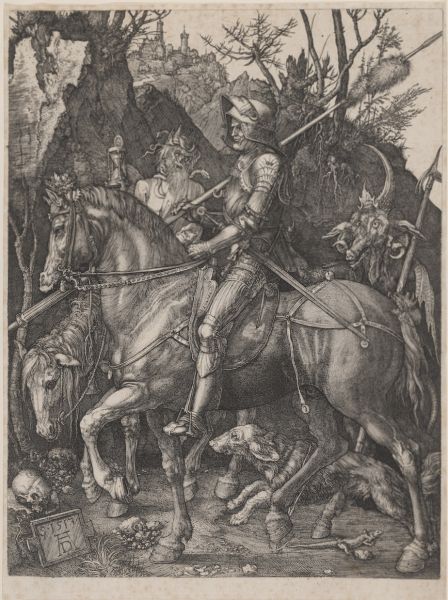
Engraved onto copper plates using a tool known as a burin, the images show Dürer’s close attention to the qualities of different materials. In Knight, Death, and the Devil, Dürer captures the lustre of the knight’s metal armour, while the stunning rock face behind the figure of Death reveals multiple refined engraving techniques. In St Jerome, light and shadow are rendered across wood, plaster, stone, cloth, bone, and fur. The remarkable surface of Melencolia I’s stone polyhedron has inspired centuries of artists to wrestle with its virtuosic material effects.
One object appears across the engravings: the sandglass, produced en masse in Nuremberg. In St Jerome, it appears paired with the skull as a sign of the saint’s awareness of mortality. In Knight, Death and the Devil, it is topped with a clock dial, revealing the last hour’s unseen proximity. In Melencolia I, surmounted by a sundial – another Nuremberg speciality – time is running out. A life measured correctly required careful, material attention.

Albrecht Dürer
Germany, 1471-1528
St. Jerome in his study 1514
engraving
Gift of Dr J. Orde Poynton 1959.
Prints and Drawings Collection, Archives and Special Collections.
University of Melbourne.
1959.2082.000.000
Seated at his desk, Saint Jerome, famous translator of the bible into Latin, is guarded by the lion whose foot he had cured. He is surrounded by significant objects: cardinal’s hat, rosary, crucifix, skull, writing materials. The pumpkin above alludes to Jerome’s contentious translation choice for the plant that had shaded the prophet Jonah. Dürer asserts a claim to translate materials, too: the wooden grain of the ceiling and light passing through bulls-eye glass are fluently translated onto the copper engraving plate.
Albrecht Dürer
Germany, 1471-1528
Melencolia I 1514
engraving
Purchased 1988.
Prints and Drawings Collection, Archives and Special Collections.
University of Melbourne.
1988.2013.000.000
A personified Melancholy sits idly, swinging a compass, amid a dream like clutter of tools, medical instruments, raw materials, measurement devices, and numbers. Mirroring Melancholy’s obsessed gaze, we try to understand why – why this bizarre array? But are we, like her, wasting our time? Perhaps this printed object is designed to work as a remedy for the listless humoral imbalance of melancholy that contemporary theory believed was due to the malign influence of the planet Saturn?
after Albrecht Dürer (artist)
Germany, 1471-1528
Charles Amand-Durand (publisher)
France, 1831-1905
Knight, Death and the Devil (1513), copy printed c.1869
photogravure
Purchased 1988.
Prints and Drawings Collection, Archives and Special Collections.
University of Melbourne.
1988.2014.000.000
The earliest of Dürer’s ‘Master Engravings’ depicts a knight riding through a gorge. He is followed by a decaying cadaver which presents him with a sandglass presaging imminent death, and a monstrous hybrid brandishing a broken polearm, likely representing a vanquished devil. Fitted out in armour which Dürer described in a 1498 drawing as typically German, the knight would seem to embody the faithful Christian who refuses to stray from the true path.

Albrecht Dürer
Germany, 1471-1528
A simplified method for perspectival representation of three-dimensional objects
in Albrecht Dürer, Unterweisung der Messung (Manual of Measurement)
(Paris: Christian Wechel, 1532), book 3, pp. 180-1
woodcuts
Purchased 2012.
Rare Books, Archives and Special Collections. UniM Bail
SpC/RB 8CT/20
Dürer’s Manual of Measurement (1525) explained his geometrical system of representation. This opening shows part of his simplified method for perspectival representation of three-dimensional shapes. In figure 60, a cube is delineated by a system of rays emanating from an eye. In figure 61, a viewer from a distance (on a foldout leaf) and a light source from above define a shadow. Figure 62 shows the finished product. Material representation for Dürer relied on careful observation and mathematical precision.

Johan Janssen (engraver)
active 17th century
after Albrecht Dürer (artist)
Germany, 1471-1528
Draftsman drawing a lute 1525, printed 1605
woodcut
Purchased 2010.
Prints and Drawings Collection, Archives and Special Collections.
University of Melbourne.
2010.0005.000.000
This is a copy of Dürer’s depiction of a perspective machine – being used to draw a lute – that concludes his Manual of Measurement (1525). The lute was not a coincidental choice. Its complex geometry involved a curved body made of segmented wooden pieces, parallel lines of strings crossed by frets, and a sharp perpendicular between neck and pegs. This became a textbook case for showing how to represent complex objects using the perspective machine’s string, pins, lead weights, and wax.