Albrecht Dürer’s Material Renaissance
exhibition labels
All website and exhibition texts copyright exhibition curators Jenny Spinks, Matthew Champion, Shannon Gilmore-Kuziow and Charles Zika. Use without prior permission is not permitted. For queries, please contact the curators.

PIETY AND PERSECUTION
Nuremberg’s many churches and chapels were replete with statues, paintings, tapestries, and precious objects, around which religious rituals and devotions were performed, some extending into civic space. Nuremberg itself became a pilgrimage destination on the feast celebrating the Imperial Relics, which included pieces of Christ’s cross, and the lance that pierced his side.
Dürer’s religious prints allowed direct emotional engagement in matters of faith. His many images of the Virgin, some located in familiar Nuremberg surrounds, were meant to stimulate devotional piety. So were the prints depicting Christ’s suffering and death, as especially found in The Small Passion and The Large Passion series, books that also included verses by Nuremberg monk and humanist, Benedict Chelidonius.
A focus on Christ’s suffering in these books, Dürer’s own writings, and many contemporary sermons, texts, and images, helped amplify false accusations, however, that the Jews were the killers of Christ. Such anti-Jewish beliefs stimulated blood libel accusations and the expulsion of Jews from many German cities and territories, including from Nuremberg in 1499.
The growing reforms and dissent related to the outbreak of the Reformation in the 1520s brought further challenges to Nuremberg; yet the city’s government and artists navigated religious change with comparatively little social upheaval.
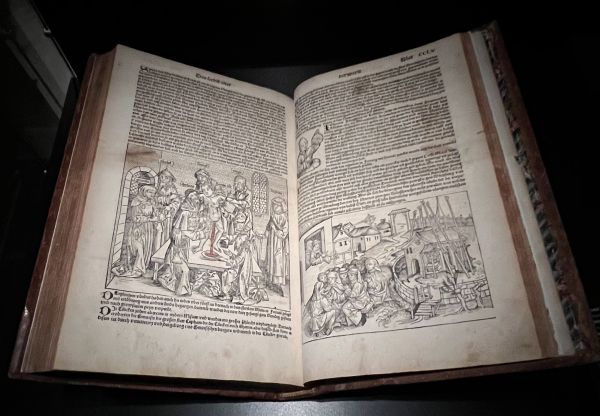
Michael Wolgemut (artist)
Germany, 1434-1519
Wilhelm Pleydenwurff (artist)
Germany, c.1458-1494
Simon of Trent; Regiomontanus; Hans Böhm, the ‘Drummer of Niklashausen’
in Hartmann Schedel, Register des Buchs des Chroniken und Geschichten
(Nuremberg Chronicle; German edition)
(Nuremberg: Anton Koberger, 1493), fols CCLIIII verso – CCLV recto
hand-coloured woodcuts
Rare Books collection, State Library Victoria.
RARESEF 093C933KB
In 1475, Jews in the Italian city of Trent (here wearing compulsory Jewish badges) were falsely accused of the child Simon’s murder: one of many ‘blood libel’ cases. Christ’s blood underpinned Christian devotion, and Simon’s Christ-like wounds are here enhanced with hand-applied red ink. Nuremberg astronomer Regiomontanus holds an astrolabe. Hans Böhm’s 1476 vision of the Virgin led him to throw ‘sinful’ objects into a bonfire and preach social and religious change; he was burned as a heretic.
Unknown artist
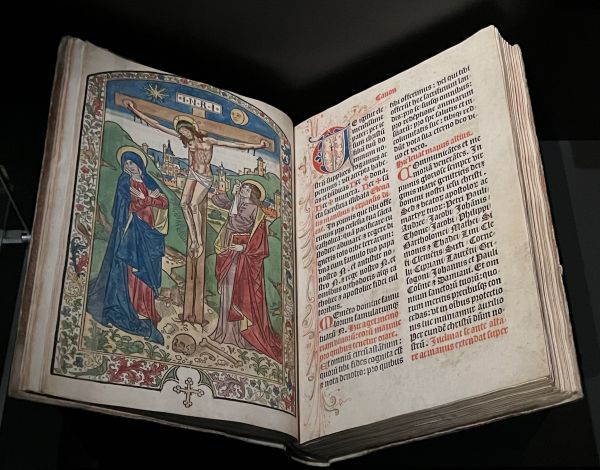
Crucifixion and Canon of the Mass
in Missale insignis ecclesie Trajectensis (Missal for the Diocese of Utrecht), 1497
hand-coloured woodcut
Rare Books collection, State Library Victoria.
RARESF 093 C974H
Missals provided the words for the Catholic Mass, that ritual where bread and wine became Christ’s body and blood. But missals were not simply scripts for priests; they were also ritual objects. At the moment in the rite shown here, as the bread was about to be transformed, priests would kiss a crucifixion image. This opening includes an ‘osculatory target’, a smaller cross at the base of the crucifixion, used so that repeated kissing would not damage the precious image.
Christoffel van Sichem II (wood-engraver)
Netherlands, c.1580-1658
after Albrecht Dürer (artist)
Germany, 1471-1528
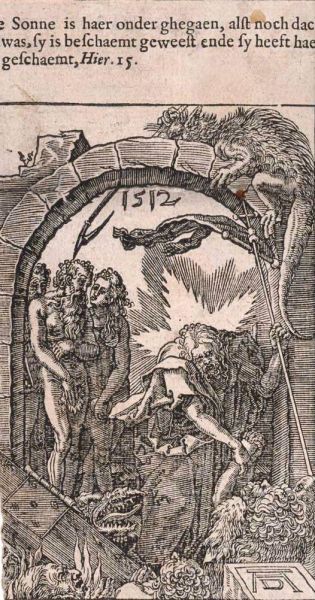
Harrowing of hell. Christ in limbo c.1600-1648
woodcut and letterpress
Gift of Dr J. Orde Poynton 1959.
Prints and Drawings Collection, Archives and Special Collections.
University of Melbourne.
1959.2936.000.000
This copy of Dürer’s print from his Engraved Passion series by one of the most productive artists of early seventeenth-century Netherlands provides one example of Dürer’s ongoing and profound influence. Dürer’s innovative representation of Christ’s release of Old Testament figures from the section of Hell called Limbo is depicted from within Hell itself. The doors have been smashed, Adam, Eve, and Moses already freed, and Christ now releases John the Baptist, to the consternation of Hell’s monstrous devils.
Unknown artist
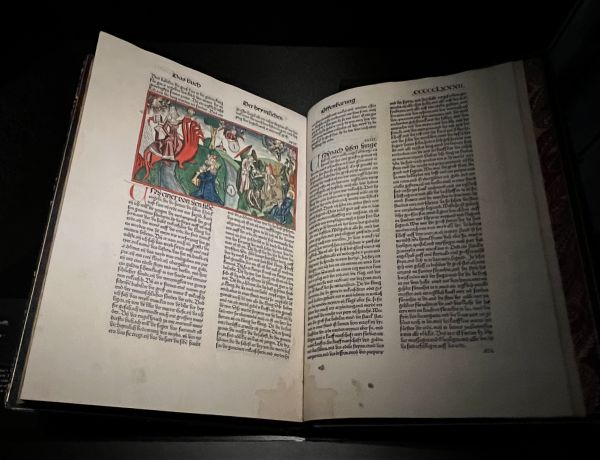
Scenes from the Apocalypse
in Disz durchleuchtigist werck der gantzen heyligen geschrifft, gennat dy bible (Koberger Bible, volume 2)
(Nuremberg: Anton Koberger, 1483), fols ccccclxxxi verso – ccccclxxxii recto
hand-coloured woodcuts
Rare Books collection, State Library Victoria.
RARESEF 093 C833K
Illustrated vernacular bibles appealed to book buyers well before Martin Luther’s 1522 German New Testament became a touchstone of the Reformation. The prophetic Book of Revelation is illustrated here: worshippers kneel before the Whore of Babylon riding the seven-headed beast and holding a metal vessel filled with the ‘filth of her fornication.’ Crops are ruined; the Devil is chained up. Dürer’s Apocalypse cycle would appear in 1498. Many people – Dürer included – looked for tangible signs of the Last Days.
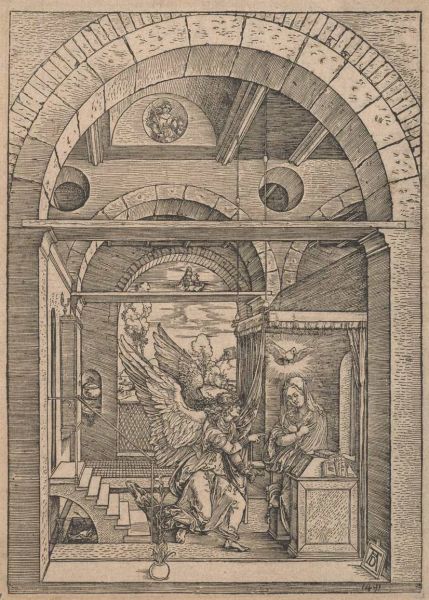
Albrecht Dürer
Germany, 1471-1528
The annunciation c.1503
from The Life of the Virgin, 1511
woodcut
Gift of Dr J. Orde Poynton 1959.
Prints and Drawings Collection, Archives and Special Collections.
University of Melbourne.
1959.5584.000.000
The angel Gabriel announces to Mary that she shall give birth to the son of God, Jesus. As the most important model for Christian piety, Mary receives the news with humility. Lily and wash basin symbolise her sexual and spiritual purity at her conception, while the figure of Judith holding the head of Holofernes above identifies the event as a victory over the Devil – shown as a badger under the stairs and chained like the Devil in Revelations 20.1-3.
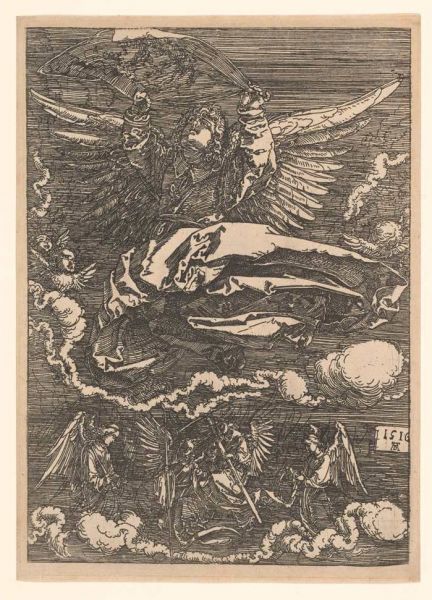
after Albrecht Dürer (artist)
Germany, 1471-1528
Charles Amand-Durand (publisher)
France, 1831-1905
Sudarium spread out by an angel (1516), copy printed c.1869
photogravure
Gift of Dr J. Orde Poynton 1959.
Prints and Drawings Collection, Archives and Special Collections.
University of Melbourne.
1959.2111.000.000
The billowing sudarium holds an imprint of the sweat wiped from Christ’s face. Objects that had touched Christ were venerated, and prints like this, widely circulated, must have acted almost as proxy ‘touch’ relics. Dürer was pious but also attentive to finances. In 1509, he complained after a difficult commission for a painted altarpiece of the Virgin Mary: ‘I shall get back to my engravings – and if I’d done that all this time I’d be 1,000 florins richer today.’
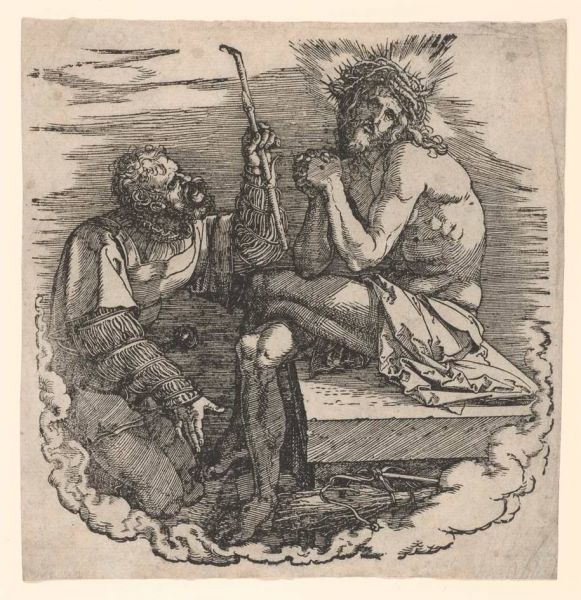
Albrecht Dürer
Germany, 1471-1528
The mocking of Christ 1511 from The Large Passion, 1511
woodcut
Gift of Dr J. Orde Poynton 1959.
Prints and Drawings Collection, Archives and Special Collections.
University of Melbourne.
1959.4279.000.000
Combining the iconographical themes of The Man of Sorrows and Christ at Rest, Dürer presents a vision of Christ after his Passion: seated on his tomb, crowned with thorns, scourge and birch at his feet, the wounds of crucifixion visible. The accompanying title-page text clarifies that Christ is addressing his viewers, admonishing them not to increase his suffering through sin – as does the soldier depicted, who mockingly offers a reed as a sceptre for the king of the Jews.
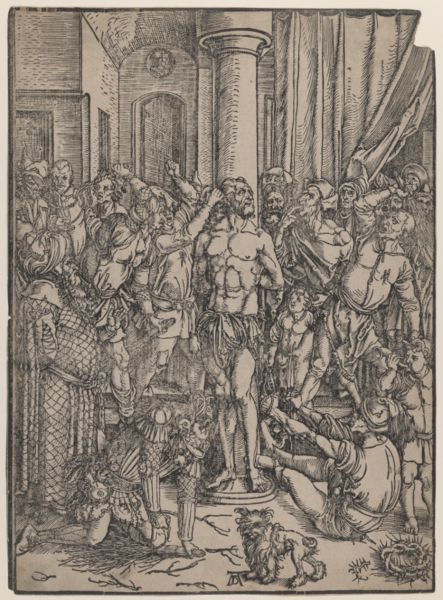
Albrecht Dürer
Germany, 1471-1528
The flagellation c.1496
from The Large Passion, 1511 woodcut
Gift of Dr J. Orde Poynton 1959.
Prints and Drawings Collection, Archives and Special Collections.
University of Melbourne.
1959.2139.000.000
The physical, mental, and emotional suffering of Christ is at the heart of late medieval and Renaissance piety. Bound against a column by a figure at lower right, Christ suffers blows from both scourge and birch-rod. An onlooker mocks him with a well-known gesture of two fingers in his mouth and a child compounds humiliation by blowing his horn. Pontius Pilate oversees punishment, a soldier prepares another birch-rod, and a crown of thorns lies ready for further derision.
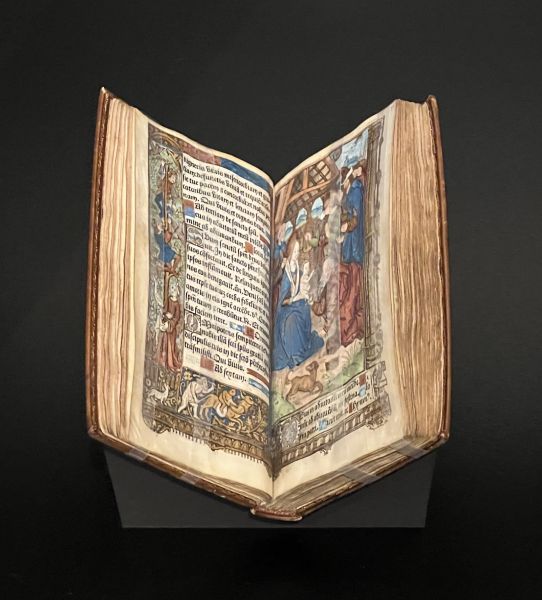
Jean Pichore (designer)
France, active c.1502-1522
The adoration of the Magi
in Heures à l’usage de Rouen (Book of Hours, Use of Rouen) (Paris: Antoine Verard, not before late 1507)
hand-coloured woodcut
G.F. Pendlebury Collection, purchased by the Ivy M. Pendlebury Bequest in memory of Gerard Frederic Pendlebury.
Rare Books, Archives and Special Collections.
UniM Bail SpC/RB 39A/16
Books of Hours such as this hand-coloured early sixteenth-century Parisian exemplar were prized objects for domestic devotions in elite households. Often owned by women, they could also become repositories of family histories, including handwritten records of births, deaths and marriages. This image comes from a sequence of devotions to the Virgin Mary and shows the three kings offering their gifts to the Christ Child in elaborate vessels that recall the prized metalwork of Renaissance cities.
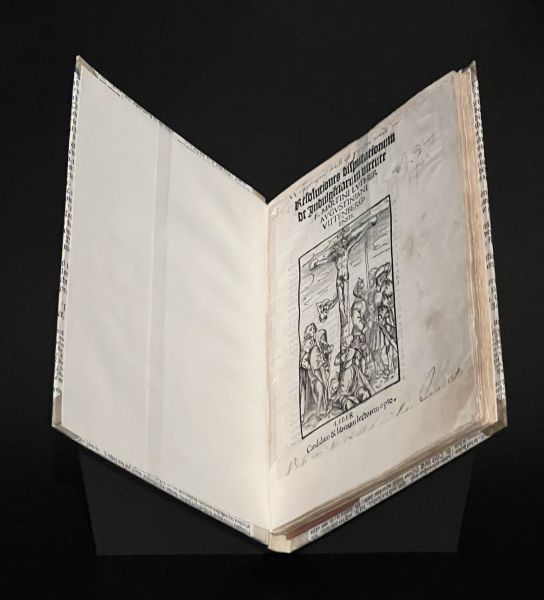
Unknown artist
Crucifixion
in Martin Luther, Resolutiones disputationum de indulgentiarum virtute (Resolutions of the Disputations on the Power of Indulgences) (Wittenberg: Johann Rhau-Grunenberg, 1518), title page
woodcut
Rare Books, Archives and Special Collections.
UniM Bail SpC/RB 14A/28
In 1517 Augustinian monk and Wittenberg professor Martin Luther’s 95 Theses had notoriously critiqued church practices of selling indulgences to reduce time in purgatory. They generated widespread controversy, and in this follow-up 1518 text Luther defended himself to Pope Leo X. The title page depicts Christ crucified. Soldiers in Renaissance armour alongside Mary Magdalene as a young German woman make the past tangible. Dürer owned c.40 publications by Luther, almost certainly including a copy of this title.