Albrecht Dürer’s Material Renaissance
exhibition labels
All website and exhibition texts copyright exhibition curators Jenny Spinks, Matthew Champion, Shannon Gilmore-Kuziow and Charles Zika. Use without prior permission is not permitted. For queries, please contact the curators.

THE RENAISSANCE BOOK
The extraordinary growth in the volume and availability of printed books during this era is sometimes characterised as a ‘revolution in print.’ Matter was central to this process. Access to paper was crucial, and in 1390 Nuremberg became the location of the first permanent paper mill in northern Europe. The key driver for change lay in more efficient ways to use the printing press. Around 1452, the German printer Johann Gutenberg of Mainz developed the technology of movable metal type. Books no longer needed to be printed from painstakingly carved pieces of wood to create ‘block books’ or written out by hand in manuscripts. Demand for luxury manuscripts and embellished printed books still remained high, however, and there was a growing market for books illustrated with prints.
Some cities developed new industries around print. These included Nuremberg and Venice, a trading partner with Nuremberg and key location for Dürer’s artistic development. Humanist and clerical scholarship in Greek, Latin, and Hebrew was fostered by the Renaissance and the rise of print. Books in vernacular languages were also increasingly widely accessible to merchants and craftspeople, making the ability to turn the pages of a book a hallmark of the material Renaissance for many people.
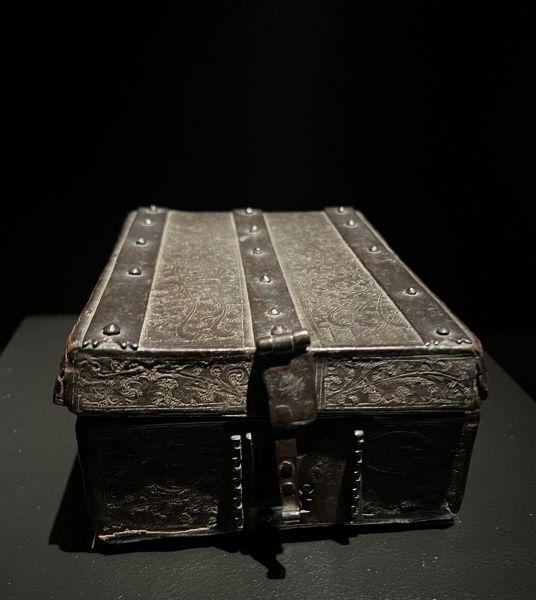
Book Coffret
[Place of creation not identified] [c.1480]
Rare Books collection, State Library Victoria.
RARESEF 095 C6549
This rare coffret expands our view of the material world of book ownership. Some books were especially precious objects to be protected by decorative purpose-built cases for use during storage or travel. This coffret incorporates metal loops on the side designed for a shoulder strap. Its makers utilised a range of skilled trades: it is covered with chased leather over a wooden core, and secured with a wrought iron lock.
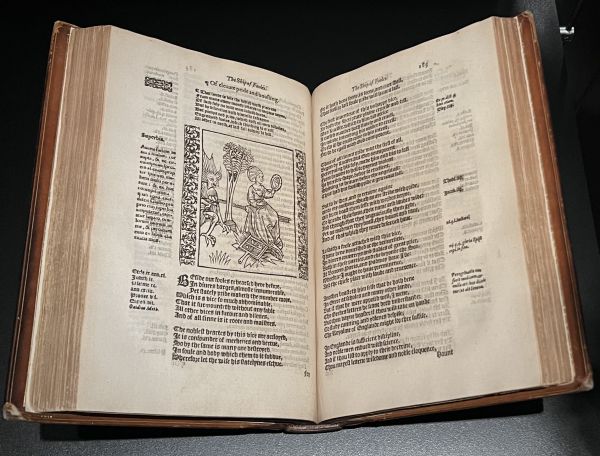
Unknown (printmaker)
after Albrecht Dürer (artist)
Germany, 1471-1528
Of elevated pride and boasting
in Sebastian Brant, Stultifera nauis (Ship of Fools)
(London: John Cawood, 1570), p. 184 verso
woodcut
Rare Books collection, State Library Victoria.
RARESF 837.32 S
The woodcuts and satire of the 1494 Ship of Fools made it an immediate best seller. This English translation includes copies of Dürer’s original woodcuts, but their homely imagery often contrasts with the refined text. Here the self-pride of a fashionably attired woman gazing obsessively into her mirror ignites fires (of lust) under her griddle. The devil promptly appears as a fowler, ready to use her as a decoy-bird on his snare and lure others into hell’s fire.
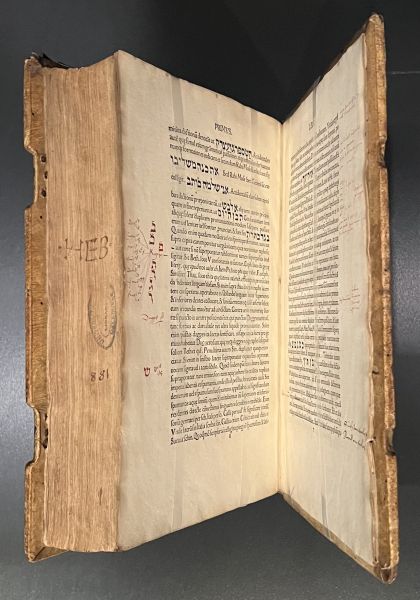
Johann Reuchlin, De rudimentis hebraicis
(Rudiments of Hebrew)
(Pforzheim: Thomas Anshelm, 1506), pp. 7-8
George McArthur Bequest, 1903.
Rare Books, Archives and Special Collections.
UniM Bail SpC/RB 54/2
This first Hebrew lexicon and grammar written for Christians (with book and pages reading right to left), marked the beginning of serious interest in Hebrew language and literature in Europe and sought to establish the primacy of the Hebrew Bible over the Greek Septuagint and Jerome’s Latin Vulgate. Numerous marginal annotations and cross-referencing in Latin, Greek, and Hebrew demonstrate its use as a comparative learning tool across linguistic cultures, an aid to focus understanding and a support for memory.
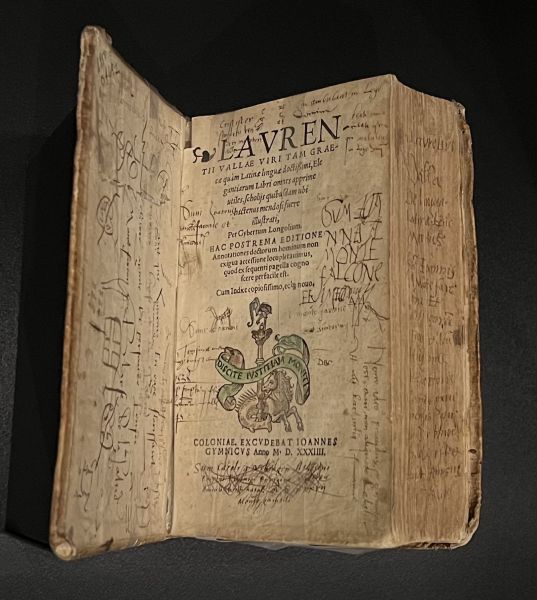
Lorenzo Valla, Elegantiae linguae latinae
(Elegances of the Latin Language) (Cologne: Johann Gymnich, 1534), title page
Rare Books, Archives and Special Collections.
UniM Bail SpC/BX 470 VALL
Valla’s manual for correct Latin usage was a classic of Renaissance humanism. This particular copy, marked by multiple users, includes a fascinating array of handwritten quotations, drawings, pen practice, scribbles, sums, crossings-out and doodles – a common fate for the Renaissance book. Here we see the names of two noblewomen: Joanna de Montfalcon and Blayse de la Palud. Alongside French, there is the start of a German hymn, and two attempts at the start of Psalm 119 in Latin.
Unknown artist
Hand-applied book decorations
in Gualterus Burlaeus, Incipit libel[us] [de] vita et morib[us] philosopho[rum] et poeta[rum] (Lives and Manners of the Philosophers and Poets)
(Nuremberg: Friedrich Kreussner, 1479)
Rare Books collection, State Library Victoria.
RARESF 093 C793
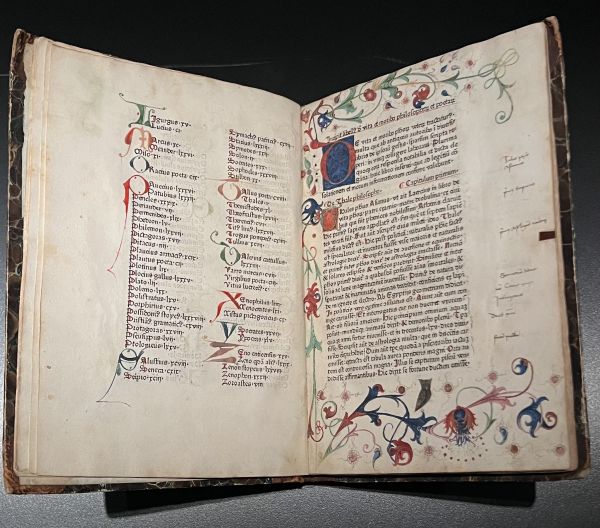
The anonymous Lives and Manners was often attributed to fourteenth-century philosopher Walter Burley, and appeared in multiple manuscript and printed versions. Friedrich Kreussner, who had humanist links in Nuremberg, published this early printed edition. Its hand-illuminated opening page – which discusses the philosopher Thales of Miletus – demonstrates how decorations commissioned in the workshop or at the instigation of owners could make printed books feel like manuscripts. Readers also annotated this well-used object.

Unknown artist
The foundation of Venice
in Werner Rolevinck (attr.), Fasciculus temporum omnes antiquorum cronicas complectens (A Bundle of Times Encompassing all the Chronicles of the Ancients)
(Venice: Erhard Ratdolt, 21 December 1481)
woodcut
Rare Books, Archives and Special Collections.
UniM Bail SpC/RB MTC/16 Incunabula
The Fasciculus temporum was the first horizontal timeline and a compendium of Renaissance knowledge. It is arranged according to two chronologies: the anno mundi (year of the world) dated from creation, and the anno Christi (year of Christ) dated from Jesus’ birth. The work was a bestseller: thirty-five editions appeared before 1500.
This opening shows Venice’s foundation and includes one of the first printed images of the city that Dürer visited in 1494-1495 and 1505-1507.
Unknown artist
Andromache, Hecabe, Helen, and Priam lament Hector’s death
in Homer, Iliad
(Venice: Stefano da Sabio, 1526)
woodcut; pen and ink drawing
Rare Books, Archives and Special Collections.
UniM Bail SpC/RB 9F/17
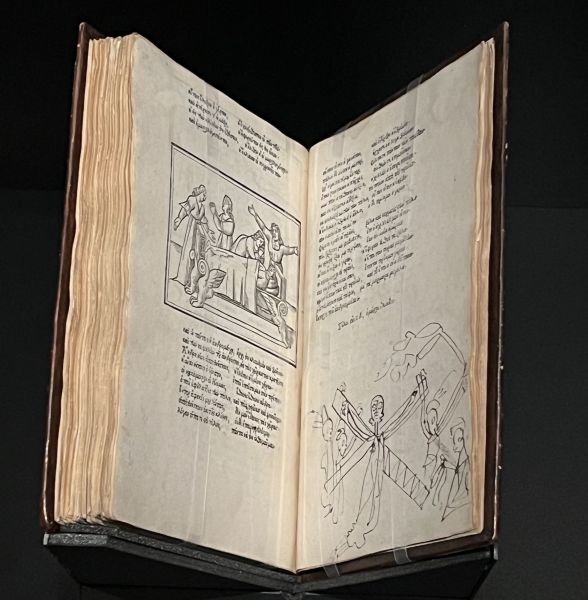
As a Greek scholar living in Italy, Nikolaos Loukanis synthesised and translated Homer’s epic from ancient Greek to the vernacular. His book was part of a movement in Venice to make ancient Greek texts more accessible to Greek-speaking middle-class consumers wanting to reconnect with their cultural heritage. In this copy, one reader has doodled an episode from the Crucifixion, in which Christ’s tormentor mimics the upraised arms of a mourner lamenting Hector’s death in the woodcut opposite.
John Peckham, Perspectiua communis (General Optics)
(Venice: Baptistam Sessam, 1504)
Rare Books, Archives and Special Collections.
UniM Bail SpC/RB 7D/2
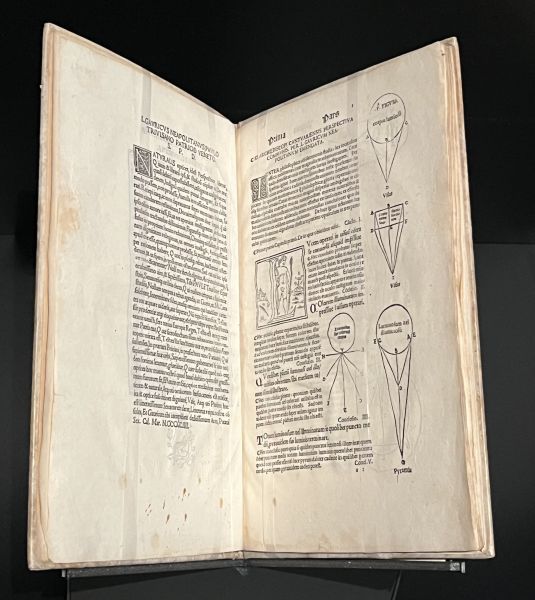
John Peckham’s Perspectiua communis continued to be the most widely read medieval treatise on the science of optics up until the mid-seventeenth century. His treatise inspired Renaissance artists in their development of linear perspective, a mathematical system that artists employed to represent three-dimensional objects and spaces on a two-dimensional surface. Throughout his book, he includes several diagrams – such as those featured here – that are associated with the physiology of the eye and the material apprehension of light.
Unknown artist
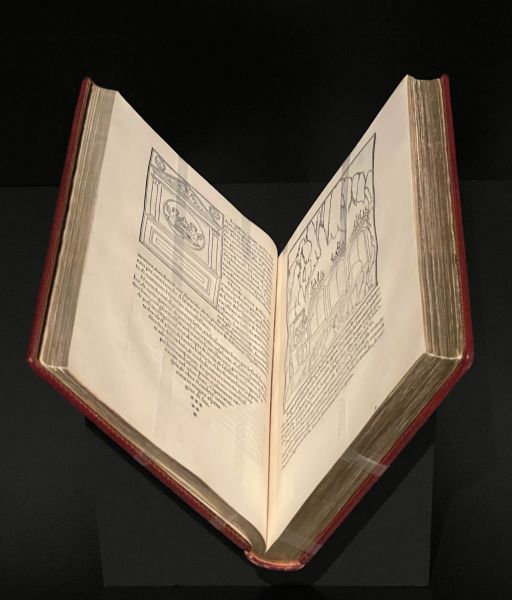
Three doors or choices of the realm of Queen Telosia
in Francesco Colonna, Hypnerotomachia Poliphili (The Dream of Poliphilus)
(Venice: Aldus Manutius, 1499), fol. h8 recto
woodcut
Purchased with support from the Ivy May Pendlebury Bequest.
Rare Books, Archives and Special Collections.
UniM Bail SpC/RB MTB/20 Incunabula
Dürer’s personal library contained a copy of the Hypnerotomachia Poliphili, which recounts the fantastical places and characters encountered by a lovesick Poliphilus in a dream. Produced by the revolutionary Venetian printer, Aldus Manutius, it represents the culmination of his innovations in typography and is notable for its inclusion of a variety of typefaces, all of which appear above the three doors depicted in the woodcut on the right: Latin, Greek, Hebrew, and Arabic.
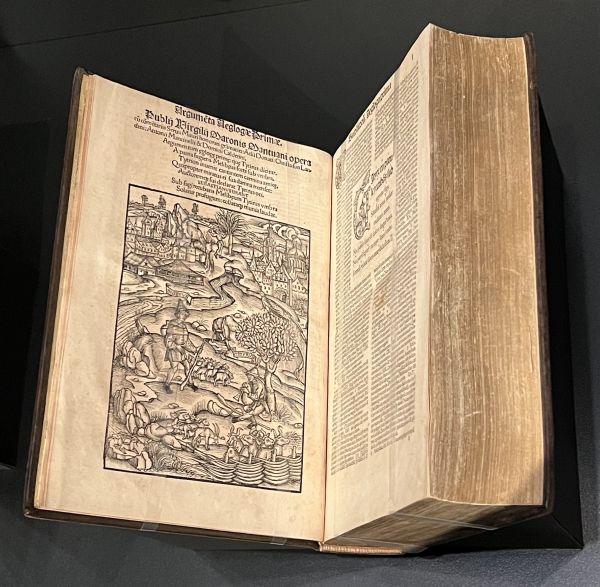
Late Master of the Grüninger Workshop
Germany, active 1502
Dialogue between two herdsmen, Meliboeus and Tityrus
in Publius Vergilius Maro, Opera, edited by Sebastian Brant (Strasbourg: Johann Grüninger, 1502), fol. A vi verso
woodcut
Purchased with funds donated to The Friends of the Baillieu Library by the George Shaw Trust.
Rare Books, Archives and Special Collections.
UniM Bail SpC/RB MTB/23
This first illustrated edition of Vergil’s works contained over 200 original woodcuts compiled by the Basel humanist author of The Ship of Fools, Sebastian Brant. Brant’s purpose in bringing Vergil to the unlettered – as in this woodcut illustrating the dialogue in Eclogue 1 between two herdsmen over changing fortunes on the land – was assisted by transposing classical narratives into the more familiar environment of half-timbered houses, church spires, pollarded trees, willow fencing, and peasant costume of southern Germany.