Albrecht Dürer’s Material Renaissance
exhibition labels
All website and exhibition texts copyright exhibition curators Jenny Spinks, Matthew Champion, Shannon Gilmore-Kuziow and Charles Zika. Use without prior permission is not permitted. For queries, please contact the curators.
WEAPONRY AND CONFLICT
The material culture and technology of warfare fascinated artists, although few eyewitness battle scenes or visual records of war’s wider social impact were produced in this era. Artists depicted armour, in particular, in exceptional detail. Nuremberg’s renowned metalworkers produced armour for men and horses, used in battle but also for elaborate ceremonies and processions. Merchants imported raw material from booming mining and metallurgy industries to feed production.
Reports of warfare – notably in Italian and Swiss territories – formed a backdrop to Nuremberg life. In an era before standing armies, regions often negotiated the direct supply of soldiers and equipment in periods of conflict. Dürer’s closest friend Willibald Pirckheimer led Nuremberg’s troops in the 1499 Swabian war, and the men’s bright red outfits would have been a regular sight in the city. The Peasants’ War of 1524-1525 included violent skirmishes close to Nuremberg. Around this time, Dürer recorded waking in terror, his body trembling, from a nightmare about a vast torrent of water falling from the sky: a deeply personal manifestation of the embodied anxieties that conflict could produce. Biblical images of violence, especially those concerning Christ, also called on viewers to tangibly imagine the impact of a whip, lance, or other weapon on flesh.
Albrecht Dürer
Germany, 1471-1528
The knight and the lansquenet c.1496
woodcut
Gift of Dr J. Orde Poynton 1959.
Prints and Drawings Collection, Archives and Special Collections.
University of Melbourne.
1959.2132.000.000
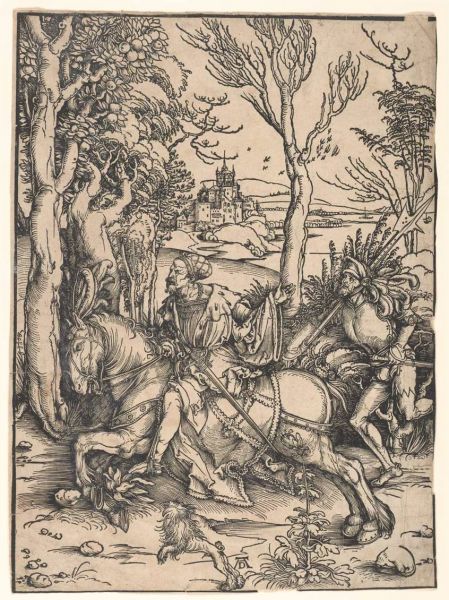
With an expansive gesture that reveals his fashionable clothing, this knight on horseback is surrounded by signs of his status. He is accompanied by a lansquenet or Landsknecht – a mercenary – who runs behind with a polearm and a plumed headdress echoing
the headdress of the horse. They speed along in a wooded space beyond city walls. The vigorous motion in Dürer’s woodcut reminds us that the countryside surrounding Nuremberg was sometimes violently contested, and travel could be dangerous.
Jacob Binck
Germany, 1494/1504-1569
Death and the foot-soldier 1526
engraving
Gift of Dr J. Orde Poynton 1959.
Prints and Drawings Collection, Archives and Special Collections.
University of Melbourne.
1959.2275.000.000
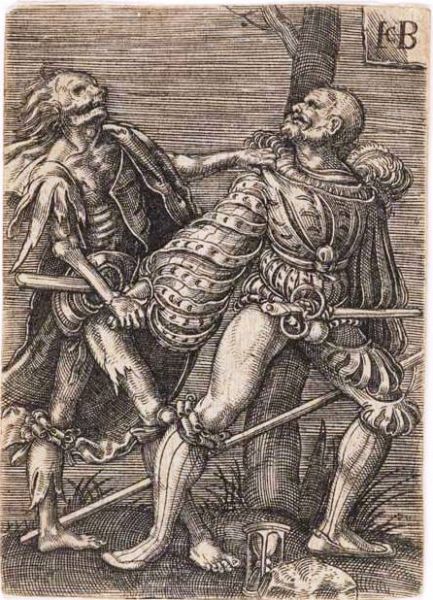
In this miniature print, Jacob Binck renders in astounding detail the mercenary’s elaborately slashed and plumed uniform, a marker of itinerant soldiers’ vain and vice-ridden lifestyles. The soldier’s finery hangs in tatters around Death’s skeletal form which accosts the soldier and serves as a reminder that such worldly goods are fleeting. The soldier’s halberd lies useless on the ground, and the hourglass at the soldier’s feet symbolises Death’s inevitable triumph.
Enea Vico (engraver)
Italy, 1523-1567
after Francesco Primaticcio (artist)
Italy, 1504-1570
Vulcan and the Cyclopes forging arrows for the cupids 1523-1567
engraving
Gift of Dr J. Orde Poynton 1959.
Prints and Drawings Collection, Archives and Special Collections.
University of Melbourne.
1959.4072.000.000
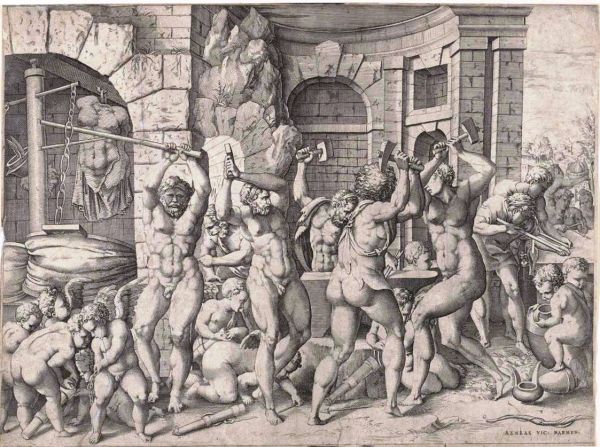
Enea Vico’s engraving is based on a design by Italian artist Primaticcio of the School of Fontainebleau. Vulcan, god of fire, works with metalworking tools: the bellows maintain the furnace’s fire and Vulcan and the Cyclopes at an anvil forge arrows, which cupids gather for their quivers. The episode speaks to the role of metals in Europe’s material Renaissance and presents the artist as an alchemist who possesses the god-like ability to transform raw materials into finely wrought objects.
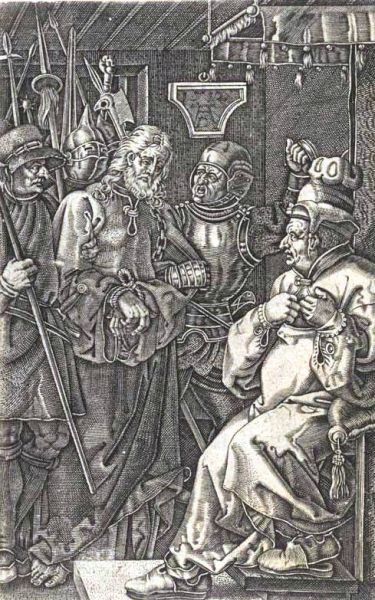
Albrecht Dürer
Germany, 1471-1528
Christ before Caiaphas 1512
from the Engraved Passion series, 1507-1512
engraving
Gift of Dr J. Orde Poynton 1959.
Prints and Drawings Collection, Archives and Special Collections.
University of Melbourne.
1959.2077.000.000
Dürer’s depiction of the Jewish High Priest Caiphas tearing his robes as he convicts Jesus of blasphemy is highly dramatic, accentuated by the compressed space, the contrast between the hands of the two protagonists, and Dürer’s use of shading. The focus on weaponry and armour – pike, lance, halberd, spiked club, as well as breastplate, gauntlet, helms, and chain mail – communicates the underlying violence. Well known to Dürer, these were objects central to Nuremberg’s metal production and trade.
Michael Wolgemut (artist)
Germany, 1434-1519
Wilhelm Pleydenwurff (artist)
Germany, c.1458-1494
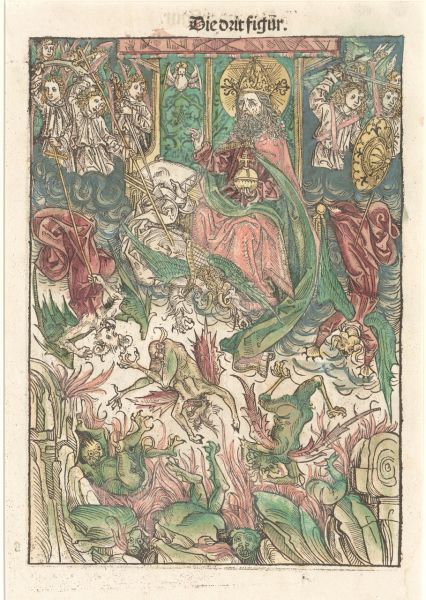
Fall of Lucifer
from Stephan Fridolin, Schatzbehalter, oder, Schrein der waren reichtumer des heils (Treasury of the True Riches of Salvation) (Nuremberg: Anton Koberger, 1491), fol. g i verso
hand-coloured woodcut
Gift of Dr J. Orde Poynton 1959.
Prints and Drawings Collection, Archives and Special Collections.
University of Melbourne.
1985.2005.002.000
Battles could take place in supernatural spaces. This leaf from the Nuremberg Schatzbehalter depicts the archangel Lucifer – dressed in clerical vestments – tumbling from Heaven to Hell. The concealing garments of accompanying demons disappear as they descend, revealing their grotesque forms. An enthroned God the Father holds a metal orb and makes the Christ- like gesture of the salvator mundi, or saviour of the world, while militant angels brandish metal swords, processional crosses, and a shield to defend their territory.
Unknown (printmaker)
after Albrecht Dürer (artist)
Germany, 1471-1528
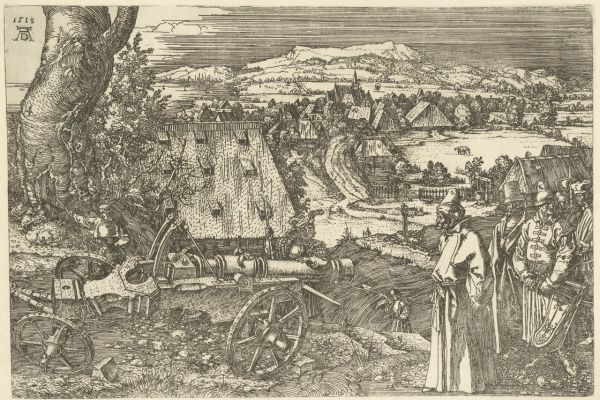
Landscape with cannon (1518), copy printed c.19th century
photogravure
Purchased 1994.
Prints and Drawings Collection, Archives and Special Collections.
University of Melbourne.
1994.2545.000.000
A decommissioned cannon has been transformed from an active firearm to an object admired for its aesthetic qualities and technological advances. The subject of Dürer’s original print speaks to the origins of the technique of etching on iron, a process first developed in armour making. Dürer’s virtuoso use of curving, intricate lines to render the landscape poses a paragone, or competition, between the two rival crafts and aims to surpass the highly revered industry of artillery making.
Basilius Wefring (artist)
Switzerland, active 1550s
Hans Rudolf Manuel (printmaker)
Switzerland, 1525-1571
Zacharias Specklin (printmaker)
Switzerland, 1505-1550
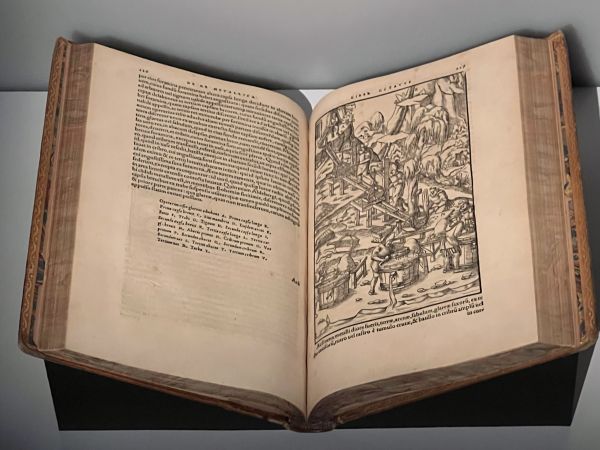
Mining scene: sifting and washing rock
in Georgius Agricola, De re metallica (On the Nature of Minerals)
(Basel: Hieronymus Froben and Nicolaus Episcopius, 1556), pp. 226-27
woodcut
Rare Books collection, State Library Victoria. RARESF 669 AG8
This book by Georg Bauer (generally known by his Latinised name Agricola) was the most important work on mining published before the eighteenth century. Bauer was a German doctor and is widely considered the founder of the discipline of geology. The book was well known in Nuremberg, given the importance of metal production for its economy. The 292 woodcuts, as in this opening illustrating the sifting and washing of rock containing copper (with a key opposite), contributed to its popularity.