Inagaki Seminar on Japan
The Japanese Studies Program at the Asia Institute, the University of Melbourne, inaugurates a new seminar series on Japan, which is named after Mr Moshi Inagaki, the pioneer of Japanese language instruction at this University.
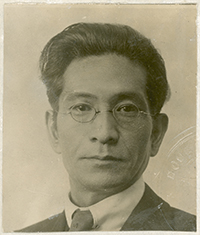
The Japanese Studies Program launched the Centenary of Japanese Language on 31 March 2017 to commemorate 100 years of Japanese language teaching at the University of Melbourne. This historic moment was celebrated with colleagues and students and the wider Melbourne community over three years (2017-2019), with the Inagaki Seminar series continuing as an ongoing fixture at the Asia Institute. It was a timely occasion to establish this seminar series on Japan as a way to honour and carry forth Inagaki-sensei's legacy.
The Inagaki Seminar features current topics on Japan within the areas of society, politics, language, and culture, as well as on the Australia-Japan relationship. It also envisions covering transnational regional issues in East Asia; in particular, such topics as Japan’s relations with neighbouring countries including China and Korea.
The Inagaki Seminar is housed within the Asia Institute Lecture series, and Akihiro Ogawa, Professor of Japanese Studies, is Lead Organiser.
Schedule
Seminar 49
Speaker: Timothy Stone CF
In 1830 escaped convict pirates from Van Diemen's Land arrived of the coast of Shikoku in an encounter now recognised as first contact between Australia and Japan In 1830, at the peak of Japan’s isolationism and 23 years before Commodore Perry forced the Tokugawa Shogunate to trade with the United States. Escaped convicts from Van Diemen’s Land arrived off the coast of Shikoku in the piratically seized Cypurs brig. For twelve days the convict pirates drifted along the coast interacting with local samurai as they sought safe harbour. In this seminar journalist Timothy Stone will discuss the recently-discovered samurai records of first contact between Australia and Japan.
Room 321, Level 3 Sidney Myer Asia Centre Building 158, The University of Melbourne, Parkville
Seminar 47 (online webinar)
Speaker: Dr Jenny Hall (University of Melbourne)
Seminar 46 (online webinar)
Speakers: Ruby Ramsden (University of Melbourne) and Dr Nick Pendergrast (University of Melbourne)
Seminar 45 (online webinar)
Speakers: Associate Professor Akito Sakasai (The University of Tokyo) and Associate Professor Younglong Kim (Otsuma Women’s University)
Seminar 44 (online webinar)
Speaker: Professor Yuki Tanaka (retired)
The Japanese government and the Japanese people in general always emphasise the fact that Japan is the only nation in the world to have suffered the atomic bombing, while they tend to ignore the terrible wartime atrocities committed by the Japanese Imperial forces. Why did the Japanese, unlike the Germans, fail to develop a sense of collective responsibility for the wartime and colonial atrocities they committed, and why do they continue to fail to do so? Professor Tanaka aims to find answers to this question by focusing on the atomic bombings - how the US made their decision, how Japan came to accept defeat, how both the US and Japan created their own state-sanctioned narratives to justify each decision, and how they accepted such narratives from each other for their own interests. Professor Tanaka will also examine what kind of social and political problems arose as a result of this collaboration, and how the prevailing social and political problems currently confronted by the Japanese people are in essence, fundamentally rooted in the manner in which the war ended.
Seminar 43 (online webinar)
Speaker: Associate Professor Hyoungduck Kwak - Department of Japanese Language and Literature, Myongji University (South Korea)
Join Associate Professor Hyoungduck Kwak (Myongji University) as they examine the diasporic journey and literary contributions of Kim Shijong, a key figure in Zainichi Korean literature. Born during Japanese colonial rule, Kim participated in the Jeju April 3rd Incident and sought asylum in Japan, where he lived under another name and engaged in social and political movements. Writing in Japanese, Kim's poetry reflects personal trauma, historical tragedies, and the struggles of the Korean diaspora. This analysis explores how Kim's experiences with the Jeju April 3rd Incident, the anti-nuclear movement, and the Great East Japan Earthquake shape themes of displacement, identity, and resistance. By positioning Kim’s works within world literature and diaspora studies, Associate Professor Kwak highlights Kim's efforts to articulate the complexities of his time, extending his influence beyond national boundaries.
Seminar 42 (online webinar)
Speaker: Dr Sally Chan, Lecturer in Japanese Studies at the Asia Institute (University of Melbourne, Australia)
Join Dr Sally Chan as she discusses the elements that facilitate and hinder learning through peer interaction. Dr Chan's research offers suggestions for class and activity design to better support learners in overcoming negative language transfer. Negative language transfer (the adverse influence of a previously learnt language on the learning or use of a target language) is a phenomenon that affects all second/foreign language learners. However, research in this area has largely focused on the identification, quantification, and description of the process of transfer and the effects on learning and output, with little attention given to how to support learners’ language learning when they experience such transfer. This seminar presents a sociocultural approach to the process of learning a Japanese grammatical item in which negative language transfer has been observed. Specifically, it examines how peer interaction might aid Chinese L1 advanced learners of Japanese in learning the possessive marker and noun-linker no—a foundational grammatical item that still poses difficulty for Chinese L1 learners due to usage differences between Chinese and Japanese. While participants may ultimately learn no through this approach, the success of peer interaction is, in fact, shaped by multiple factors.
Seminar 41
Speaker: Dr Judit Kroo, Senior Lecturer in Japanese Studies at the Asia Institute (University of Melbourne, Australia)
In contemporary Japan, permanent socio-economic precarity is making it increasingly difficult for many individuals to participate in once taken for granted social practices such as secure jobs and romantic relationships. Join Dr Judit Kroo to learn how changes in language and linguistic meaning map onto broad social changes in Japanese life. These changes are themselves now documenting how shifting social worlds are given meaning through language. Dr Kroo's work uses data gathered from naturally occurring conversations of marginalized Japanese communities including younger adults facing precarious work lives, and rural workers struggling with demographic and social disaster.
Seminar 40
Day and time: 22 November 2024 12:30-1:30pm AEDT
Title: Toward an Environmental History of Health and Sunlight: A Perspective from Modern Polish History
Speaker: Kenshi Fukumoto, Associate Professor Kyoto University, Graduate School of Human and Environmental Studies
Seminar 39
Day and time: 18 November 2024 12:30-1:30pm AEDT
Title: Emplacing East Timor: Regime Change and Knowledge Production, 1860-2010
Speaker: Kisho Tsuchiya, Assistant Professor, Kyoto University, Center for Southeast Asian Studies
Emplacing East Timor explores the relationship between the cycle of regime change and that of knowledge production, offering an alternative framework to periodize the history from 1850s to 2010s. Kisho Tsuchiya shows that the prevailing perceptions of East Timor have been shaped by large-scale wars, postwar consolidation, and the dominance of foreign observers. The transitions that construct what we know about East Timor have followed the rhythm of devastating violence and regime transformations. Playing a role as well are personal, institutional, and geopolitical interests and the creativity of Timorese and foreign observers. Acknowledging this cycle, Tsuchiya interweaves narrative of crucial events and political movements with an analysis of Timor’s connections to global circulations and historical transitions. He traces key persons and communities that shaped the contour of East Timor—from Portuguese colonial officers to anthropologists, Japanese occupiers to Australian activists, and Timorese poets to revolutionaries. Their experiences and imaginations of (East) Timor have been expressed through scholarly works, secret documents, policy statements, ceremonies, revolutionary songs, and museums. Using multi-archival historical research, the author introduces sources in several languages and provides missing links, including secret documents in Portuguese archives and the National Archives of Timor-Leste, Japanese wartime sources, and Timorese sources in the Archives of Timorese Resistance. Emplacing East Timor skillfully synthesizes nationalism studies and borderland studies, creating a comprehensive approach to modern East Timorese national imaginings, the historical role of territorial borders, and its postcolonial problems.
Seminar 38
Day and time: 17 October 2024 6:00 – 7:00pm
Title: Imag(in)ing Japanese Architecture
Speaker: Professor Ari Seligmann, Monash University, Associate Dean Education for the Art, Design and Architecture Faculty
This talk gives consideration to how images shape our readings and imaginations of Japanese architecture by detailing a hybrid historical and historiographic study, investigating of roles for photography as well as illuminating and spotlighting specific photographers behind the lens.
Drawing from a thematic survey of modern architectural developments and forming connections with a current publication project examining the photographic construction of Japanese architecture. The project examines key photographers and the evolution of architectural photography in Japan since the Meiji Period.
The publication project broadens international understanding of Japanese architectural production by examining those responsible for framing architectural developments and how their particular framing shapes our reception of Japanese architecture. Framing considers both individual photographs and collectively within media outlets.
Seminar 37
Day and time: 13 September 2024, 1:30 – 2:30pm
Title: Influences of Japan’s curriculum guidelines on the production of the ministry authorised high school English textbooks
Speaker: Professor Atsushi Iino, Hosei University, Department of Economics
Professor Atsushi Iino will review the changes of the guidelines and the influences on the society in Japan, education in general, and textbooks.
Seminar 36
Day and time: 30 August 2024, 2:00 – 3:30pm
Title: The Legacy of Japan’s Traumatic Experiences of the Second World War
Speakers: Dr Eugen Koh (Senior Fellow, Centre for Mental Health and Community Well-being, Melbourne School of Population and Global Health, University of Melbourne), A/Professor Eri Nakamura (Sophia University), Dr Tadashi Takeshima (Director of Kawasaki City Inclusive Rehabilitation Center)
In Japan over the past 6 years, members of a growing network of mental health professionals, community leaders and researchers in history, social science, politics and the arts have engaged in interdisciplinary symposia and workshops aimed at understanding the long-term effects of the Second World War on the Japanese people, their culture and society.
This seminar, presented by the network’s founding members, introduces the work of the group, and seeks expressions of interest to participate in a joint Japanese-Australian symposium in 2025, to mark the 80th anniversary of the end of The War in a spirit of goodwill and peace.
Seminar 35
Day and time: 9 August 2024, 12:30 – 1:30pm
Title: From Under the Mushroom Cloud: The Importance of A-bomb Survivor Narratives
Speaker: Dr Eliza Nicoll, Monash University School of Languages, Literatures, Cultures and Linguistics
As we approach the 80th anniversary of the atomic bombings of Hiroshima and Nagasaki, it becomes imperative to document and reflect upon the narratives of those directly impacted. This presentation offers an insight into this moment of global significance through the lens of one of the earliest anthologies of Hiroshima survivor testimonies, Personal Accounts of the Atomic Bomb (原爆体験記). Proposed in 1950 by Hiroshima City’s first democratically elected mayor, the anthology contains twenty-nine firsthand accounts detailing the events of 6 August 1945. Yet despite the poignancy of these testimonies, the survivor’s voices underwent systematic censorship during both wartime and the subsequent post-war occupation era, relegating their narratives to obscurity until 1965.
These accounts transcend mere historical documentation, serving as invaluable pedagogical tools for future generations. They evoke empathy, foster understanding and inspire a collective commitment to peace. With the passage of time inexorably claiming the lives of survivors, their written narratives assume paramount significance.
Soon, only their written and recorded accounts will remain as a testament to the events. Against the backdrop of escalating nuclear tensions, symbolised by the ominous advancement of the Doomsday Clock to 90 seconds to midnight, the accessibility of texts elucidating the horrors of nuclear devastation assumes heightened importance in our contemporary context.
Seminar 34
Day and time: 16 May 2024, 12:00 – 2:00pm
Title: Supporting Children's Learning of Community Language
Speaker: Dr Kaya Oriyama, Lecturer in Japanese Studies, Asia Institute, University of Melbourne
What could parents do to support children’s learning of community language? Learn about the findings from the Australia-wide study on the Japanese community.
The family can be conceptualised as both a private and public ‘space’ (Canagarajah, 2013; Lanza and Lomeu Gomes, 2020) that operates within a society. Family Language Policy (FLP) (King, Fogle and Logan-Terry, 2008) on language maintenance and development, therefore, would reflect social as well as affective factors (Schalley and Eisenchlas, 2020) that influence each other. While Spolsky’s (2004) tripartite model of language policy, composed of language ideology, language practices, and language management, has been used in many FLP studies, the focus of FLP research has evolved from explicit and overt language planning and management to include implicit and covert ones through practices such as literacy and identity construction in recent years. However, there are still gaps in research.
This seminar draws on some of the findings from the Australian Network for Japanese as Community Language (ANJCL)’s nation-wide interview study on learners of ‘Japanese as Community Language’ (JCL) to interpret the dynamic functions of FLP and its impact on language maintenance and development. Analyses of interviews with 18 families that have raised JCL speakers to adulthood uncovered complex relationships among FLP factors, language environment and resources, and JCL maintenance into adulthood.
Seminar 33
Day and time: 22 April 2024, 1:00 – 2:00pm
Title: Interactional Competence in Japanese
Speaker: Prof Yoko Nakai, Professor, Tokyo University of Foreign Studies
While J. V. Neustupný was at Monash University, he argued that it was necessary to address interactional competence in the field of Japanese language teaching. The concept of interactional competence includes linguistic competence, socio-linguistic competence and social competence.
Mastery of these competences is required for Japanese language learners to successfully interact with Japanese language speakers as well as develop careers using the Japanese language.
This seminar discusses the nature of interactional competence and how teachers could teach interactional competences in Japanese language classes, showing the following research and practice:
1. Adjustments made by Chinese students and Japanese students during online conversation (Nakai et al., 2024 and Nakai, 2024)
2. Effectiveness of academic Japanese in post-graduation workplace activities: findings through interviews with the recipients of Japanese government scholarship (Suganaga and Nakai, 2016)
3. The design of teaching materials for career development support for Japanese language learners and Japanese students with a focus on tasks and projects (Nakai et al., 2023)
A project in progress to develop teaching materials suitable for conversational education will also be introduced.
Seminar 32
Day and time: 7 March 2024, 6:00-7:300pm
Title: Film Screening: Paper City
Speaker: Adrian Francis, Award-Winning Filmmaker
Paper City, directed by Adrian Francis, is a documentary film that highlights the 70th anniversary of the firebombing of Tokyo on March 10, 1945. The US firebombed Tokyo, destroying a quarter of the city and killing 100,000 people. Now, in a society rapidly forgetting, three elderly survivors fight to leave behind a public record of their experiences before they pass away. Paper City explores what we choose to remember and aim to forget—and what the consequences of that are.
Seminar 31
Day and time: 19 October 2023, 12:00-1:00pm
Title: Protecting Yanbaru's Treasures: Akino Miyagi's Battle Against US Military in Okinawa's Risks
Speaker: Scott Musgrave-Takeda, PhD Candidate, Asia Institute, University of Melbourne
Discussants: Associate Professor Keisuke Mori (Senshu University), Dr Shinnosuke Takahashi (Victoria University of Wellington)
This presentation is a critical examination of the strategies employed by Akino Miyagi, a pioneering environmental activist, in mitigating the risks posed by the US military presence to endangered species in Okinawa's Yanbaru forest. Miyagi's proactive and often solitary approach stands out within the realm of civil society activism. Through an anthropological lens, Scott uncovers the profound implications of her efforts, shedding light on the alarming impact of the military presence on Yanbaru's delicate ecosystem. This research underscores the urgency of addressing environmental risks, advocating for the protection of endangered species, and reevaluating the consequences of the military's footprint in this unique region.
Seminar 30
Day and time: 13 September 2023, 12:00-1:00pm
Title: New Developments in School History Education in Japan
Speakers: Prof Philip Seaton and Prof Nobuo Haruna, Tokyo University of Foreign Studies
As global concern rises about the threat to democracy posed by populist and authoritarian governments, evaluating the role of history textbooks as a tool of governments to “impose” their visions of history and national identity on the nation’s youth becomes ever more important. Within the Japanese context, history textbook content has been the subject of considerable contestation ever since the 1950s. This joint lecture by two professors at Tokyo University of Foreign Studies is in three parts. The first section (Seaton) discusses why history education has become so politicized and gives a brief overview of the history textbook issue in Japan with a particular focus on the activities of the Japanese Society for History Textbook Reform (Atarashii Rekishi Kyokasho wo Tsukurukai) since 1996. The second section (Haruna) will examine the new subject recently introduced in Japanese high schools: “Integrated History”. It traces the roots of many principles and concepts within the course back to arguments made since the 1990s by JSHTR. The final section (Seaton) uses actual examples from English and History textbooks to discuss how historical consciousness is being formed not simply through history textbooks but also teaching methods and materials in other subjects like English. So, while Japan is not nearly as blatant as some countries in using history textbooks effectively as a form of nationalist propaganda, the Japanese case does offer insights into how education can easily and quietly slip in that direction.
Seminar 29
Day and time: 21 August 2023, 12:00-1:30pm
Title: Translating Gender: Ambiguity within the Nihon shoki
Speakers: Dr Natalie McKay, Asia Institute, University of Melbourne
The Nihon shoki is a chronicle of ancient Japanese history, beginning with its mythic origins and continuing until the end of the seventh century C.E. This research, inspired by the author’s in-process translation work with the text, highlights issues related to the interpretation and translation of gender within the text: the presence of textual ambiguities related to gender and women’s social position. Focusing on several specific examples–the gendering of Michi no Omi, the collection of chieftains bearing –tobe as a name component, and the uncertain fate of the Kumaso woman Ichikaya–this study examines how normative assumptions regarding gender roles have impacted our interpretation and translation of ancient texts, comparing original text against various translations as well as scholarly interpretations. By shedding light on these points of ambiguity, this research also illuminates new avenues of study related to women’s position in ancient Japanese society, and in particular women’s occupation of leadership roles. It is also hoped that appreciation of these ambiguities will encourage further discussion on how to best translate ambiguous passages without erasing said ambiguity, and be of interest to scholars who work from the text in translated form.
Seminar 28
Day and time: 18 May 2023, 12:30-1:30pm
Title: Minilateralism as a Pragmatist Diplomatic Approach to Connecting Asia
Speakers: Prof Apichai W. Shipper, Georgetown University
Discussant: Adam Eldridge, PhD candidate, Asia Institute
During the past two decades, Northeast Asia has become more connected with South Asia, Southeast Asia, and Oceana. The PRC’s Belt and Road Initiative (BRI), Japan’s Free and Open Indo-Pacific (FOIP) vision, Taiwan’s New Southbound Policy (NSP), and South Korea’s Indo-Pacific Strategy strengthen this regional connectivity, as they deliberately include South Asia, Southeast Asia, and Oceana into their calculus. Northeast Asian economies have formulated their foreign policy in the region after having thoroughly identified the needs of South Asia, Southeast Asia, and Oceana in conjunction to advancing their own national interest. An interesting development in Asia is how certain Northeast Asian countries have formed their owned institutional platform/s to address shared concerns/problems with relevant countries in mainland and/or maritime Southeast Asia. Mainly through these minilateral platforms of like-minded networks to maximize the potential benefits of mini-alliances, they address specific regional needs/problems through coalitions of countries working together on shared objectives. Such minilaterialism brings to the table the smallest possible number of countries needed to have the largest possible impact on solving a particular problem. In essence, Asia embraces minilateralism as a pragmatist diplomatic approach that is connecting the region together.
Seminar 27
Day and time: 10 March 2023, 12:30-1:30pm
Title: Minamata & Fukushima – Lessons from Minamata for Today's Challenges
Speakers: Aileen Mioko Smith, Founder and Executive Director of Green Action, Kyoto, Japan.
Minamata disease, methylmercury poisoning caused by eating fish and shellfish contaminated by the factory wastewater of the chemical company Chisso in Minamata, Kyushu, is one of Japan's worst industrial pollution disasters. Officially discovered in1956, Minamata is an ongoing issue with 9 lawsuits currently in the courts. An epidemiological study of the half million people who may have been exposed to the pollution is yet to be undertaken. The struggles faced by the tragedy of Minamata, and the lessons learned from it offer insight into meeting the challenges facing the aftermath of the Fukushima Daiichi nuclear power plant accident now entering its 12th year. The history of Minamata is a history of the fight for democracy in Japan. It is a testament to how environmental justice and constructive change benefiting all of society can be attained if victims are joined in their struggle with peoples of all walks of life. Minamata provides lessons not only for Fukushima today but also for the global challenge facing us today in working for a sustainable, equitable global society
Seminar 26
Day and time: 12 October 2022, 12:30-1:30pm
Title: The Classroom and Ecologies of Translation: Tawada Yoko's Animal Babel
Speakers: Dennitza Gabrakova, Senior Lecturer in Japanese Studies, Victoria University of Wellington
This is a performance-component online presentation on Tawada Yoko’s post-disaster playscript 「動物たちのバベ ル」(Animal Babel, 2017), which proposes that the organizational dimensions of translation are core to social action, with parody as potential for constructive critique of labor and wellbeing, and the “orchestration of discord” in the second language acquisition classroom. My interpretation is based on the way the fable format distills Tawada’s critique of intercultural and inter-regional communication presented in her earlier play 「夕陽が昇るとき」(Still Fukushima, 2013) as well as in『地球に散りばめられて』(Scattered all over the World, 2018). By grafting the “Tower of Babel” myth onto the motifs of (nuclear) disaster and interregional, international and inter-species miscommunication, Tawada invites her audience to step out into a literal place(場)of translation as a translucent project. I am also trying to argue that this place is an allegory of civil society.
Seminar 25
Day and time: 11 October 2022, 12:30-1:30pm
Title: Continual diaspora: language, identity and education of return migrants
Speakers: Prof Svetlana Paichadze, Hokkaido University
Sakhalin Island is a border territory between Russia and Japan. The island is separated from the continental mainland in Russia’s far east by the Nevelskoyi Strait (Tartary Strait) and from Japan’s northernmost island of Hokkaido by the Sōya Strait (La Pérouse Strait). The border between Russia and Japan has changed various times in this region, therefore Sakhalin has always been a borderland. The Sakhalinian identity has been subject to various influences (Russification, Japanization, Sovietization, Koreization of the Japanese community, and so on). It is the convoluted identities of the people in Karafuto that creates conflicting narratives of homeland, nation, ethnicity, and language. This lecture explores issues of education, use of languages and the formation of self-identification of the Japanese and Korean diasporas of Sakhalin for over a hundred years: from the time they moved to the island until their “return” to historical homelands in Japan or South Korea. During this time, their language environment and language of education changed four times, and the Japanese and Korean of Sakhalin continued to be a linguistic and ethnic minority.
Seminar 24
Day and time: 19 September 2022, 12:00-1:00pm
Title: The state's construction of Japanese women in Manchuria since the 1930s
Speakers: Dr Mayuko Itoh, Associate Lecturer, School of Humanities, University of Tasmania
This seminar is to present part of a study on an under-researched area of Japan’s history, concerning Japanese women’s experiences of repatriation from Manchuria in the aftermath of the Second World War. In this seminar, the focus will be on the historical trajectory of Japanese women’s migration to and repatriation from Manchuria and its representation in official discourses of the Japanese state since the 1930s. The Japanese state both implicitly and explicitly constructed gendered images of Japanese women in Manchuria along with its political strategies under the expansion and collapse of Japan’s imperialism. In this seminar, it is shown how the state’s positioning of those women in official discourses have depicted, and reflected on the fate of the women during and after the war to the present day.
Seminar 23
Day and time: 30 August 2022, 12:00-1:00pm
Title: Caring community under transformation in Japan
Speakers: Assoc Prof Emi Ooka, Kwansei Gakuin University, School of Sociology
With the progress of a super-aging society and a declining birth rate, Japan has suppressed its budget for social welfare. Both the government and the public have recently developed high expectations for the reconstruction of caring community through "mutual assistance" or “Kyo-jyo” in local communities. However, as World Giving Index 2021 demonstrated, social capital in Japan has become vulnerable to deterioration. Why has social participation and mutual assistance in local communities become such a difficult matter in Japan? What kind of efforts have been made to reorganize and establish caring communities? Based on action research projects in Hyogo, Japan, this seminar explores the possibilities and limitations of “community cafes” which function as new local hubs for attracting new members and opening paths for active community participation.
Seminar 22
Day and time: 12 May 2022, 12:30-1:30pm
Title: Strategies for Challenging Japan's Refusal to Recognize Korean Forced Labor
Speakers: Dr David Palmer, Honorary Associate, School of Historical and Philosophical Studies, University of Melbourne
Japan’s refusal to recognize and compensate its use of Korean forced labor during World War II has not abated since the signing of the Treaty of Basic Relations in 1965. Since then there have been many strategies to try to break through this impasse. These include litigations by former Korean forced laborers that have succeeded in South Korea, but been denied by Japan; protests that have linked the “comfort women” and “forced labor” issues; South Korea’s Truth Commission on Forced Mobilization under Japanese Colonialism that documented in detail the history of forced labor and Korean deaths in Japan; publications and exposés by Zainichi Koreans of the local history of Korean forced labor sites in Japan; and the history textbook and World Heritage site controversies. These past strategies have raised public awareness, but have failed to change the attitude of the many LDP governments and of Japanese corporations. An alternative future strategy is needed: an international commission to negotiate a settlement modeled on Germany’s “Foundation Remembrance Responsibility and Future” that will encompass not only Japan and South Korea, but also the main Allied powers - the United States, China, Australia, Britain, and the Netherlands - affected by POW forced labor in Japan.
Seminar 21
Day and time: 11 March 2022, 5:00-6:00pm
Title: Wind power & energy policies in Japan: Prospects for a decarbonized society
Speakers: Jin Kato, Executive Director, Japan Wind Power Association
The world is now making rapid progress to prevent the climate crisis and realize a carbon-free society. Japan is still highly dependent on imported fossil energy, but in October 2020 former Prime Minister Suga declared that Japan would reduce greenhouse gas emissions to net zero by 2050, that is, to realize 2050 decarbonized society. Accelerating the introduction of renewable energy is the key to achieve this commitment, and wind power, which is the core power of renewable energy, especially offshore wind power, is drawing attention in Japan. In this seminar, Mr. Kato, Vice chairman of Japan Wind Development Co., Ltd. will focus on offshore wind power and explain the current status of energy policies by Japanese government and its decarbonization strategies toward 2050 and discuss the prospects for realizing a decarbonized society we are aiming for.
Seminar 20
Day and time: 14 October 2021, 12:30-1:30pm
Title: Understanding the Azuchi Castle Tenshu in Japanese Warring State Ideology
Speakers: Mark Erdmann, Lecturer in Art History, School of Culture and Communication, University of Melbourne
Azuchi Castle was a watershed in Japanese visual culture. Completed in 1579 as the home of Oda Nobunaga and destroyed in 1582 in the wake of Nobunaga’s assassination, Azuchi was the first castle to de-emphasize military preparedness in lieu of opulent materials and visual impact. Azuchi’s form is today generally understood as a symbol of its master. However, this characterization fails to account for Azuchi’s unique attributes. In particular, the form of its tenshu, a towering edifice that rose seven-stories, is one-ofa- kind in the history of East Asian architecture. This paper argues that the Azuchi tenshu and particularly its keep, a golden, square hall seated upon an octagonal hall, represents an adaptation of the architecture of sage kings of classical Chinese histories for the social and political context of Warring-States period Japan. Through an examination of the tenshu’s character, the castle complex, the etymology of tenshu, and Nobunaga’s Zen monk advisors, the long ignored Chinese roots of Azuchi Castle are made apparent. Azuchi’s tenshu was not just a reflection of Nobunaga, but a loud proclamation of Nobunaga as heir to a long history of Chinese and Japanese rulers.
This seminar is co-sponsored by the School of Culture and Communications Art History, Art Curatorship, Arts and Cultural Management Research Seminar.
Seminar 19
Day and time: 30 September 2021, 12:30-1:30pm
Title: Trials and Tribulations of Ainu Indigenous Education in a Global Frame
Speakers: Prof Jeffry (Jeff) Gayman, Hokkaido University
In recent years, it is becoming more and more a common practice to take a critical view on colonization as a worldwide occurrence which has affected peoples all throughout the globe. Although the Ainu people have been engaged in international exchange with Indigenous peoples for many decades, support for and understanding of the ideas of Indigenous Education, which shares the above perspective, have not been salient. The Ainu people not only had their lands and resources stripped from them by the Japanese State, but many were forced, due to the pressures of assimilatory policies and severe discrimination, to choose the option of living as a Yamato Japanese. As a result, the original group identity-supporting facets of the Ainu kotan came to be greatly atrophied. In this way, it can be considered that, unlike the Indigenous residents of countries and regions where the discourses of Indigenous Education are strong, the Ainu are, on both a resource front and in terms of collective identity, not even standing at the start line which would make them receptive to such notions. Against such a background, the presenter has been working with the Ainu people for approximately 15 years, in a fits-and-starts attempt to introduce to them the ideas and practice of foreign Indigenous education, often with little success. In this presentation, I will introduce the obstacles which have become evident during the course of this process: negative ascription to poverty and discrimination, the temptations of a modern lifestyle influenced by globalization, insufficient policy measures, conflicts in methodology between Activist Ainu and Cultural Bearers, the problematic nature of seeking for solidarity with other domestic minorities, and so on. Alternatively, on the other hand, I will also introduce the results of a joint research project that I have been working on for the past five years with four young Ainu Elders, which indicates ways forward through non-formal educational initiatives to empower Ainu language, culture and identity through the transmission of Ainu language and culture alongside consciousness-raising activities. Presenting in Melbourne, a place wherein cuttingedge dialogs on world Indigenous Education are taking place, but also where issues which plague Indigenous groups the world over such as non-recognition and the problems of urban Indigeneity can be witnessed, will provide insights into common obstacles which the Ainu as a world Indigenous people face, as well as hopefully the means with which to overcome them. It is also expected that this presentation will contribute to the examination of similarities and differences between the Indigenous peoples of Australia and Japan in terms of achieving solidarity with other domestic minorities. Through a lens which is simultaneously global and local, I thus hope to contribute to a re-examination of the discussion on global and historical phenomenon of Indigenous Education, Indigenous policy and multiculturalism.
The event starts with a Welcome to Country ceremony from the Wurundjeri Woi Wurrung Cultural Heritage Aboriginal Corporation.
This event is co-sponsored by Co-sponsored with Indigenous Settler Relations Collaboration, School of Social and Political Sciences.
Seminar 18
Day and time: 26 August 2021, 12:30-1:30pm
Title: From Victim to Activist
Speakers: Setsuko Thurlow, Anti-nuclear Advocate
This is the testimony of a Hiroshima atomic bombing survivor whose life has been transformed from a victim of the devastation of her hometown to a life-long advocate for the total abolition of nuclear weapons. Her persistent search for the meaning of her survival in the unprecedented catastrophe has empowered her to share her conviction with the world that humanity must reject the "ultimate evil" of nuclear weapons, and build a nuclear weapon free world to ensure its own survival, and the future generations. This is also a story of the triumphant achievement of the United Nations Treaty on the Prohibition of Nuclear Weapons, adopted by the majority of the world on July 7, 2017. This Treaty came into force on January 22, 2021, championed by a coalition of diplomats and citizens' groups worldwide, coordinated by the International Campaign to Abolish Nuclear Weapons (ICAN). In this struggle Australian activists played a leadership role. ICAN was awarded the 2017 Nobel Peace Prize "...for its work to draw attention to the catastrophic humanitarian consequences of any use of nuclear weapons, and its ground-breaking efforts to achieve a treaty-based prohibition of nuclear weapons."
Seminar 17
Day and time: 10 May 2021, 12:30-1:30pm
Title: Enforcing Human Rights: The View from Japan
Speakers: Professor Miho Aoi, Gakushuin University
This presentation is based on my research on the Human Rights Act of the ACT (ACTHRA), conducted at the Australian National University (ANU) from April 2020 to March 2021. It examines the meaning of the enforcement of human rights against the background of the ACTHRA, focusing specifically on the similarities and differences between Japan’s constitutional rights and the ACTHRA’s human rights. The ACTHRA is sometimes counted as one example of an intermediate model or a new commonwealth model of judicial review. And, on the surface, it seems the ACTHRA has moved from parliamentary-centred human rights protection to a hybrid version of legal and political human rights protection. However, it should be pointed out that there are some theoretical difficulties in calling it a rights-based judicial review. Scrutiny, by the judiciary, of human rights is detached from the case at hand and therefore, litigants don’t have sufficient opportunity to utilise their human rights. One of the reasons for this could be attributed to its failure to provide a scheme that bridges parliamentary sovereignty to the judicial enforcement of human rights. Therefore, human rights sit somewhere between political and legal entities. The comparison to Japan highlights these difficulties and clarifies the uniqueness of human rights implementation in Australia.
Seminar 16
Day and time: 15 April 2021, 12:30-1:30pm
Title: Fraternization: Censorship and Expression in US-Occupied Japan
Speakers: Dr. Jon Glade, Lecturer in Japanese Studies, Asia Institute
As part of its post–World War II occupation of Japan (1945–1952), the US Military established a system of censorship that required careful navigation for those who wished to publish their work and avoid punishment meted out by occupation authorities and domestic leaders. One of the primary targets of censorship during the occupation was “fraternization”: loosely defined as both explicit portrayals of relations between occupation troops and Japanese women as well as allusions to such relations. In addition to representing a link with Japan’s prior imperial expansion throughout Asia—similar to the structure of censorship itself, the suppression of portrayals of fraternization significantly limited the ability to conduct thorough assessments of Japan’s imperial past and discouraged open critiques of the US Military Occupation. This resulted in the construction of a discursive boundary that continued to impact cultural production in Japan long after the occupation’s end.
Seminar 15
Day and time: 11 March 2021, 12:30-1:30pm
Title: Reflections on Fukishima: A Science and Technology Studies Perspective
Speakers: Dr. Kyoko Sato, Associate Director, Science, Technology and Society Program, Stanford University
The 2011 Fukushima nuclear disaster shocked Japan and the world, and prompted a re-examination of nuclear governance frameworks and intense debates on the future of nuclear technology, national security, and energy and sustainability. In Japan, as it became quickly clear that a disaster of this magnitude cannot be tackled solely by technical experts and regulators, much discussion took place regarding the significance of cross-disciplinary collaboration (especially between technical and social scientific expertise), the role of experts in policymaking, and public engagement with science and technology. It was hoped that the devastation of Fukushima as a wake-up call would lead to productive changes not only in nuclear governance, but also more broadly in knowledge production, expert advising, and civic engagement. Today, however, Fukushima has become a thing of the past for much of the Japanese public, despite its severe ongoing repercussion for survivors, the economy, and the environment. While some valuable new insights and practices emerged in such areas as citizen science and energy politics, the kind of societal transformation envisioned earlier has not taken place. Covid-19 revealed a very familiar set of challenges in decision making and policy implementation that we faced in Fukushima. This talk will reflect on Fukushima’s legacy, particularly the ways we have approached the disaster over the decade, from the perspectives of science and technology studies, a field that has long interrogated the relationships between science, technology, and democratic society. I propose pathways for change.
Seminar 14
Day and time: 12 October 2020, 12:30-1:30pm
Title: Book Launch: queerqueen: Linguistic Excess in Japanese Media (2020, Oxford University Press)
Speakers: Assoc Prof Claire Maree (Asia Institute, University of Melbourne) Assoc Prof Cindi SturtzSreetharam (Arizona State University), Prof Akihiro Ogawa (Asia Institute, University of Melbourne)
From the twins Osugi and Peeco to longstanding icon Miwa Akihiro, Claire Maree traces the figure of the Japanese queerqueen, showing how a diversity of gender identifications, sexual orientations, and discursive styles are commodified and packaged together to form this character. Representations of gay men's speech have changed in tandem with gender norms, increasingly crossing over into popular media via the body of the "authentic" gay male up to and including the current "LGBT boom" in Japan. In this context, queerqueen demonstrates how commercial practices of recording, transcribing, and editing spoken interactions and use of on-screen text encode queerqueen speech as inherently excessive and in need of containment. Tackling questions of authenticity, self-censorship, and the restrictions of heteronormativity within this perception of queer excess, Maree shows how queerqueen styles reproduce stereotypes of gender, sexuality, and desire that are essential to the business of mainstream entertainment.
Seminar 13
Day and time: 7 September 2020, 12:30-1:30pm
Title: Book Launch: New Frontiers in Japanese Studies (2020, Routledge), co-hosted with The Japan Foundation, Sydney
Speakers: Prof Akihiro Ogawa (University of Melbourne), Prof Philip Seaton (Tokyo University of Foreign Studies), Dr Jun Ohashi (University of Melbourne), Assoc Prof Stacey Steele (Melbourne Law School), Prof Simon Avenell (Australian National University)
Over the last 70 years, Japanese Studies scholarship has gone through several dominant paradigms, from ‘demystifying the Japanese’, to analysis of Japanese economic strength, to discussion of global interest in Japanese popular culture. This book assesses this literature, considering future directions for research into the 2020s and beyond. Shifting the geographical emphasis of Japanese Studies away from the West to the Asia-Pacific region, this book identifies topic areas in which research focusing on Japan will play an important role in global debates in the coming years. This includes the evolution of area studies, coping with ageing populations, the various patterns of migration and environmental breakdown. With chapters from an international team of contributors, including significant representation from the Asia-Pacific region, this book enacts Yoshio Sugimoto’s notion of ‘cosmopolitan methodology’ to discuss Japan in an interdisciplinary and transnational context and provides overviews of how Japanese Studies is evolving in other Asian countries such as China and Indonesia. New Frontiers in Japanese Studies is a thought-provoking volume and will be of great interest to students and scholars of Japanese and Asian Studies. The book is an academic milestone for the centenary celebration (2017-2019) of Japanese language teaching at the University of Melbourne.
Seminar 12
Day and time: 9 March 2020, 5:30-7:30pm
Title: Film screening of "Little Voices from Fukushima" (2014)
Director: Hitomi Kamanaka, Film Director
Little Voices from Fukushima (2014) is a documentary film capturing lives of ordinary people in post-2011 Fukushima through eyes of mothers who decided to continue their family lives there with children. Juxtaposing their daily practices of protecting children from radiation with experiences of their counterparts in Chernobyl, this film depicts how these mothers in the two countries have envisioned their hopes for future in the post-nuclear disaster societies.
Seminar 11
Day and time: 15 October 2019, 6:00-7pm
Title: LGBT diversity and the queering of Tokyo
Speaker: Professor Akiko Shimizu, University of Tokyo
What does it mean when a city claims to promote diversity? Who qualify as legitimate members of a "diverse" community, and whose lives become even less "tolerated"? Starting by overviewing the history of sexual/spatial politics in which sexual minorities have (ab)used the public space, this lecture will examine the current politics of "LGBT diversity" in pre-Olympic Tokyo.
Seminar 10
Day and time: 10 September 2019, 5:30-7pm
Title: Trends in Japanese language education through an ANU lens
Speaker: Associate Professor Carol Hayes, Australian National University
What is the current state of play in the Japanese language and studies program at the ANU? How does the Japanese program sit within the Education Vision of the College of Asia and the Pacific and the ANU as a whole? How do we respond to the changing needs of students transitioning from secondary programs into university? After reviewing these questions, Dr Hayes will focus on her practice and how she seeks to empower her students to engage with their own learning as they learn to ‘communicate’ in Japanese. New technologies have changed the landscape of language teaching and can enable innovative approaches, but also problematise traditional delivery models. With lecture recordings and volumes of content easily accessible online, the role of the teacher and the classroom have shifted. She will explore how her blended approach creates new spaces for rich face-to-face engagement in class and supports effective teaching to diverse student cohorts, and discuss how these approaches can be applied at all levels of education in all languages.
Seminar 9
Day and time: 21 May 2019, 6-7pm
Title: Transpacific Imagination: Nuclear Representation in Australia and Japan
Speaker: Professor Tomoko Ichitani, Seinan Gakuin University
What does it mean for art to encounter the Post-Fukushima world? How can aesthetic practices tackle the present social and political reality with a view to creating new and alternative mindsets? By posing these questions, various artists and writers both within and beyond Japan have responded to the catastrophic 2011 Fukushima disaster.
Seminar 8
Day and time: Tuesday 9 April 2019, 6-7pm
Title: Women's Challenges at work in Japan
Speaker: Dr Emma Dalton, Royal Melbourne Institute of Technology
Venue: Old Geology, Theatre 2, Parkville Campus, University of Melbourne
Japanese society remains a deeply gender-unequal one. International rankings such as those carried out by the World Economic Forum consistently rank Japan as one of the most gender-unequal countries in the developed world. When it comes to health and education,there is little if any gender gap. The main reason for Japan's low results in these ranking systems is inequality between men and women in the realms of political and economic empowerment. This lecture takes a look at women's status in the workforce, and considers the inequalities between men and women as well as the inequalities between women. What have the consequences of labour-market deregulations since the 1990s been on working women?
Why does the gendered division of labour in households persist? How has the #metoo movement developed in Japan with relation to sexual harassment at work? By exploring these questions and more,this lecture will shed light on women's status at work in Japan today.
Seminar 7, part 2
Day and time: Tuesday 12 March 2019
Title: Film Screening, "I want to go home"
Speaker: Miki Hawkinso, Asia Institute, University of Melbourne
Seminar 7
Day and time: Tuesday 12 March 2019
Title: Reinventing Fukushima: Post-Disaster Recovery and the Japanese Energy Transition
Speaker: Professor Miranda Schreurs, Technical University of Munich, Germany
Seminar 6
Day and time: Monday 17 September 2018
Title: Japan Studies in the 21st Century
Speaker: Professor Philip Seaton, Tokyo University of Foreign Studies
Seminar 5
Day and time: Wednesday 29 August 2018
Title: Multicultural Japan: Diversity and inclusion in a newly-emerging immigration country
Speakers: Professor Keizo Yamawaki, Meiji University; Professor Koichi Iwabuchi, Monash University; Dr Jeremy Breaden, Monash University; Associate Professor Nana Oishi, The University of Melbourne
Seminar 4
Day and time: Thursday 24 May 2018
Title: Not-In-My-Backyard (NIMBY) attitudes toward refugee resettlement: Evidence from Randomized Experiments in the US and Japan
Speaker: Professor Yusaku Horiuchi, Dartmouth College
Seminar 3
Day and time: Tuesday 17 April 2018
Title: The Japanese nature of describing the colour of things
Speaker: Dr Olivia Meehan, Ian Potter Museum of Art, University of Melbourne
Seminar 2
Day and time: Tuesday 13 March 2018
Title: Fukushima Fallout: The Proponents and Opponents of the Japan-India Nuclear Cooperation Agreement
Speaker: Dr Caitlin Stronell, Citizens' Nuclear Information Center, Tokyo
Seminar 1
Day and time: Tuesday 1 August 2017
Title: Collective Memory, Multidisciplinarity, Public Sociology: Japan and China's Islands of Contention
Speaker: Professor Tim Liao, University of Illinois at Urbana-Champaign
Facilitated by Professor Akihiro Ogawa