Creative Gene
Supported by the Melbourne Public Humanities Initiative.
There’s a story written in our genetic code.
Around one in 350 Australians carry the BRCA1 or BRCA 2 (BReast CAncer gene) pathogenic variant, substantially increasing risk of certain cancers. Some make this discovery after their own cancer, some following cancer in their family and some find out when looking into their heritage. These experiences strongly affect how people see themselves and their relationships.
Creative Gene is an arts and health initiative, building on previous successful programs such as Flesh After Fifty and In My Prime, to showcase and elevate women’s health experiences.
In August 2024, those with lived experience of BRCA1/2 were invited to come together with award-winning artist Deborah Kelly to craft one-of-a-kind collage artworks. Supported by the University of Melbourne, Inherited Cancers Australia and the Royal Women’s Hospital, these workshops generated unique and compelling visual stories that reflected the artists’ BRCA experience and identity.
During November, posters of these artworks, plus other work focusing on BRCA1/2, were distributed across the streets of Melbourne.
On Tuesday 19 November some of the artists of these incredible works came together for a special live event in Melbourne, where they will shared stories and connected with members of the community.
See below for images of the artworks, the street posters, and the live event.
Contributing artists


Photography


Learn more about 'Creative Gene'
'Creative Gene' is an inter-disciplinary collaboration between researchers, advocates, artists and community members. The initiative aims to raise awareness of inherited cancers and women’s health.
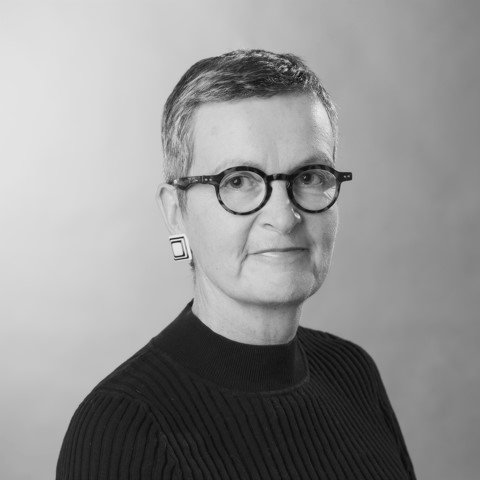
Professor Martha Hickey, The University of Melbourne
Martha is a world leading researcher in menopause and healthy ageing. She runs menopause services at the Women’s Hospital and has a particular focus on managing menopause after cancer. She cares for many BRCA1/2 patients and was struck by the complexity of their experiences and choices, and wished to try and represent these using art. She previously led the successful Flesh after Fifty art project focusing on positive images of older women.
Learn more
Sarah Powell, CEO Inherited Cancers Australia
Sarah Powell is the CEO of Inherited Cancers Australia, a patient-focused organisation that supports families with hereditary cancer risk. Affecting ~1 in 400 Australians, Sarah leads Inherited Cancer's vision to ‘Break the cycle of cancer in Australian families and start conversations that save lives.’ Sarah’s lived experience has led her to be both a researcher and a passionate advocate for improving the lives of the hereditary cancer community. She was diagnosed at the age of 29 with Triple Negative Breast Cancer and subsequent genetic testing revealed that she has a BRCA1 mutation. Being an inherited cancer risk individual herself, she understands the needs and challenges of the community, dedicating herself relentlessly to ensure all Australians ‘Know Their Risk’ so they can ‘Change Their Future’.
Learn more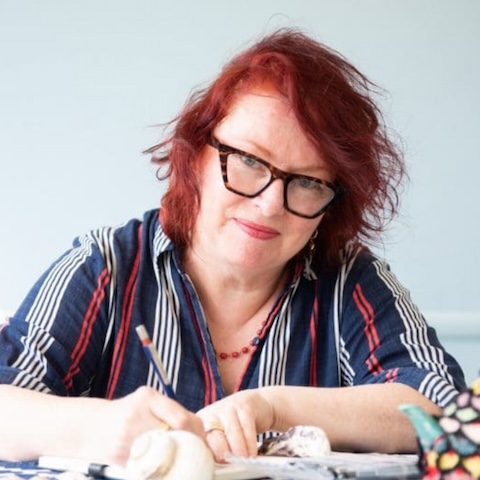
Deborah Kelly, artist
Deborah is a Sydney-based artist who works across disciplinary and geographical boundaries to produce artworks which encompass collage, installation, event and performance. Her projects are often collaborative and concerned with lineages of representation, politics and history in public exchange, and practices of collectivity on small and large scale, from epic to intimate, both fleeting and durational.
Learn more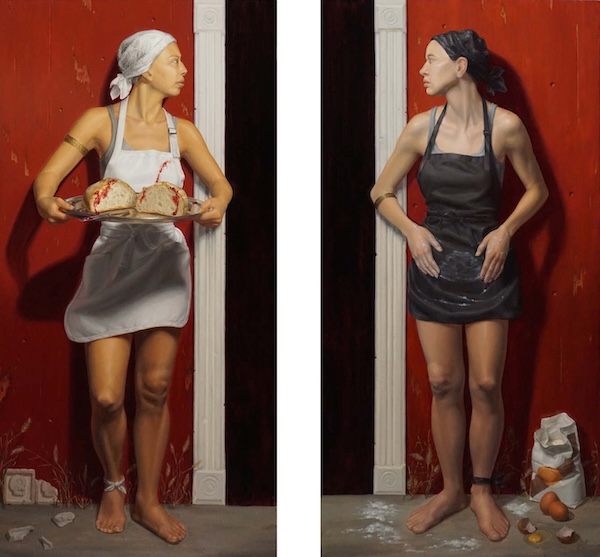
Sally Cochrane - 'BRCA diptych'
"This diptych was inspired by the two most common types of female cancers caused by the BRCA mutations: breast and ovarian cancer. A visual description of these cancers is embedded in a narrative of a bakery scene, where both figures look around a corner into the dark unknown. On the left, the bread is held at chest-level and "dissected" to look like mammograms, and the jam is spread to evoke the trauma of mastectomy. On the right the figure wipes flour from her hands in a pattern like an ultrasound image, used to detect ovarian abnormalities. I was inspired to use a bakery scene because bread baking is often considered a stereotypically feminine task, associated with nurturing and supporting a family, and these cancers are also primarily a burden that women bear."
Sally Fama Cochrane (b. 1988) is a classically-trained painter with a PhD in the History of Science from Princeton University (2023). Her work combines her fascination with science and medicine and her love of traditional realism through the use of symbolism and allegory in figurative painting, portraiture, and still lives.
There’s a story written in my genetic code, but I choose how the next chapter unfolds.
Creative Gene was part of the 2024 Being Human Festival, a festival of the humanities founded by the University of London in 2014. The University of Melbourne was delighted to once again serve as an international hub in 2024, supported by the Melbourne Public Humanities Initiative.