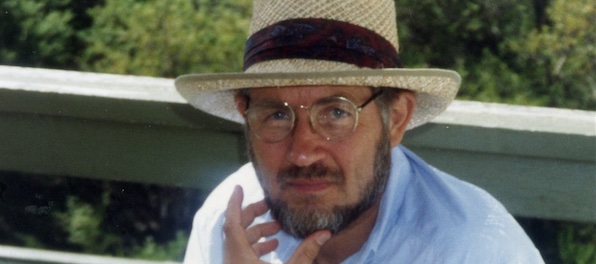
 Pictured: Peter Blazey
"Peter was someone with a lion's head of loose ends that could never fit into some ideologically sound and tidy space. Storyteller, mythomane, and one of the last great conversationalists in a country wary of the free flow of uncensored language, he was a comet who flashed his tail at everyone."
— Tim Herbert, OutRage, 1997
"Peter Blazey was a larger-than-life figure with a vital interest in politics of all kinds, a hectic energy and a creative curiosity that propelled his many friendships with other writers, artists and troublemakers."
— Clive Blazey AM, 2024
A life so lived as to outstrip all discretion
"A life so lived as to outstrip all discretion," reads the cherry-red pamphlet announcing the inaugural Peter Blazey Fellowship. Founded in memory of Peter Blazey (1939–1997) by his partner, Tim Herbert, and his brother, Clive Blazey AM, the award supports rigorous and generative works that aim to contribute to important conversations. Looking back on the last twenty years, Clive and his wife Penny tell me that they're "pleased that the award has proven a steppingstone to publishing success and to literary career-making, with a high number of writers going on to win critical acclaim for the books they created through this prize in Peter's name." Launching the fellowship in 2004, Hon. Michael Kirby noted:
"As we launch the Peter Blazey Fellowship … we acknowledge a man distinctive and memorable. A political activist. A political biographer. A political journalist. He saw both sides of politics. He tasted all sides of life. He pretended to be naughty and some churchmen called his nature 'intrinsically evil'. But for me, he was a good man."
A good man, a radical, a comet flashing his tail: one can find these and many other versions of the man in his memoir, Screw Loose, published posthumously in 1997. A propulsive, expansive and wickedly funny account of a life lived large, Screw Loose opens with Blazey's childhood in the 1940s in Melbourne's bourgeoisie and ends with diary entries leading to his death in Sydney in 1997 from AIDS-related illnesses. Herbert remembers Blazey writing the memoir up until the day he died.
As a child Blazey attended Scotch College, of which he dryly notes the college's commandments: "Keep Your Feelings to Yourself, and Always Go with the Crowd". He inevitably flouts both directives in socially and sexually conservative mid-century Melbourne, and Screw Loose brims with gay debauchery and clandestine romance. Attempting what he describes as "social acceptability", Blazey courted and became engaged to a Joanna O'Rourke, only to cancel the engagement nine days before the wedding (but not before her Afghan hound gobbled up his mother's wedding ring).
Throughout his life, he worked as a journalist for The Australian, Nation Review, National Times; in the 1970s he managed to convince the Editor-in-Chief of The Australian to run a four-page liftout titled Homosexuality in Australia in the Weekend Australian (recounting this in his memoir, Blazey remarks that Murdoch was "horrified"). He was hired as a press secretary for politicians Andrew Peacock and Moss Cass, and also published a handful of books, including a best-selling political biography of Henry Bolte, the longest-serving Premier of the State of Victoria.
In 1978, Blazey ran for by-election under the Gay Solidarity Group, with the slogan "Put a Poofter into Parliament"—six years before homosexuality was decriminalized in New South Wales. He won 108 votes and lost his deposit. Of the campaign, Blazey writes:
"I still believe that every act of gay visibility is good in itself and that my running Earlwood helped promote the issue in the public arena. Gay liberation is about personal resistance and public affirmation. It is one of the only ways we can beat the many forces which still want to keep us isolated, fearful and silent."
Peter Blazey at the University of Melbourne
Peter and Clive's mother, Lorna Blazey, was a student at the University of Melbourne, completing her Master of Arts on "Whimsy in Shakespeare" in 1938. Her sons followed in her footsteps. As a student at the University of Melbourne from 1959 to 1962, Blazey edited the Melbourne University Magazine, performed with the Melbourne University Dramatic Society, and was a committed member of the ALP Club. Blazey refers to the University as "the Shop", deems the English department "moribund and arcane". Striking now is Blazey's description of student life and government support for students. He describes the period:
"As students we may have been naive and idealistic, but we weren't impoverished. Postwar prosperity saw to that. Vacation jobs were plentiful and there were generous Commonwealth scholarships and new universities personally provided by our Prime Minister Mr Menzies. Clothes, books and booze were all cheaper while Marlboro cigarettes were a mere three shillings and threepence (later 33 cents) a packet."
Much has changed in the last sixty-five years. I'm not sure what Blazey would have thought of the government's education policies, of our current English department, or the cost of cigarettes. But it seems that across his fifty-eight years, he understood intimately that one needed resources in order to write.
Twenty years of the Peter Blazey Fellowship
Tim Herbert recounts that he "first approached Peter's dear friend Hilary McPhee, who encouraged me to work with the Australian Centre to set up the Fellowship. There were not many awards for biography or memoir twenty years ago and certainly none for a work-in-progress. Screw Loose was an ideal model and Peter's beloved brother Clive supported me in setting up the Fellowship."
For the past twenty years, the Peter Blazey Fellowship has been awarded annually, to further a work in progress for writers in the nonfiction fields of biography, autobiography and life writing. It was first awarded to Sara Hardy in 2004, for her biography of Australian landscape designer Edna Walling. In The Unusual Life of Edna Walling, Hardy writes:
"Fashions in garden styles come and go, yet most people can still be seduced by an Edna Walling landscape. There's something about the beauty, the line and contour, the sense of reverie one feels, just being there, breathing it in … Edna's spirit lives."
In a similar mode, the work that has eventuated from the Peter Blazey Fellowship often seeks to uphold the spirit and legacies of often unknown or under-celebrated subjects across time. Many of these subjects have been artists; in her biography of Australian photographer Olive Cotton, 2012 Fellow Helen Ennis describes Cotton's "unwavering belief in the value of a creative life and experienced first-hand the struggles and compromises that can threaten to destabilise or even destroy it." 2007 Fellow Judith Pugh's Unstill Life takes on the life of artist Clifton Pugh, but she also carefully pulls at her own life, alongside his: "It is so hard to look back and understand this of myself, but, after all, I had no reason to doubt. Life was filling up and there was much to do."
Several fellowships concern such complex work of looking back at one's own life. 2020 Fellow Ellen van Neerven's award-winning sports memoir Personal Score begins with an author's note: "I am not to scalpel you with the details but sing to you in poetry, and this is where these memories will rest." Receiving the prize, van Neerven says, "was a great honour. First of all, it allowed me to be connected to the special legacy of Peter Blazey and previous recipients. Importantly, it allowed me to dedicate time on my book Personal Score: Sport, Culture, Identity (2023). I encourage any writers with a work-in-progress of non-fiction life-writing to apply."
Though often anchored in this country, many of the works move across or query national borders. 2019 Fellow Sanaz Fotouhi's Love Marriage in Kabul traces her experience making a film in Afghanistan; 2010 Fellow Lily Chan's Toyo draws on pre- and post-war Japan to create a complex portrait of her grandmother. 2008 Fellow Dmetri Kakmi's memoir Mother Land begins at "land's end, gazing at the Aegean Sea". Back in Australia, and far from the coast, in her memoir When it Rains, 2009 Fellow Maggie MacKellar unknots her grief, dreaming "that the house is like a shore and the land around me is the ocean."
University of Queensland Press (UQP) Publisher Aviva Tuffield, who has previously judged for the Fellowship, says she admires the sheer "breadth of life writing" that the prize supports: "memoir, biography, creative nonfiction, cultural history and beyond." It is worth noting that all of the historical works that the Fellowship has supported have concerned this country's violent colonial history: 2018 Fellow Cassandra Pybus' Truganini; 2017 Fellow Eleanor Hogan's Into the Loneliness; 2015 Fellow Rebe Taylor's Into the Heart of Tasmania: A Search for Human Antiquity; 2006 Fellow Robert Kenny's The Lamb Enters the Dreaming.
Melbourne University Press (MUP) Editor Catherine McInnis, another former judge, tells me that the Fellowship is "a wonderful legacy, supporting Australian authors at a key moment in their writing." She points to the significant number of works supported by the Fellowship which have won literary awards. Tuffield also appreciates the strong emphasis on early development: "authors truly have the support and encouragement to pursue their visions, untrammelled by the need to fit a publisher's expectations." 2022 Fellow Dženana Vucic, who is currently finalising her manuscript, notes how the support of the Blazey has extended beyond her project, allowing her to travel for her research, as well as Bosnian language lessons, which "not only benefited my manuscript, but also gave me a closer and deeper connection to my history, to my home country, and to my community."
In 2013 Fellow Kim Mahood's Position Doubtful, Mahood writes that the object you hold in your hands is "not a book but a map. It is well-used, creased, and folded, so that when you open it, no matter how carefully, something tears and a line that is neither latitude nor longitude opens in the hidden geography of the place you are about to enter." This image of a map hidden and expanding cannot help but evoke Blazey's own legacy.
Looking back over the Fellowship's twenty years, Tim Herbert writes to me: "Almost all of those who have received the Fellowship have gone on to complete and publish their work. Often there's a familiar theme entailing marginalisation, stigma and the personal courage required to compel societal change. As a "78er", caught up in the riot that would become the first Sydney Gay and Lesbian Mardi Gras, Peter Blazey would be very pleased."