Universities in Ukraine under Attack: Associate Professor Galyna Piskorska Reflects on the War’s Impact on Students and Scholars
After Russia’s full-scale invasion of Ukraine in February 2022, Associate Professor Galyna Piskorska was forced to leave her native city of Kyiv; she found a temporary home at the Centre for Advancing Journalism in the School of Culture and Communication (SCC) under the Scholars at Risk program, and now remains as an Honorary Research Fellow in SCC. In this text, Galyna reflects on the impact the war has had on Ukrainian universities.
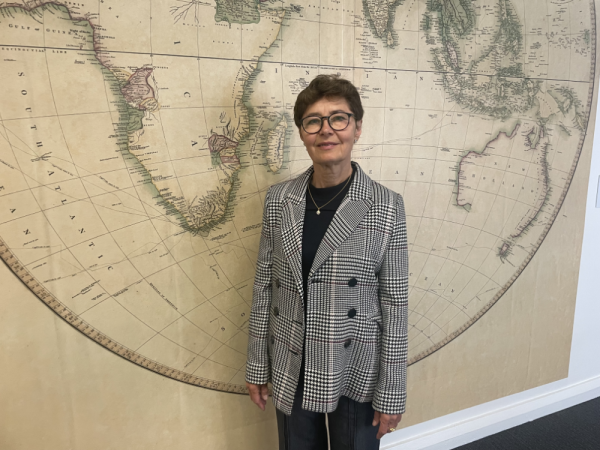
Pictured: Associate Professor Galyna Piskorska (Honorary Research Fellow, School of Culture and Communication). Photo by Nicole Davis.
The two years of Russia’s barbaric and unprovoked full-scale war against Ukraine have changed the world. The danger that this war holds for Ukraine and the world cannot be overstated. Russia has the world’s largest nuclear arsenal and threats to use nuclear weapons against Ukraine or Ukraine’s Western allies have become commonplace in Russian media. Meanwhile, a massive conventional war is underway. The front line is vast, about 1000 kilometres long. Close to one million soldiers are fighting on each side. There is no clear dividing line between Ukrainian soldiers and civilians in this war. Our enemy dominates the skies, subjecting our cities and villages to relentless bombardment, leaving behind a trail of devastation. Ukraine is fighting for its right to exist. And after Putin’s sham ‘re-election’ last month, there is no doubt that the war will continue.
Ukraine’s higher education system has been particularly vulnerable in this war: to date 63 percent of the nation’s educational infrastructure has either been destroyed or damaged. Some Ukrainian universities have found themselves in the middle of the active war zone, and one in five has been damaged beyond repair or destroyed, their staff evacuated. A campaign to obliterate Ukraine’s intellectual capital and resources is an integral part of Russia’s genocidal war. Ukraine’s National Academy of Sciences has called Russia’s destruction of Ukrainian universities an act of ‘scienticide’. As of March 2024, we know of at least 124 Ukrainian scholars who have lost their lives in the full-scale war. These are both well-established and emerging scholars of note.
I was forced to leave Ukraine in March 2022. The constant shelling and bombing in Kyiv, where I lived, made it impossible for me to continue my work. As I taught journalism for a long time, it was too dangerous for me to stay. Journalists were among the first to be executed in the occupied territories. They remain a highly vulnerable group. In Australia, I was fortunate to spend 12 months as a Senior Research Fellow at the Centre for Advancing Journalism in the University of Melbourne’s School of Culture and Communication under the Scholars at Risk program. The University of Melbourne, just like other Australian universities, expressed its solidarity for Ukraine in the early days of the war, offering help to scholars and students. After the Russian Union of Rectors published a statement of support for Russia’s invasion of Ukraine, the university severed its connections to the Russian Federation, including to its scientific and educational programs.
Ukrainian universities have been going through profoundly difficult times. In the first weeks following the full-scale invasion, all education was suspended, and universities were turned into evacuation hubs. When it became clear that Kyiv would not fall, universities resumed teaching, often moving their classes online. Many of our colleagues and students have been fighting in the army; many have lost loved ones and homes. Everyone has been impacted by constant air raids. Students are stressed about the safety of their families and anxious about Ukraine’s future, and yet the Faculty of Journalism at Borys Grinchenko Kyiv University where I teach has attracted a higher-than-usual number of students this academic year. The Dean of the Faculty has noted that while students used to choose a university based on its quality of education and its emphasis on innovation, now one of the key drawcards is a university’s commitment to students’ safety, its ability to move classes to bomb shelters and to provide reliable psychological support. The opportunity to participate in international projects is another important factor in the mix. For the past two years, my university has been reconceptualising its mission. It is no longer just a place of study – it’s also an island of stability, a haven and a hub for people who share the values of justice and humanism.
When Bucha and Irpin were occupied in the early stages of the full-scale war, and Kyiv was under the real threat of imminent occupation, it became clear that the Russian army was purposefully targeting TV towers, destroying media outlets, educational facilities and monuments, and murdering teachers, journalists and bloggers to stop the world learning about the genocide it was perpetrating in Ukraine. The work of Ukrainian journalists and the need to develop effective tools to counter disinformation have never been more crucial.
Overnight, journalists in Ukraine, my journalism students among them, became war correspondents, reporting from the front lines. Most of them never expected or wanted to be war reporters, nor were they trained in how to interview traumatised people or how to deal with trauma themselves. It’s impossible to reconcile the fact that young people, our students and colleagues, enlist to fight, many of them never to return home. They are the ones who should be rebuilding our country.
In Australia, I’ve been doing all I can to draw attention to the war in Ukraine and to the work of Ukrainian journalists. My position at the University of Melbourne – I’m currently an Honorary Research Fellow in the Arts Faculty, having completed a year under the Scholars at Risk program – has enabled me to gain and deepen new knowledge and connections, which, in turn, will contribute to the reconstruction of Ukraine’s tertiary sector when the war is over. At the Centre for Advancing Journalism, I have been doing research and delivering guest lectures and seminars on disinformation, propaganda, information wars and Russia’s war against Ukraine. I owe a great deal to my colleague at the Centre Lucy Smy for recognising the importance of my research and the need to counteract both the pervasive disinformation about Ukraine and its gradual forgetting in Australia. With the support of Professor Paul Rae, Head of the School of Culture and Communication, and Associate Professor Andrew Dodd, Director of the Centre for Advancing Journalism, together with my Ukrainian colleagues, I gave presentations on the role of Ukrainian journalists in our country’s fight for survival at the two annual conferences organised by the Journalism Education and Research Association of Australia (JERAA).
On the first anniversary of Russia’s full-scale invasion, I took part in an event ‘With Ukraine: One Year On’, organised by Dr Olga Maxwell (SOLL), Associate Professor Julie Fedor (SHAPS) and Associate Professor Maria Tumarkin (SCC). Our focus was the role of universities in times of war. The event, held in the Forum Theatre in Arts West, was a sell-out. It was opened by Professor Tony Birch, Boisbouvier Chair in Australian Literature, who welcomed Ukrainians displaced by war to Australia and urged them to tell their stories and the stories of their ancestors. Journalism students from Borys Grinchenko Kyiv University, Evgeniya Horbunova and Yana Mytsko, spoke, via recordings, about their lives before and during the war and shared their thoughts about the role of journalism. Our history, they said, is Ukraine’s fight for its future.
Evgeniya Horbunova (journalism student, Borys Grinchenko Kyiv University):
Yana Mytsko (journalism student, Borys Grinchenko Kyiv University):
Marko Pavlyshyn, Emeritus Professor of Ukrainian Studies at Monash University, spoke about the need to defend the rights of Ukrainians to remain Ukrainians. From the first days of the full-scale invasion, Professor Pavlyshyn has been urging Australia’s academic community to offer its wholesale support to Ukraine. Together with Professors Mark Edele and Margaret Cameron, he played a key role in establishing the Mykola Zerov Fellowship in Ukrainian Studies in the School of Historical and Philosophical Studies, funded by the Ukrainian Studies Support Fund of the Association of Ukrainians in Victoria.
In what was an eye-opening part of the two-year anniversary event, Ukrainian academics, most of whom are still in Ukraine, spoke about the vital role of Ukrainian universities in supporting our country’s fight for survival: Professor Natalia Kudriavtseva (Kryvyi Rih State Pedagogical University), Dr Yevhen Zakharchenko (School of History, V. N. Karazin Kharkiv National University), Professor Olena Hurko (Oles Honchar Dnipro National University). The audience also heard from Ada Wordsworth from the Kharkiv and Przemyśl Project (KHARPP) and the University of Oxford.
Prof. Natalia Kudriavtseva in conversation with Emeritus Professor Marko Pavlyshyn:
Dr Yevhen Zaharchenko (School of History, V. N. Karazin Kharkiv National University):
Ada Wordsworth (KHARPP – The Kharkiv and Przemyśl Project / University of Oxford):
On the second anniversary of the whole-scale invasion, my University of Melbourne colleagues organised a screening of 20 Days in Mariupol. This documentary about the first three weeks of the war, directed by Mstyslav Chernov, received the first Oscar in Ukrainian history. The screening was introduced and hosted by Hanna Manoilenko, a Ukrainian postgraduate student undertaking her PhD at the University of Melbourne. Hanna is from Kyiv like me, with her entire family still in Ukraine.
In this third year, we have entered a war of attrition. Whoever has more resources and support will win. Should Ukraine lose, the country will face not only the loss of political sovereignty but also the catastrophic destruction of much of its population and of its linguistic, cultural and religious identity. In this third year, we have come to understand that war can happen anywhere at any time.
A lecturer’s biggest gift is their students – their capacity to think for themselves, their ability to learn and grow and to interpret and respond to the world around them. The young people of any country, at any university, are always especially vulnerable to propaganda and disinformation. It is our responsibility to support them in developing critical filters, the capacity to distinguish between truth and disinformation and to understand the nature and causes of crises and conflicts.
Ukraine and Australia share common values. This means a great deal at this time of global upheavals. For my colleagues and students in Ukraine, the ability to collaborate with Australian scholars and students is a lifeline. I urge my University of Melbourne colleagues to consider undertaking collaborative research and organising joint classes, conferences and seminars across disciplines. Ukraine continues to show what it means to believe in values of justice, sovereignty, democracy and truth and to defend these values in the face of massive existential threat. Injecting energy, ideas, resources and imagination in building strong ties with Ukrainian universities makes a real difference to Ukraine’s ability to continue resisting Russia’s aggression and to rebuild in the future.