Dr Jane Carey awarded 2025 Ernest Scott Prize
The Faculty of Arts at the University of Melbourne is pleased to announce Dr Jane Carey as the winner of the 2025 Ernest Scott Prize.

Pictured: Dr Jane Carey. Image supplied.
The Ernest Scott Prize for History is awarded annually to a book based on original research judged to be the most distinguished contribution to the history of Australia or New Zealand or to the history of colonisation. The 2025 prize was judged by Professor Linda Bryder, University of Auckland and Professor Penny Edmonds, Flinders University, who selected the winner from 43 publications.
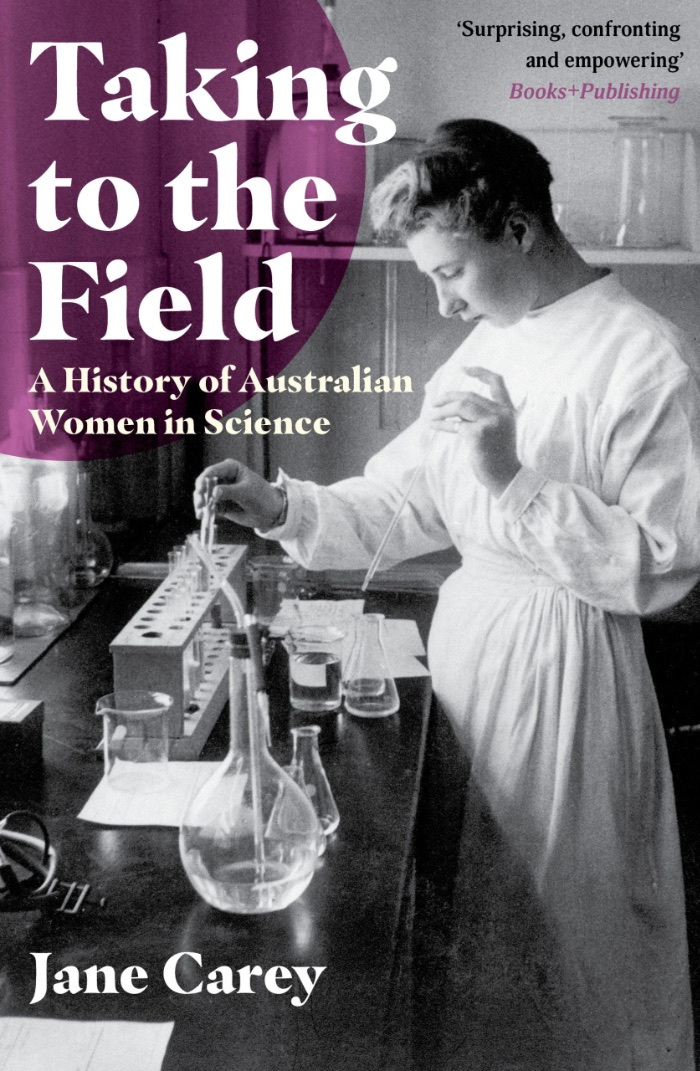
In awarding the prize to Dr Jane Carey for her book Taking to the Field: A History of Australian Women in Science (Monash University Publishing, 2023) the judges said:
"When molecular biologist Elizabeth Blackburn became the first Australian woman to receive a Nobel Prize in Physiology or Medicine in 2009, she was heralded as 'a pioneer for women in the field'. In this landmark and meticulously researched book, Carey challenges this pioneer status through uncovering a long and significant history of Australian women's scientific endeavours stretching back to the 1830s. Writing with clarity and elegance, she convincingly shows that women's contributions were indeed essential to the very foundation of Australian science. Until now, however, their histories remained untold; histories of science largely overlooked women, and women's histories focused on their exclusion or marginalisation in science.
"This book provides a wide-ranging exploration of the richness and diversity of women's engagement in Australian science over time, ranging from amateur science (natural history, botany and 'colonial anthropology'), to involvement in a range of scientific social-reform movements such as eugenics, to scientific occupations. It does not, however, suggest a continuous upward trajectory in science from exclusion to acceptance; with the post-Second World War era being one in which their contributions shrank markedly. Carey reveals the various forms of discrimination faced by women in science, and their lack of equal employment opportunities with men, evidenced by her interviews and surveys of over 300 women science graduates. This is a truly impressive and significant history contributing to women's history, the history of science, social movements, and to the history of colonisation. Challenging presumptions about women scientists, the story told here is core to promoting women in science in the future."
In accepting the prize, Dr Jane Carey said:
"I am deeply honoured that Taking to the Field has been awarded the 2025 Ernest Scott Prize. At a time when the humanities in general and history in particular seem to be under siege, having awards such as this that support historical scholarship on Australia and Aotearoa New Zealand, and histories of colonialism, has never been more vital.
"I would like to thank the judges for the time they devoted to this award and their engaged reading of the book. Many thanks to my publisher, Monash University Publishing, for all their support and the outstanding work they do in supporting scholarly publishing generally. To the more than 300 women who shared their experiences of studying and working in science with me, most of whom are no longer with us, I am profoundly grateful.
"In this book I sought to document the long and strong history of Australian women in science – despite the barriers and discrimination they faced. But it is not just a celebratory recovery of forgotten pioneers. The impact of Western science has not been uniformly positive and women were certainly associated with some of its darker episodes. Holding these two things in productive tension provides, I hope, greater understanding and a firmer foundation for more women in science into the future."
A special commendation went to the following outstanding writer:
Dr Geraldine Fela, Critical Care: Nurses on the Frontline of Australia’s AIDS crisis (UNSW Press, 2024)
"In this excellent work, Dr Geraldine Fela offers a new perspective on the history of the AIDS epidemic in Australia through the lens of nurses and their critical activism and care for HIV/AIDS patients. This lucid and engagingly written book is an important social, cultural and health history. Existing scholarship and popular narratives on the epidemic have focused primarily on the role and activism of community organisations, with nurses being largely invisible in the accounts. Fela uses oral history to explore broader themes balanced with personal stories, inevitably difficult and some heart-breaking but sensitively told. She deftly explains how AIDS nurses, some of whom were themselves from the LGBTQ+ community, helped to move public health strategies away from the traditional 'test and contain' medical model to infection control policies based on universal precaution regardless of suspected or confirmed infectious status. This advocacy and activism occurred within the context of existing LGBTQ+ activism in Australia, and through the close relationships that had developed between trade unions and social movements. Fela shows how nurses, their unions and affected communities worked together to argue that communities themselves should be given the knowledge, tools and resources to protect their health. This history has important policy implications for the future."
Shortlisted books (alphabetical order by author)
Dr Katie Cooper, Rēwena and Rabbit Stew: The Rural Kitchen in Aotearoa, 1800-1940 (Auckland University Press, 2024)
Professor Noah Riseman, Transgender Australia: A History Since 1910 (Melbourne University Press, 2023)
Professor Angela Wanhalla, Dr Sarah Christie, Emeritus Professor Lachy Paterson, Dr Ross Webb and Dr Erica Newman, Te Hau Kāinga: The Māori Home Front during the Second World War (Auckland University Press, 2024)