Interview with filmmaker Felipe Gálvez on 'The Settlers'
Dr Cristóbal Escobar, Lecturer in Screen Studies at the Faculty of Arts interviews Felipe Gálvez on his debut feature film The Settlers.
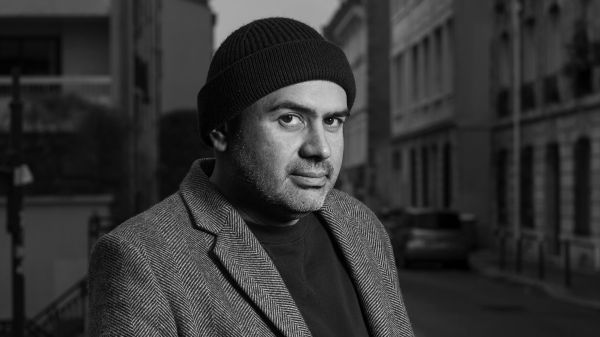
Pictured: Filmmaker Felipe Gálvez. Source: Oscar Fernández Orengo.
Synopsis (The Settlers)
Chile, beginning of the 20th century. A wealthy landowner hires three horsemen to mark out the perimeter of his extensive property and open a route to the Atlantic Ocean across vast Patagonia. The expedition, composed of a young Chilean half-blood, an American mercenary, and led by a reckless British lieutenant, soon turns into a “civilizing” raid.
Interview with filmmaker Felipe Gálvez by Dr Cristóbal Escobar and MK2 Films
Dr Cristóbal Escobar: Why did you decide to do a film on the colonisation of Chile and tell this particular episode of history?
Felipe Gálvez: The events in the film are not part of the official version of Chilean history. They are not included in the school curriculum either. I’d never heard of the genocide of the Selk’nam people, whom the whites in our country refer to as the Ona. I read about it fifteen years ago in an article that mentioned the hidden reality of the genocide. Also, in school, we learn the history of Chile up until 1973. There is no mention of the military dictatorship that followed. There is still no official version of the history of the authoritarian regime. Is telling that story a worthwhile endeavour? And, more importantly, how does one go about telling it? These questions led me to think about the earlier events, at the start of the 20th century, that were discounted as well. What happens to a country when an entire page of its history is erased? Why not look back to that other episode, some one hundred years earlier, rather than the present-day deletion of the military dictatorship? What interested me in all of this, and what I was going for with my film, was to show how the history of a population that has disappeared has become part of a national narrative. The film is rooted in that reality, and in that paradox.
Dr Cristóbal Escobar: Did you and Antonia Girardi conduct extensive research while writing the screenplay? Did the characters in the film actually exist?
Felipe Gálvez: The film is a mix of real and fictional characters. President Montt and Menéndez really existed. Nearly all of the land featured in the film belongs to this day to the descendants of the Menéndez family who settled in Chilean and Argentine Patagonia. The end credits feature a number of pictures of the family, including the real José Menéndez, played by Alfredo Castro in the film. Menéndez’s foreman, Chancho Colorado, is a real-life character. MacLennan, who is also seen in some of the photographs, is a legendary figure in Chile today. Moreno, the man appointed to draw up the border between Argentina and Chile, is a factual character as well. We also know that the judge, Waldo Seguel, was dispatched to Punta Arenas at the end of the 19th century to carry out the first investigation into the slaughter of the indigenous populations. These initial legal proceedings, which never came to anything, were discovered some twenty years ago by a pair of Chilean anthropologists who located and transcribed the original records of the investigation. Hundreds of testimonies recount the slaughter and persecution of the native populations, but no convictions were ever made. The film’s characters were inspired by that story, by the testimonies and interviews contained in the recently recovered archives. But the idea was to produce a fictional story, as well. The film drew its inspiration from novels, popular legends, paintings, and cinema, and not just from these events alone. The Settlers isn’t a true reconstruction of history. Rather it is a reflection on how fiction, and especially cinema, can modify and distort it, and even rewrite it.
Dr Cristóbal Escobar: The colonisers of Latin America are generally associated with the 16th-century conquistadors of Spain. Your narrative of colonisation is set much later, at the onset of the 20th century…
Felipe Gálvez: We are all familiar with the conquistadors of the 16th century, and the barbarity of how they imposed their model of civilisation on indigenous populations. Today these accounts are included in the official version of Chilean history, explored in works by writers, historians, and artists. But one of the unique perspectives offered by the film is the idea that we, the Chilean people, were colonisers in our own land. How do newly formed countries forge national identities? And why does the horror of conquest repeat itself, inflicted, in this case, by the Chileans and not the Spaniards? There are few accounts of this period of history in Chile. In Argentina, the military’s extermination of the indigenous populations, ordered by the army general and president, Julio Argentino Roca, has been thoroughly documented. In Chile, the slaughter of the indigenous peoples, perpetrated by the ranchers of Tierra del Fuego and indirectly supported by the Chilean government, has been expunged from the country’s official history. The events are never mentioned. They were entirely hushed up. I was interested in portraying the settlers as ordinary people. In reality, the colonisers were poor, ignorant, and uncouth. They were not heroes. There are no heroes in my film, but rather a diversity of perspectives that force the viewer to take a stand, to decide which characters they can either relate to or reject.
Dr Cristóbal Escobar: The story is told in two parts, over two time periods, and in two distinct registers. First, the exterior scenes, with the expedition of three characters on a mission – to conquer land and exterminate the indigenous populations – and in the end, the characters in their respective homes: Menéndez in his grand residence in Punta Arenas, and the mestizo Segundo, a member of the expedition, with his wife in their simple hut on Chiloe Island, farther to the north.
Felipe Gálvez: I wanted the first part to take place outdoors: a journey on horseback in the company of three characters whom we either empathise with or disprove. And through them, to show the different perspectives and mindsets of the colonists, depending on the responsibilities and authority of each. This is why the story opens with Menéndez, who is the driving force behind everything that happens in the film, and why it ends with him in his home, where the wealth he acquired from his large land and sheep holdings, built on acts of barbarity and death in the name of “civilization”, is clearly visible. The breathtaking landscapes with their bright, bold colours are left behind as we enter a dark and frozen interior.
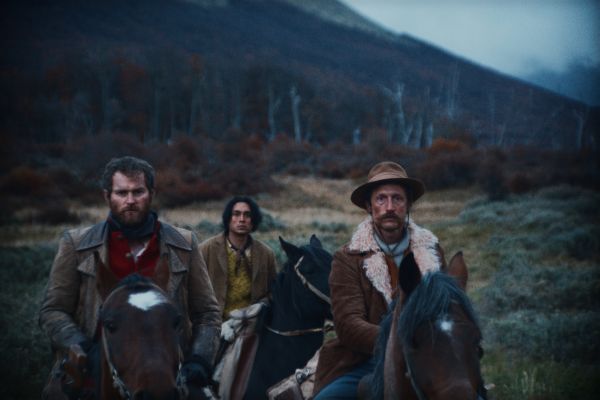
Pictured: Still from 'The Settlers' (2023). Source: Quijote Films and Rei Cline.
Dr Cristóbal Escobar: The mercenaries and bounty hunters are of different origins. Bill is North American and fought the Comanches. MacLennan, on the other hand, is from the British army.
Felipe Gálvez: Prior to the opening of the Panama Canal in 1914, the only passage from the Atlantic to the Pacific Ocean was in the region. Tierra del Fuego attracted numerous foreigners of many different nationalities. The landowners and sheep farmers needed labour, and they imported it: Bill, who had worked as a cowboy in Texas, was among them. Bill represents the New World. And MacLennan, the Old World. Bill may or may not be more racist than the others, but unlike them, he doesn’t try to hide it. Their mission is clearly to kill the natives. It was part of the territory’s “cleansing”, to make way for the development of livestock breeding. The extermination of the native populations was tied to the preservation of the sheep farming economy, and therefore to the interests of the farmers. Anything that could potentially kill or eat a sheep, whether a wild animal or indigenous person, had to be eliminated.
Dr Cristóbal Escobar: Segundo, who is half Mapuche and half Spanish, is on the wrong side of history. He at once betrays his people and his origins and is a victim of the racism of the bounty hunters, and Bill’s, in particular. This explains Segundo’s uneasiness during the massacre and rape scenes. He is the witness of what was done to the indigenous peoples, the living memory of the tragedy, of the genocide…
Felipe Gálvez: Mestizos were part of the colonisation process. His role, as guide and scout, is true-to-life. Segundo’s position and point of view add a layer of complexity to it all. I needed him to be young. His mother, a Mapuche, was likely to have been raped by a Spaniard. Segundo, who has a Spanish given name, is at once the offspring of a victim of colonisation and is the child of the conquest. The other characters’ actions are seen through his eyes. We empathise with him. He makes it possible for us to grasp the horror. He is travelling over lands whose ancestral inhabitants are being killed. The inner conflict he faces as a half-white and half-indigenous person allows him to understand his place in the world. I see his return to Chiloe and his renewal with the indigenous way of life – he does not have a horse; he lives from fishing – as a return to the motherland. For me, it is connected to his maternal lineage. The path he follows, considering his mixed descent, can also be seen as a personal journey, and his experience of the tragic events, as a quest for identity.
Dr Cristóbal Escobar: The film makes ample use of violence, graphic violence that is. But at the same time, the worst massacre in the film is recounted, but not shown. Segundo describes it to Vicuña, who doesn’t take any action.
Felipe Gálvez: That is the other violent reality, that of the authorities who, after accepting the slaughter of the native populations, deny them their history, which is deliberately erased. Segundo bears the full brunt of it, first as a witness and then when Vicuña turns a deaf ear to the horror of his account. In a way, he is the viewer’s double... Who commits the greatest acts of violence in the film? That’s an interesting question, and the answer may well vary depending on the viewer. The closing scene, when Vicuña is shown directing Kiepka for his film, could be perceived as particularly violent. Violence can be physical and thus made visible to the naked eye, but it can also take on other forms, like the violence suffered by Kiepja when Vicuña forces her to behave in an unnatural way. Vicuña owns the camera and has the power to rewrite history. He doesn’t care what happened to the native populations. He just needs to capture their image. We are less used to seeing this kind of violence than we are to the other.
Dr Cristóbal Escobar: How do you think The Settlers will be received in Chile?
Felipe Gálvez: I like to think of The Settlers as a film that reflects the present by recounting a story from the past. I am very eager to see how the closing scene will be received in Chile, and how the character of Kiepja, who changes her name to Rosa when she is in a relationship with Segundo, will be interpreted. I have the feeling that her character, to Chileans, is the embodiment of a long- standing debate. A deep wound.
Dr Cristóbal Escobar: This is your debut feature film – tell us a bit about your background and how you came to filmmaking…
Felipe Gálvez: I am a passionate cinephile, completely in love with cinema. I studied at the Universidad del Cine in Buenos Aires, where I was lucky enough to share my time with a generation of Latin American filmmakers who have become great friends for life. My formation comes from that place, from watching films and discussing them with them. Almost 15 years ago, I started working as an editor. The idea of cutting, pasting and erasing is something I am deeply obsessed with in film. I love creating narrative devices and artifacts that have an original structure. Through editing, I learned how to write screenplays and direct. Filmmaking is a craft that is passed down, and from every film I've edited, I've learned something new.
Dr Cristóbal Escobar: The cinematography is particularly striking – how did you work with your DP, and what were some visual inspirations for you?
Felipe Gálvez: The first thing I need to write in a story is an image that obsesses me. Black and white photographs of men killing Selk'nams struck me with their brutality. At first, I had the urge to make a black and white film, as I felt that this removed history did not exist in colour. However, along the way I discovered that black and white put me in a realistic place. My goal was to make a film that talked about cinema as an artifice, and to question the idea of truth that cinema sometimes proposes. That's why I decided to base it on the first experiments in colour photography. Together with cinematographer Simone d'Arcangelo, we started by building the colour palette from the wardrobe and, with that premise, we began to work on the image of the film. We wanted to create something particular and visceral that would transport the viewers to that moment in history and provoke a strangeness in them. We were not looking to be precious, but to build a different image. That's why we chose the aspect ratio 3:2, the new full frame of digital cameras, which refers to photography and also to the Western and its need to always be using the latest technology of its time.
Dr Cristóbal Escobar: The locations in the film are stunning as well, where did you shoot in Chile and how did you select them?
Felipe Gálvez: The Settlers was filmed in Tierra del Fuego, an island in Chile that we consider the end of the world. It's a beautiful but inhospitable place. Tierra del Fuego is still mostly owned by the Menendez family to this day. We looked for locations where we could work with some comfort. Although the landscapes are beautiful, being there is quite hostile. We tried to build a picture of the island by filming only a small part of it. As we searched for locations, new scenes came up in the film. For me, the script is always finished on location. You arrive on set with a guide, but it's there, in the territory, with the actors and the whole crew, that you finish writing a scene. The first idea was always to start on location with the construction of the fences, then to film forests and the sea. The film had to start in yellow, go to green, pass through blue and end in red.