Hazlitt’s inky stars
4th Floor Linkway, John Medley Building, University of Melbourne.
MapShare via
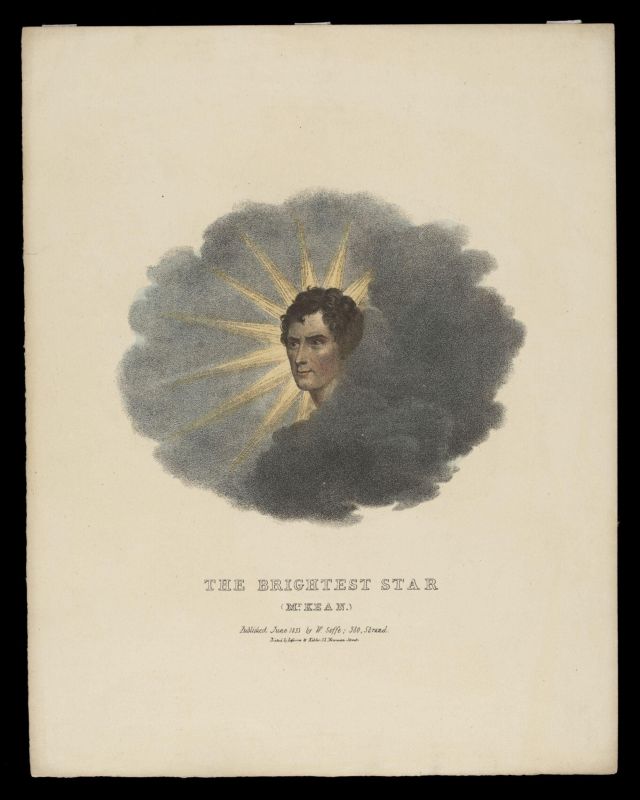
Hazlitt’s inky star: ‘all that we are, all that we wish to be, and all that we dread to be’ (William Hazlitt, ‘On Actors and Acting’, 1817)
Clara Tuite (University of Melbourne)
- Wednesday 9 September, 4.00-5:30pm
- 4th Floor Linkway, John Medley Building, University of Melbourne
Abstract
From 1812-1830, across hundreds of theatre reviews and essays in newspapers, magazines and reviews, and several full-length volumes, Romanticism’s most important theatre critic, and one of celebrity’s most perceptive theorists still, William Hazlitt (1778-1830) illuminated celebrity at its moment of emergence as a uniquely modern form of fame and as an acutely temporal form of social, cultural, and emotional life.
My paper explores how Hazlitt’s writings on theatrical celebrity in Regency London sustain what Jonathan Mulrooney memorably refers to as ‘the tension between theater’s eventful impermanence and its lasting textual remainders’ (Romanticism and Theatrical Experience, 3). Lovingly curating the often ambivalent reputations of ‘theatrical favourites’, Hazlitt’s reviews created a pantheon of stars who linked the world of the playhouse (and its stage, sweat and greasepaint) with theatre’s inky print-cultural world (that mixed text and image), of periodicals, play-bills, posters, actors’ portraits in the ‘greasy ink’ medium of the lithograph and as decoupage pieces cut, glued and mounted (on Byron’s folding screen).
Hazlitt’s darkest, inkiest, most scandalous, and most beloved star was Edmund Kean, the mercurial outsider from the provinces, whose special form of illumination were the ‘flashes of lightning’ that made ‘darkness more terrible’ (‘On Mr. Kean’s Iago’), administered to audiences through dazzling ‘electrical shocks’ (‘Mr. Kean’s Richard II’) as he ‘went through the different exploits of wickedness’ (‘The Libertine’). Hazlitt was the first critic to appreciate Kean’s talent, his own career poignantly entwined with Kean’s, whose debut as Shylock in January 1814 at Drury Lane, bringing him overnight fame, coincided with Hazlitt’s debut as a regular theatre critic with ‘a situation’ for The Morning Chronicle newspaper and for Leigh and John Hunt’s radical weekly The Examiner.
In such ‘a situation’, Hazlitt’s extraordinary reviews were as wondrously off the charts as the theatrical turns they commemorated—taking on mesmerising lives and afterlives of their own.
Clara Tuit