The See Yup Temple 四邑關帝廟: Chinese Australian collections, recovery, conservation
Case study introduction
On February 17 2024, a fire devastated Melbourne’s 1866 See Yup Temple, Melbourne’s oldest Chinese temple, severely impacting its main hall and its material culture, and the Asian Australian community. The recovery and conservation of the temple is well underway, and a temporary altar to the temple’s god Kwan Tai is in place for worship. But the severity and complexity of the damage means there is important community consultation, decision making and building works still to do. It will be some time before the necessary repairs and the temple is fully restored, and enough funds are in place to do this work.
What we’re interested in
The temple stands as a vibrant symbol of how Chinese religious and cultural practices were sustained, adapted, and integrated into the multicultural fabric of Australian society. Through its living and material heritage, the See Yup Temple continues to embody the resilience of the Asian Australian community and its enduring contribution to Australia’s diverse cultural landscape.
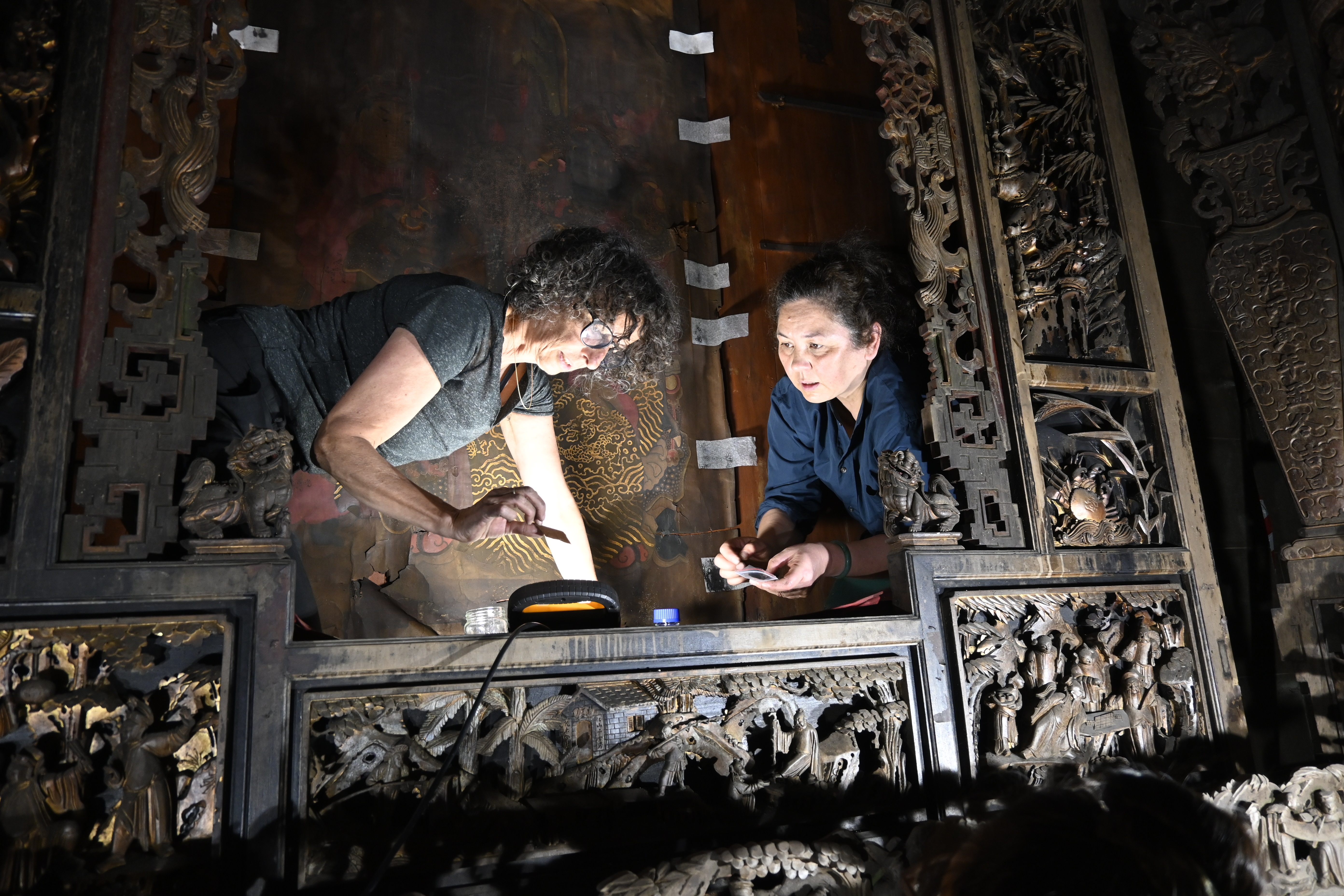
Image: Danni Lin.
Our approach
In response to the fire and to preserve the fire affected Chinese-Australian collections, the Robert Cripps Institute for Cultural Conservation was urgently engaged in a collaborative conservation and education project. Under the supervision of Associate Professor Nicole Tse, the project has assembled a team of conservation students, historians, scientific specialists, and community volunteers, and were recently awarded an ARC Discovery Project to learn more and support the reconstruction of the See Yup Temple ritual collections.
The See Yup Temple project stands as a critical example of integrating post-disaster recovery with heritage education. Through the integration of cultural and material conservation methods, creative educational programming, multilingual outreach, and inclusive community participation, the project aims to conserve material heritage and also revitalise the temple’s living cultural practices. The project’s approach emphasises the importance of balancing technical conservation needs with respect for religious functions and community ownership of heritage narratives.
Key participants include academic staff and students, the See Yup Temple’s recovery project team, caretakers, heritage professionals and government, and broader local Chinese-Australian community representatives.
Research aims
- To examine how disaster recovery and conservation actions can contribute to the social and economic reconstruction of living heritage and religious temples.
- To experience how conservation interventions can sustain tangible materials and intangible cultural practices, ensuring that living religious and community functions continue alongside technical recovery.
- To propose a replicable, community-centered and transnational framework for post- disaster recovery, adaptable to resource-constrained heritage contexts.
- To investigate how early-stage heritage education and relational communication can strengthen community resilience and cultural continuity following heritage disasters.
- To provide the next generation of cultural conservation professionals deep research and training opportunities at the Cripps Institute.
Key activities
Early Achievements
- Recipient of 2026 Australian Research Council Discovery Project ‘The See Yup Temple: Chinese Australian collections, recovery, conservation’ with Tse, N (Lead CI), Eckfeld, T, Soon, S, Kyi, C, Zhu, Z, & Yang, H
- AICCM Outstanding Volunteer Award for the See Yup Temple Recovery Project, 2025, awarded to Mollie Liu, Danni Lin, Hernan Lopera, Zeejay Tan, Lucinda Papas, Laura Jane Delaney, Ameliah Rose Tioriori, Yori Akbar Setiyawan, Jiahe Yi, Mengxuan Zhang, Satriyo Wibowo, Sarah Johnston, Brigid Stapleton, Chuqing Huang, Ju-Wei (Rita) Hsu, Debbi Min, Hannah Berry, Qianyu Tang.
- Tse, N and Lin, D ‘From Ashes to Stories: Innovative Heritage Education and Post-Fire Conservation at the See Yup Temple’, awarded a 2025 Global Award for World Heritage Education Innovative Case (AWHEIC UNESCO) World Heritage Institute of Training and Research-Asia and Pacific , 8 July at the UNESCO 47th Session of the World Heritage Committee in Paris.
- Mollie Liu featured on SBS Chinese
- 2025 National Library Australia Cultural Heritage Grant, ‘See Yup Temple and Training’, submitted by the See Yup Temple
- 2024 Tse, N, Couchman, S, May, A, Kyi, C, Soon, S & Lam, M ‘The See Yup Temple: A site of reconstruction and collective care’, Centre for Contemporary Chinese Studies, University of Melbourne
- 2024 Mollie Liu Presentation to the UoM Advancement Heritage Society Luncheon, Melbourne Connect, University of Melbourne.
- 2024 Mollie Liu and students, Willem Snoek Award, Grimwade Centre for Cultural Materials Conservation, Faculty of Arts, UoM
- 2024-25 Mollie Liu Hansen Little Public Humanities Award, Faculty of Arts, UoM
- Couchman, S, Beeston, J and Tse, N ‘: 'See Yup Temple: The Next 170 Years' at See Yup Temple, 76 Raglan St, South Melbourne from 16 February 2026.
- Lin, D 2026-2029 ‘Lives of the artefacts: Ritual practice, material biography, cultural memory and post-disaster heritage in Chinese Diaspora Temples’, PhD candidate, Robert Cripps Institute, University of Melbourne.
Get in touch with the research team
- nicoleat@unimelb.edu.au