Researchers and advocates set to track the true extent of poverty
In August 1975, the Henderson Inquiry First Main Report was officially released in Parliament. Spearheaded by Professor Ronald Henderson and his colleagues at the University of Melbourne, one of the key outcomes of the Inquiry was establishing an income-based poverty measurement tool – the Henderson Poverty Line – to identify those who are income poor.
Although 2025 marks the 50th anniversary of the first major report of the Henderson Review, Australia still does not have a nationally agreed definition of poverty or agreed indicators to track progress.
Addressing this gap is the focus of ‘Defining and measuring poverty’, a project currently underway as part of the longstanding partnership between the University of Melbourne and the Brotherhood of St. Laurence.
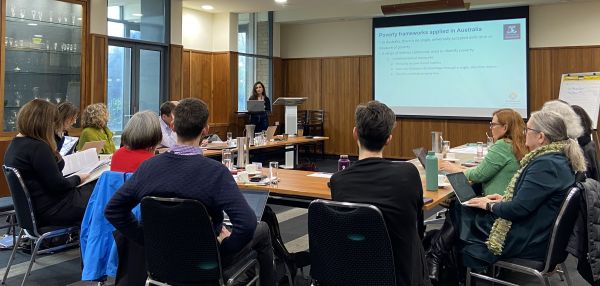
On Tuesday, 16 July the Melbourne Institute of Applied Economic & Social Research and Brotherhood of St. Laurence co-delivered a roundtable discussion that was co-funded by the School of Social and Political Science, the first of a series of events drawing together researchers from key disciplines and institutes with the express focus of addressing this gap in policy.
The roundtable co-sponsors were Dr Travers McLeod, Executive Director of the Brotherhood of St. Laurence, and Prof Roger Wilkins, Deputy Director of the Melbourne Institute.
‘It’s vital that we develop a future-focused definition for poverty in Australia that reflects the real life experience of Australians,’ said Travers.
‘Without a definition and a set of measurable indicators – factors that influence poverty levels in Australia – we lack the foundation required to invest meaningfully in those experiencing disadvantage or even to begin understanding the true extent of poverty – not just in terms of numbers, but also the impact on individuals and families doing it toughest.’
The roundtable brought together academics and advocates from the Brotherhood of St. Laurence’s Social Policy and Research Centre; the University of Melbourne’s Melbourne Institute, Melbourne Disability Institute, Indigenous Knowledge Institute, Melbourne School of Population and Global Health and School of Social and Political Sciences; Australian National University’s Children’s Policy Centre, as well as the Centre for Community Child Health and Murdoch Children's Research Institute, both at the Royal Children's Hospital.
‘We have seen the pressures on Australians change dramatically since 1975 when the Henderson Poverty Line was adopted,’ said Roger.
‘For example, access to key services and opportunities that are essential to an acceptable standard of living – such as running water, adequate healthcare and appropriate employment – are not captured if we measure poverty using only household economic income.’
Dr Nicole Bieske, event co-facilitator and Director of the Brotherhood of St. Laurence’s Social Policy and Research Centre, said that identifying people who are most disadvantaged and also those at risk of poverty, requires a transdisciplinary approach that reflects the complexity of factors such as cultural background, migrant status and disability.
‘We’ve also seen a shift in the typical family unit between 1975 and now – the breadwinner model that was so common then, with a single income that supported a traditional family unit of two parents and children, doesn’t reflect the experience of the majority of Australians in 2024,’ she said.
A key outcome of the project will be twofold; a proposed definition of poverty in Australia and a proposed set of indicators developed by experts across disciplines. The approach will be tested and validated through a process that includes a symposium later this year.
‘Based on any given measure, progress toward addressing poverty levels in Australia has remained stubbornly stuck for over two decades,’ said Travers.
‘It’s time we changed that. Our hope is that the work under this project will not only inform policy and practice, but will enable a more targeted approach to reducing poverty through meaningful investment and tracking progress toward goals.’
Questions: Dr Jennifer Frean, jfrean@unimelb.edu.au; Chris Black, chris.black@bsl.org.au