2026 Melbourne Critical Theory Winter School - Structure and Action: Psychoanalytic Theory Now
Share via
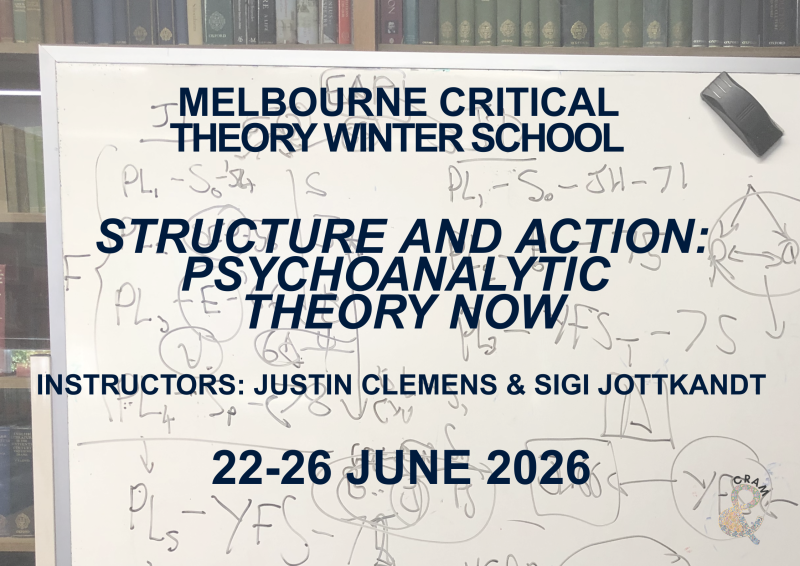
Structure and Action: Psychoanalytic Theory Now
22 - 26 June
University of Melbourne, Parkville Campus
The CRAM Critical Theory Winter School is an annual event that takes up a pressing topic confronting contemporary critical theory and philosophy. The 2026 Winter School, taught by Sigi Jöttkandt and Justin Clemens, will interrogate the conditions of action within the structures of our contemporary situation.
‘Structure and action’ is the most enduring of psychoanalytic preoccupations. Under what conditions, asked Jacques Lacan, do actions 'give the lie' to the structures upon which they operate? How has such action been misrecognised in the past, and to what extent must it remain so for the sake of the present? Whether thought in terms of continuity or break, revelation or generation, the psychoanalytic theory of how actions succeed existing structures and precede new ones presses urgent ethical, epistemological, and political questions. To pose the question of ‘psychoanalytic theory now,’ then, necessitates a rigorous rearticulation of contemporary structures and the actions – latent, virtual, as yet unnamed – that would be capable of transforming them. For psychoanalysis, the relation between structure and action is lived, by the subject, as the difference between repetition and transformation.
Our two instructors leading the 2026 CRAM Winter School are globally recognised for their scholarly and pedagogical responses to these questions. Sigi Jöttkandt (UNSW) and Justin Clemens (University of Melbourne) will lead participants in a full week of immersive collaborative study and intensive discussion. Attendees will be offered a substantial programme of masterclasses, reading groups, public lectures, and screenings designed to further the critical inquiry into the very structures and actions our instructors have spent their careers articulating.
We especially encourage graduate students and early-career researchers to apply.
Structure:
Each participant will attend five 3-hour reading groups (reading packs will be supplied), two 2-hour masterclasses, and two 1.5-hour public lectures throughout the week. In addition to this core program, several optional activities will be scheduled.
Fees:
$120 student/unwaged
$180 waged
$300 waged with institutional support
Participants are responsible for independently organising their travel and accommodation.
How to apply:
Please prepare a ~500-word statement giving details of your current/previous education and the relevance of the Winter School’s theme to your academic interests.
Submit via this form by 22 May 2026.
Places are strictly limited. Successful applicants will be notified on 25 May.
Bursaries:
We are able to offer several travel bursaries of up to $500 to graduate students and scholars unable to access institutional funds travelling from overseas, interstate, or regional Victoria. Bursary recipients will also have their participation fee waived. Please indicate in your application whether you wish to be considered for a bursary.
Instructors:
Professor Justin Clemens works at the intersection of literary studies, psychoanalysis and contemporary European philosophy. He has written extensively on figures such as Sigmund Freud, Jacques Lacan, Alain Badiou, and Giorgio Agamben, as well as on themes of technology, slavery, torture, and love. Among his scholarly publications are Barron Field in New South Wales (2023), co-authored with Thomas H. Ford, What is Education? (2017), edited with A.J. Bartlett, and Psychoanalysis is an Antiphilosophy (2013). In addition to his scholarly research, he also publishes poetry and criticism.
Associate Professor Sigi Jöttkandt specialises in 19th and 20th century British and American literature, Lacanian psychoanalysis, and continental philosophy. She is the author of several books, including most recently The Nabokov Effect: Reading in the Endgame, and has published widely on such topics as Henry James, Jacques Lacan, Alain Badiou, love, aesthetics, feminism, and environmental philosophy. She is a founding Director of Open Humanities Press and edits S: Journal of the Circle for Lacanian Ideology Critique.
Sample Reading List:
The week’s study and discussion will focus on articles and extracts including:
- Giorgio Agamben, Remnants of Auschwitz, 1998.
- Alain Badiou, Conditions, 2008.
- Barbara Cassin, Sophistical Practice: Toward a Consistent Relativism, 2014.
- Hélène Cixous, “The Eye Patch,” 2007.
- Claire Colebrook, “Ethics of Extinction” in Sex After Life: Essays on Extinction Vol. 2, 2014.
- Justin Clemens, “Exception” in Future Theory: A Handbook to Critical Concepts. Patricia Waugh and Marc Botha (eds.), 2024.
- Tom Cohen, “The Geomorphic Fold: Anapocalyptics, Changing Climes and 'Late' Deconstruction,”, 2010.
- Mary Graham, “The Law of Obligation, Aboriginal Ethics: Australia Becoming, Australia Dreaming,” 2023.
- Carol Jacobs, “On Looking at Shelley's Medusa,” 1985.
- Sigi Jöttkandt, “The Cornered Object of Psychoanalysis: Las Meninas, Jacques Lacan and Henry James,” 2013.
- Sigi Jöttkandt, “Truth, Knowledge, and Homeopathic Magic in The Golden Bowl,” 2008.
- Jacques Lacan, The Ethics of Psychoanalysis (Seminar VII), 1997.
- Chari Larsson, “And the Word Becomes Flesh: Georges Didi-Huberman’s Symptom in the Image,” 2015.
- Jonathan Lear, Radical Hope, 2006.
- Ed Pluth and Dominiek Hoens. “What If the Other Is Stupid? Badiou and Lacan on ‘Logical Time,’” 2004.
- Mari Ruti, “The Brokenness of Being: Lacanian Theory and Benchmark Traumas”, 2023
Final reading list TBC. A reading pack will be provided.