Borders as both site and method conference
Share via
Borders as both site and method
Thursday 18 July and Friday 19 July
University of Melbourne, Ian Potter Southbank Centre (Building 880)
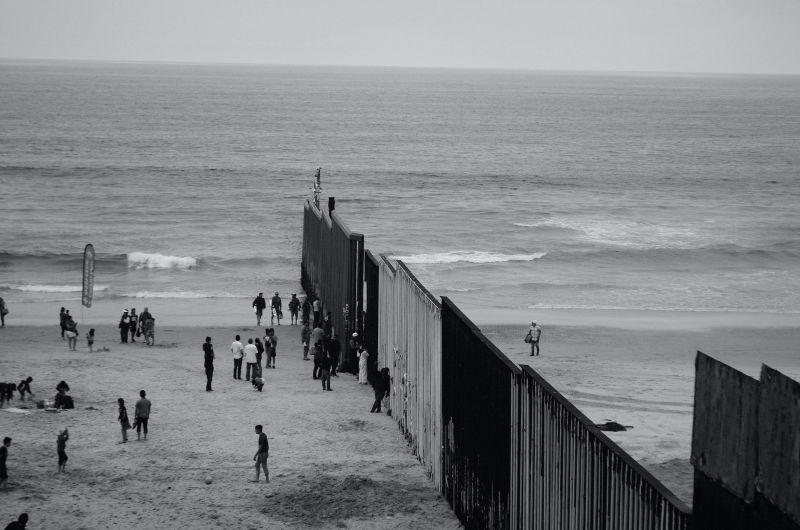
Borders can be territorial, geographical and political, physical or cultural. Yet they can never be defined exclusively through these terms because, regardless of the origins of that border, there is necessarily a consideration of plurality in relation to the operation of a built form. This is because the border is by definition, never singular. It is always a separation (and thus a joining) that occurs within a context. Thus, the certainty of abstraction is immediately undone by the plurality of particularities that exist within and around border conditions. From sites of military conflict to municipal boundaries, from housing estates to gated communities, it is this plurality that drives the continual return to discuss and understand the concept of borders and bordering.
The border sites that will be discussed at this conference are not limited to those of nation-states. While important, limiting discussion of borders to such a narrow viewpoint risks entwining the discussion of border sites with the particularities of geo-political conflicts (and thus misses a layer of nuance) or even worse, abstracting back to drawn lines on a map. Such a limitation also ignores the operation of different kinds of borders that exist outside of state-lines but whose operation runs so parallel as to disappear into the horizon. This is what Mezzadra and Neilson call the 'proliferation' and 'heterogeneity' of borders; a plurality of sites whose operation continues to invite interrogation. Taking this intertwined idea and extrapolating further, the border can be defined as both site and method simultaneously.
This conference will see a wide range of thought-provoking papers delivered by presenters from a wide variety of disciplines including Architecture, Art, Literature, Cultural Geography and Critical Theory.
Keynotes:

Professor Teresa Stoppani, Director of Architecture and Interior Design, Norwich University of the Arts
Professor Teresa Stoppani is an Architetto (Italy) and architectural theorist, she lectures in history and theory, and teaches design studio across the disciplines. Teresa studied Architecture at the IUAV University of Venice and received a PhD in Architecture and Urban Design from the University of Florence. She has taught at the IUAV, the University of Greenwich and the Architectural Association in London, UT Sydney, and Leeds Beckett University where she was the Head of the School of Architecture.

Professor Brett Neilson, Deputy Director, Institute for Culture and Society, Western Sydney University.
Brett Neilson’s research and writing aims to provide alternative ways of conceiving globalisation, with particular emphasis upon its social and cultural dimensions. Drawing on cultural and social theory as well as on empirical studies, his work has derived original and provocative means for rethinking the significance of globalisation for a wide range of contemporary problems and predicaments, including the proliferation of borders, the ascendancy of financial markets, the pressures of population ageing, the governance of logistical chains, and the role of digital infrastructures.
Schedule:
Thursday 18 July
11:00-11:45 | Registration and coffee/tea |
11:45-12:00 | Welcome, Acknowledgement of Country, Introduction |
12:00-1:00 | Keynote: Professor Teresa Stoppani. |
1:00-2:00 | Lunch |
2:00-4:00 | Panel One - Borders and Power |
4:00 | Closing |
Friday 19 July
9:30-10:00 | Coffee/tea |
10:00-12:00 | Panel Two - Borders as Such |
12:00-1:00 | Lunch |
1:00-3:00 | Panel Three - Beyond Borders |
3:00-3:30 | Afternoon Tea |
3:30-4:30 | Keynote: Professor Brett Neilson |
4:30 | Closing Remarks |
Review the Call for Papers
For further details contact Jonathan Laskovsky <jonathan.laskovsky[at]unimelb.edu.au>.