Autonomy against police power: the Aboriginal Tent Embassy and the historical avant-garde w. Astrid Lorange and Andrew Brooks
Share via
Please join us for the next instalment of the Critical Management Studies Seminar.
‘Autonomy against police power: the Aboriginal Tent Embassy and the historical avant-garde'
Astrid Lorange (UNSW) and Andrew Brooks (UNSW)
Wednesday 22 May, 1pm-2:30pm
John Medley Linkway (Level 4), University of Melbourne Parkville campus.
This talk excerpts from a book project called Art of Unmaking: Abolition and Aesthetics in Australia. An aesthetics of unmaking offers a way of understanding the project to abolish the police, the prison, the colony, and capital through an analysis of the work of art, here taken as a refusal of completion that mirrors the ongoing nature of abolitionist struggles. The unmaking of settlement is at once the projection of a new future and a political project grounded in an acknowledgment of the unbroken Indigenous sovereignty that precedes and exceeds the settler state. Art of Unmaking engages these multiple temporalities to consider the work of art as a refutation of settler history, a document of the present moment, and the suggestion of a world yet to come. The book project tracks the centrality of police power – which we take to be in excess of the police as an institution, describing a form of power that manufactures and secures social order – to the establishment and reproduction of the settler colony and the capitalist mode of production. We read art as one site in which struggles to unmake the police power of the colony are given form, encouraging a mode of reception attuned to the horizon of abolition.
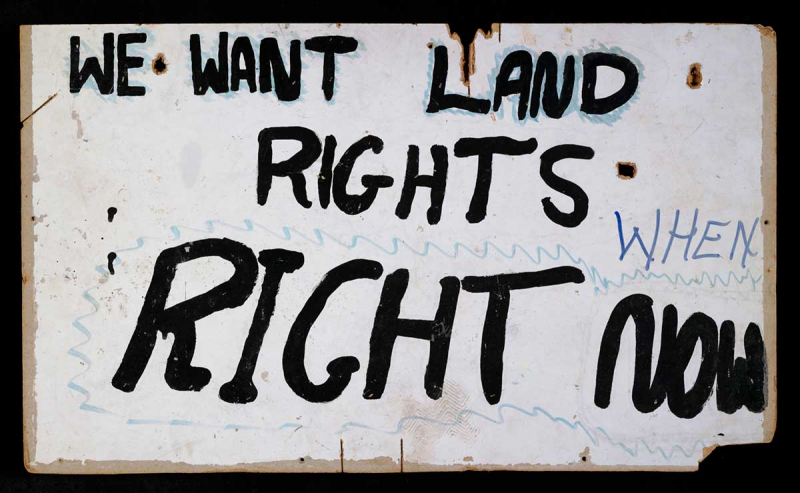
We read the Aboriginal Tent Embassy, the Aboriginal Legal Service, and the Aboriginal Medical Service which all emerged from this fertile period of activism as responses to the expansion of police powers and surveillance practices across the first half of the twentieth century into a range of social welfare functions that reconfigured the police as paternalistic guardians of First Nations people. The Embassy brought into being not only a set of public political demands but also systems for documenting, sustaining, broadcasting, and communicating those demands. We will argue that the Embassy and associated aesthetico-political experiments are expressions of what Joshua Clover has termed the ‘historical avant garde’ which describes aesthetic practices that emerge from social upheavals and antagonisms in a given time and place. The historical avant-garde stands in opposition to the endurance of avant-garde practices that fetishise a formal aesthetics of radicalism predicated on the prior. We will argue for reading the Embassy as an expression of the historical avant garde and as a way of attuning to the unpredictable forms of aesthetic production that will emerge from contemporary abolitionist movements.