The Teaching of Philosophy and the Life-Death of the Academy: On Canguilhem as Derrida’s ‘philosophical super-ego' w. Chris O'Neill
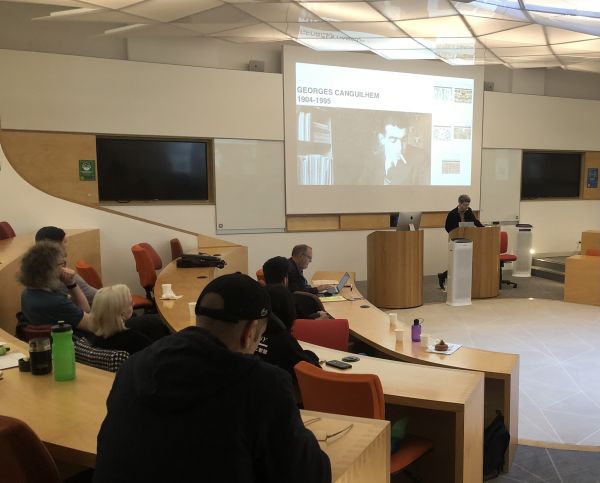
William MacMahon Ball Theatre, Old Arts (Room 107)
MapShare via
Please join us for the next instalment of the Critical Management Studies Seminar.
The Teaching of Philosophy and the Life-Death of the Academy: On Canguilhem as Derrida’s ‘philosophical super-ego'
Dr Christopher O’Neill
In Benoît Peeters’ 2013 biography of Jacques Derrida, we learn that Derrida was known to refer to the French philosopher of science Georges Canguilhem as his “philosophical super-ego”. Given that Derrida and Canguilhem are generally considered to ‘belong’ to quite distinct traditions of thought, the apparent significance of Canguilhem as a philosophical influence upon Derrida is perhaps surprising. While Canguilhem is best known for his philosophy of vital normativity, he was also maybe the most significant teacher of philosophy in post-war France, counting Derrida among his many celebrated pupils. In this talk I propose that Canguilhem is a crucial rather than incidental or even simply oppositional figure for understanding Derrida’s thinking and critique of the ‘life-death’ of the academic institution. Although Derrida and Canguilhem were to become exceptionally critical of each other’s (teaching) philosophies, they were both equally critical of a notion of teaching as the simple transmission of knowledge, of the role of the teacher as a repeater of certain formulae, and of the teaching of philosophy as oriented around the fulfilment of a given ‘programme’ of thought. Drawing upon materials from the Canguilhem archives (CAPHÉS - École Normale Supérieure) and the Derrida archives (University of California – Irvine), I argue that it is through considering the institutional stakes of the pair’s respective philosophies of the living and of ‘life-death’ that we can understand the ambiguous nature of Derrida’s tribute.