On the Question of Technology in China revisited: Disorientation in Jia Zhangke’s 'Still Life'
Share via
Tuesday 16 Dec, 1pm-2pm
Ian Maxwell Room, John Medley 261E
University of Melbourne, Parkville Campus
Jack Cao, “On the Question of Technology in China revisited: Disorientation in Jia Zhangke’s Still Life”
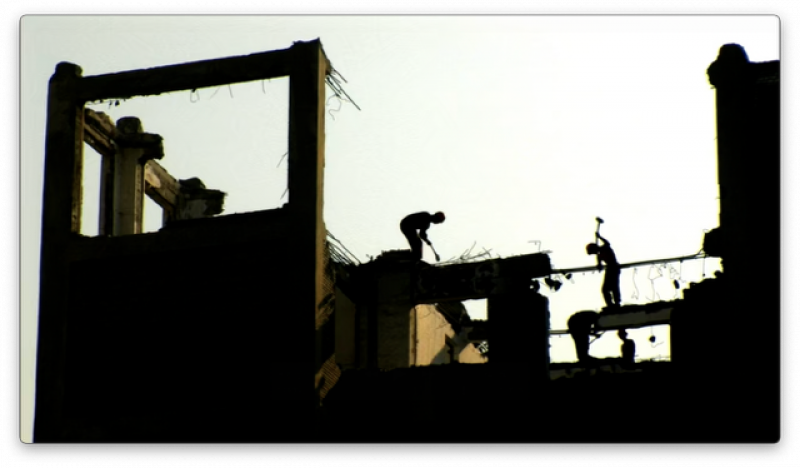
Martin Heidegger’s essay ‘The Question Concerning Technology’ famously argued that technology is not a question of discrete material technologies but something more fundamental to human subjectivity. For Heidegger, technology is a historical form of intuition: a form of ontological unveiling that sees the world as mere resources to be exploited or what he calls ‘standing reserve’. As one of the most influential essays in the phenomenological tradition, it has spurred some debate, to put it lightly. Whatever its political leanings or Luddite tendencies, the question of modernity’s destruction of ‘tradition’ continues to be a pressing issue as the capitalist world system shifts its centres of gravity. Yuk Hui has recently continued this line of inquiry on China’s hyper-compressed capitalist development, interrogating the consequences of what he interprets as a lack of reflection on historicity and technology in the Chinese philosophical tradition. However, given the wide influence of Hui’s work, it’s surprising that Maoism as a serious philosophy of history does not get a mention in his diagnostics, which in many ways continues the line of ‘Chinese modernisation without modernity’. I look to bridge discussion in continental philosophy and East Asian studies through an analysis of Still Life by Jia Zhangke — one of China’s major contemporary filmmakers. In this film, I argue that Jia navigates between the claims of both post-Heideggerian media theory and Marxist readings of space-time compression to stage a layered disorientation. The film stages an existential structure that mediates the modernities of failed Maoist industrialisation and the contemporary subsumption of socialist forms of life exemplified by construction of the Three Gorges Dam. I argue that Yuk Hui’s reconstructions of nihilism in contemporary China should be recast by considering the lost objects of romanticism and magical thinking in Maoist transformations of labour. Technology as a historical mode of intuition could be compellingly reread from the perspective of Maoist developmental speed and its ruins.
Speaker bio:
Jack Cao is a PhD candidate in Comparative Literature and Theory at UPenn where he is a Benjamin Franklin fellow. He researches and lectures in contemporary literature, film and theory in the Americas and China. His writing has been published in Critique and work from his dissertation entitled American Decline in the Chinese Century: Intuiting the World System is forthcoming.