Times of Catastrophe: How can we act in time?

Share via
How can we act in time?
Dr Oliver Feltham (American University of Paris)
Thursday 11 July 2024, 6pm-7:30pm - Elisabeth Murdoch, G06 Lecture Theatre A, University of Melbourne Parkville campus
How can we act in time? The most obvious way to unfold this question is to focus on how we might no longer avert, but at least slow, limit, and reduce the extent of our ecological disaster. Yet if we leap into analysis of climate and environmental policy – rolled back or watered down according to the economic or political conjuncture – or climate activism, we might miss what is at stake in the interrelation of collectivity, action, and time posed by the question itself.
In this lecture, I will follow Hobbes and Spinoza in categorising actions as a subset of the passions. Hence the question can be rearticulated: how do we find ourselves implicated in collective relationships to temporality via the passions? How do specific configurations of the passions socialise us into a particular experience of time? And how might an experience of time manifest our ‘being-together’, the actual collectivity that enfolds us?
On the basis of Vittorio Morfino’s research into plural temporalities in Marx and the Marxist tradition, the challenge for a theory of time as a collective passion is to show that, in what is taken to be one and the same society, there are plural temporalities at work. The second and more difficult challenge is to show that some of those temporalities are not fully or exclusively human, or machinic, but natural. It is only as cognisant of such plural times that an action might take the measure of catastrophe.
This public lecture will be delivered as part of the inaugural Melbourne Critical Theory Winter School, presented by the Critical Research Association Melbourne(CRAM).
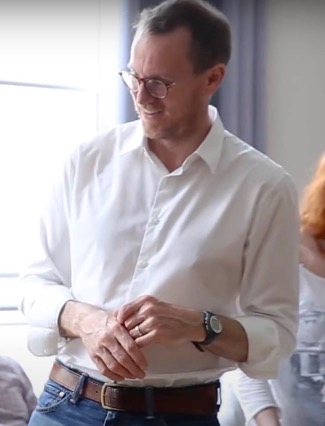
Oliver Feltham is an Australian philosopher working in Paris. He has published two works on the genealogy and comparative ontology of political action: Anatomy of Failure: Philosophy and Political Action (London: Bloomsbury 2013) and Destroy and Liberate: Political Action on the Basis of Hume (London: Rowman & Littlefield International, 2019). He translated Alain Badiou’s Being and Event, wrote a monograph on Badiou’s philosophy, and has published on Jacques Lacan. He has recently written two tragicomedies, Twig and Gull, on ecological catastrophe as lived through by animals (but some of their friends die). He is currently working on the intersection of time, nature, society and government in nineteenth century European philosophy. He is Professor of philosophy at the American University of Paris.