Exhibition highlights
DÜRER’S NUREMBERG
During Dürer’s lifetime, the city of Nuremberg reached the height of its political, economic, territorial, and cultural power, to become a leading city in the Holy Roman Empire. It had won independence from neighbouring princes, was subject to the emperor alone, and considerably expanded the number of villages under its control.
Nuremberg’s economic wealth was based on its metalworking, textile, and timber production, as well as long-distance trade and innovative print workshops. In this dynamic craft environment, intense specialization developed, including for craftsmen working in different metals such as bronze, iron, or silver. The city also began to regulate the production of goods considered critical for its reputation. Objects such as armaments, trumpets, and scientific instruments were stamped with an ‘N’ or the Nuremberg eagle, as assurance of their high quality (just as Dürer stamped his prints with a monogram).
Given Nuremberg’s many churches and ecclesiastical institutions, as well as its deep investment in religious culture and ritual through its safeguarding of the Imperial Relics and Regalia, much of its artistic and economic energies were directed towards sacred artefacts and religious piety. Religious faith and practice remained integral to Nuremberg’s material Renaissance, even as it confronted and adopted religious reform.
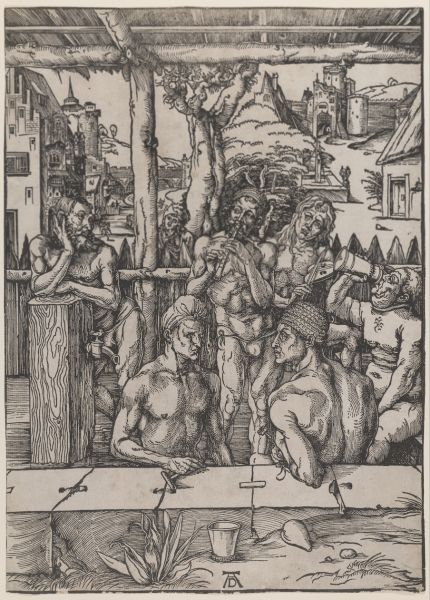
Albrecht Dürer
Germany, 1471-1528
The bath house c.1496
woodcut
Gift of Dr J. Orde Poynton 1959.
Prints and Drawings Collection, Archives and Special Collections.
University of Melbourne.
1959.2141.000.000
This depiction of an open-air bath house in a setting featuring typical south German architecture in both town and castle displays Dürer’s interest in nudes in different poses after his return from Italy in 1495. The representation of male sociability and homoerotic pleasure (suggested by the careful positioning and linguistic innuendo of the cock-shaped tap at left) also possibly relates to the closure of bath houses in Nuremberg in 1496 to guard against the new epidemic of syphilis.
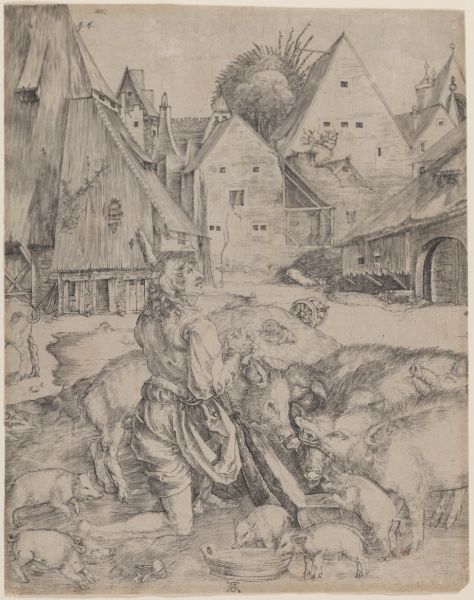
Unknown (printmaker)
after Albrecht Dürer (artist)
Germany, 1471-1528
The prodigal son and the swine (c.1496), copy printed c.19th century
engraving
Gift of Dr J. Orde Poynton 1959.
Prints and Drawings Collection, Archives and Special Collections.
University of Melbourne.
1959.5554.000.000
Dürer’s setting for this biblical story, depicting the Prodigal Son’s misery as he kneels before a dung heap and feeding trough in a bleak farmyard, was a novel one. The detailed attention to the environment – wooden shingles, steep gables, brick masonry of the village wall, puddles of water, ducks, a cow, and swine – locate the story in Nuremberg’s country environs and Dürer’s contemporary present, while the penitent’s gaze towards the church at top right suggests a broader spiritual meaning.
FASHION
In Renaissance Germany, the materials and objects a person wore communicated important information about their gender, social station, and profession. Like those of many European cities, Nuremberg’s sumptuary laws attempted to police social boundaries by dictating the types of clothing worn by members of each class. As an external marker of identity, dress could also allow individuals to visually climb the social ladder. Dürer curated for himself a striking personal style that exploited and expanded fashion trends and elevated the status of the artist. In his artworks, clothing, shoes, headdresses, and jewellery offered opportunities to suggest the blurring or subversion of social and gender norms.
When travelling, Dürer’s numerous costume studies exhibit his fascination with regional dress. His two trips to Venice in 1494/95 and 1505/7 were pivotal moments in developing his interest in fashion. Coming from Nuremberg, which was known for its more conservative and modest style, Dürer was fascinated by Venetian women’s sumptuous gowns and high platform shoes. He was also inspired by Venetian artists’ interest in accurately documenting the clothing of the Islamicate world. His prints – including the Adoration of the Magi – exhibit his familiarity with the work of Venetian painter, Gentile Bellini, who studied Ottoman dress during his sojourn in Constantinople.
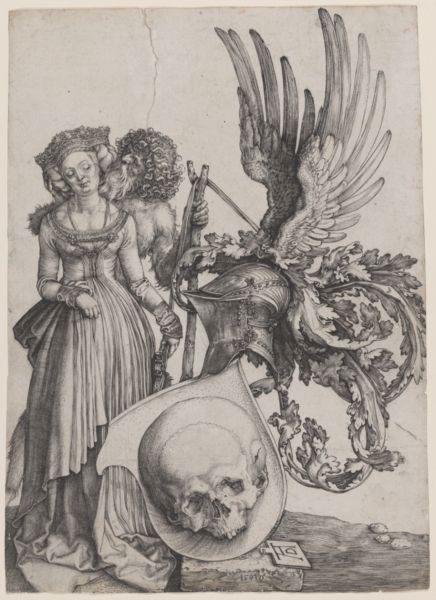
Albrecht Dürer
Germany, 1471-1528
Coat of arms with a skull 1503
engraving
Gift of Dr J. Orde Poynton 1959.
Prints and Drawings Collection, Archives and Special Collections.
University of Melbourne.
1959.2083.000.000
Coats of arms populated public spaces in Nuremberg, and self-glorification through excessive heraldic display attracted criticism. Rather than a vain projection of one’s identity, Dürer’s arms are instead an invitation for critical introspection and self-examination.
A patrician bride, who wears a fashionable Nuremberg-style gown and an elaborate bridal crown, has succumbed to the sensuous embrace of a wild man. The skull on his shield reveals his true identity as Death and cautions against the vices of vanity and lust.
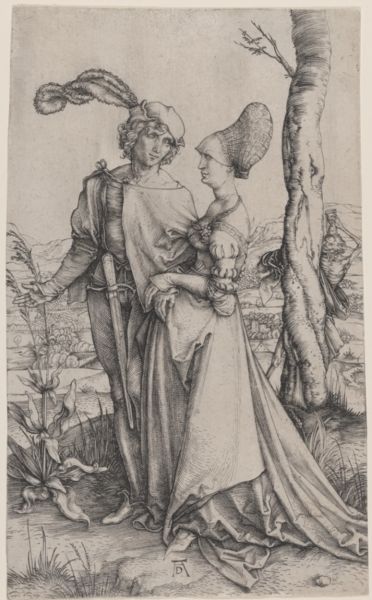
Albrecht Dürer
Germany, 1471-1528
The promenade c.1498
engraving
Gift of Dr J. Orde Poynton 1959.
Prints and Drawings Collection, Archives and Special Collections.
University of Melbourne.
1959.2105.000.000
In this remarkable image, every hat tells a story. The man’s ostrich feather is tucked in a stylish beret; the woman wears an elaborate headdress. In the background Death has a hat, too – a sandglass –unseen by the young couple, but warning the viewer that all adornments are material vanities. Even at the height of its growth, the grass will wither, and the flower fade away. Time is running out.
MASTER ENGRAVINGS
These three powerful works are Dürer’s most renowned, often referred to as his Meisterstiche (‘Master Engravings’). Produced from 1513 to 1514, their significance was swiftly recognised by contemporaries, who debated their meanings and described them as 'marvels', astonishing the whole world'.
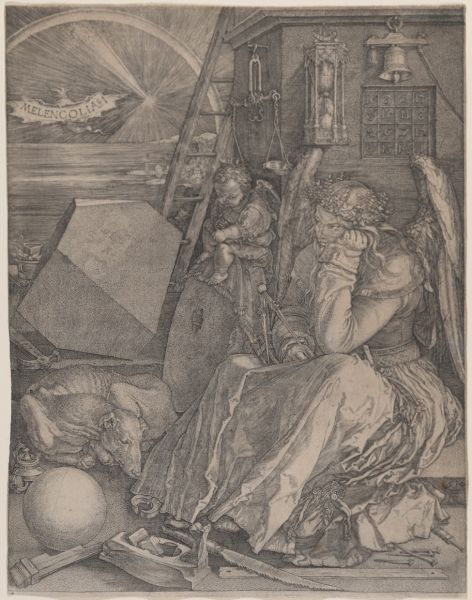
Engraved onto copper plates using a tool known as a burin, the images show Dürer’s close attention to the qualities of different materials. In Knight, Death, and the Devil, Dürer captures the lustre of the knight’s metal armour, while the stunning rock face behind the figure of Death reveals multiple refined engraving techniques. In St Jerome, light and shadow are rendered across wood, plaster, stone, cloth, bone, and fur. The remarkable surface of Melencolia I’s stone polyhedron has inspired centuries of artists to wrestle with its virtuosic material effects.
One object appears across the engravings: the sandglass, produced en masse in Nuremberg. In St Jerome, it appears paired with the skull as a sign of the saint’s awareness of mortality. In Knight, Death and the Devil, it is topped with a clock dial, revealing the last hour’s unseen proximity. In Melencolia I, surmounted by a sundial – another Nuremberg speciality – time is running out. A life measured correctly required careful, material attention.
Albrecht Dürer
Germany, 1471-1528
Melencolia I 1514
engraving
Purchased 1988.
Prints and Drawings Collection, Archives and Special Collections.
University of Melbourne.
1988.2013.000.000
A personified Melancholy sits idly, swinging a compass, amid a dream like clutter of tools, medical instruments, raw materials, measurement devices, and numbers. Mirroring Melancholy’s obsessed gaze, we try to understand why – why this bizarre array? But are we, like her, wasting our time? Perhaps this printed object is designed to work as a remedy for the listless humoral imbalance of melancholy that contemporary theory believed was due to the malign influence of the planet Saturn?

Albrecht Dürer
Germany, 1471-1528
St. Jerome in his study 1514
engraving
Gift of Dr J. Orde Poynton 1959.
Prints and Drawings Collection, Archives and Special Collections.
University of Melbourne.
1959.2082.000.000
Seated at his desk, Saint Jerome, famous translator of the bible into Latin, is guarded by the lion whose foot he had cured. He is surrounded by significant objects: cardinal’s hat, rosary, crucifix, skull, writing materials. The pumpkin above alludes to Jerome’s contentious translation choice for the plant that had shaded the prophet Jonah. Dürer asserts a claim to translate materials, too: the wooden grain of the ceiling and light passing through bulls-eye glass are fluently translated onto the copper engraving plate.

THE HOUSEHOLD AND THE BODY
Dürer appreciated the body’s expressive potential. He rendered the harmonious proportions of the human form with mathematical precision and produced Four Books on Human Proportion (published posthumously in 1528). He employed these techniques in his mythological, allegorical, and religious subjects. He channelled the same studious energy into genre scenes in which the stout, work-worn body of the humblest peasant was worthy of careful attention. The grotesque body could also serve a purpose – comical, satirical, cautionary, or all three.
Dürer’s bodies are embedded in a material world that was familiar to the inhabitants of Renaissance Nuremberg. He populated his artworks with objects commonly found in his own household and those of his neighbors: furnishings, metal vessels, ceramics, candlesticks, and woven baskets. Objects came to embody relationships, emotions, and the body itself: keys, purses, bellows, cookware, and hourglasses were imbued with meaning and served to define the bodies they surrounded and adorned.
Prints themselves were found in the home. They featured in the private collections of urban merchants and elites, while religious subjects served as foci of private devotion or as edifying models for burghers and their families. Dürer’s prints even came to be reproduced on objects intended for household use, such as ceramics.

Albrecht Dürer
Germany, 1471-1528
The temptation of the idler / The dream of the doctor c.1498
engraving
Gift of Dr J. Orde Poynton 1959.
Prints and Drawings Collection, Archives and Special Collections.
University of Melbourne.
1959.2092.000.000
Wrapped in a fur-lined house cloak, lulled by soft pillows and a hot Kachelofen (ceramic stove), this man falls asleep on the ‘hell bench’, the warmest site of a household. His vision of Venus and Cupid is powered by heat, the devil’s bellows – which pump lustful thoughts into his ear – and the scent of the warmed aphrodisiacal mandrake fruit. Kachelöfen and their tiles (manufactured in Nuremberg) were both prized consumer items and morally ‘perilous possessions’, as new research shows.

MAKING MUSIC
Music mattered in Dürer’s intellectual, spiritual, and social worlds. Dürer, like many of his humanist friends, would have known basic music theory concerning harmony, which in the Renaissance was closely related to the mathematics and theories of proportion so central to artistic practice. Dürer’s surviving writings include a musical setting of the well-known Marian antiphon Salve Regina (Hail, Queen) using a numerical system of notation known as tablature.
Musical instruments – harps, lutes, drums and trumpets – are a constant presence in Dürer’s depiction of heavenly scenes, particularly those featuring the Virgin Mary. We can perhaps imagine these prints evoking the sounds of the numerous musical works in Mary’s praise that were sung in churches, on the streets, and in homes in early modern Nuremberg.
Nuremberg was a city renowned for its manufacture of brass instruments – part of its metalworking expertise. Numerous other musical instrument makers and performers are found scattered through the city’s records and Dürer’s images. Dürer’s close interest in music across different physical and social settings is witnessed in works such as The Bathhouse and his astonishing portrait The Bagpiper, which explores the rougher sounds of rural peasant music-making.

after Albrecht Dürer (artist)
Germany, 1471-1528
Charles Amand-Durand (publisher)
France, 1831-1905
The bagpiper (1514), copy printed c.1869
photogravure
Gift of Dr J. Orde Poynton 1959.
Prints and Drawings Collection, Archives and Special Collections.
University of Melbourne.
1959.2069.000.000
The harsh, unrefined sound of the bagpipes were associated with peasants and shepherds across early modern Europe. The instrument’s bag is made of animal skin stitched together, just like the piper’s leather jerkin and trousers. The leather shoes are worn, revealing the contours of the piper’s toes. The carefully worked wood of the pipes seems offset by the gnarled wooden tree trunk. This is sound that derives from nature’s rough materials.
WEAPONRY AND CONFLICT
The material culture and technology of warfare fascinated artists, although few eyewitness battle scenes or visual records of war’s wider social impact were produced in this era. Artists depicted armour, in particular, in exceptional detail. Nuremberg’s renowned metalworkers produced armour for men and horses, used in battle but also for elaborate ceremonies and processions. Merchants imported raw material from booming mining and metallurgy industries to feed production.
Reports of warfare – notably in Italian and Swiss territories – formed a backdrop to Nuremberg life. In an era before standing armies, regions often negotiated the direct supply of soldiers and equipment in periods of conflict. Dürer’s closest friend Willibald Pirckheimer led Nuremberg’s troops in the 1499 Swabian war, and the men’s bright red outfits would have been a regular sight in the city. The Peasants’ War of 1524-1525 included violent skirmishes close to Nuremberg. Around this time, Dürer recorded waking in terror, his body trembling, from a nightmare about a vast torrent of water falling from the sky: a deeply personal manifestation of the embodied anxieties that conflict could produce. Biblical images of violence, especially those concerning Christ, also called on viewers to tangibly imagine the impact of a whip, lance, or other weapon on flesh.
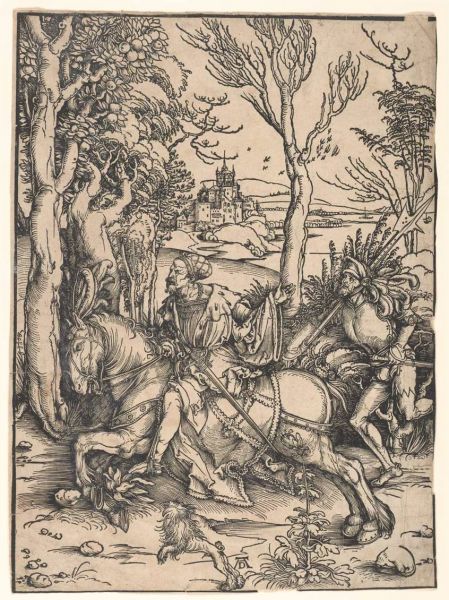
Albrecht Dürer
Germany, 1471-1528
The knight and the lansquenet c.1496
woodcut
Gift of Dr J. Orde Poynton 1959.
Prints and Drawings Collection, Archives and Special Collections.
University of Melbourne.
1959.2132.000.000
With an expansive gesture that reveals his fashionable clothing, this knight on horseback is surrounded by signs of his status. He is accompanied by a lansquenet or Landsknecht – a mercenary – who runs behind with a polearm and a plumed headdress echoing
the headdress of the horse. They speed along in a wooded space beyond city walls. The vigorous motion in Dürer’s woodcut reminds us that the countryside surrounding Nuremberg was sometimes violently contested, and travel could be dangerous.
Enea Vico (engraver)
Italy, 1523-1567
after Francesco Primaticcio (artist)
Italy, 1504-1570
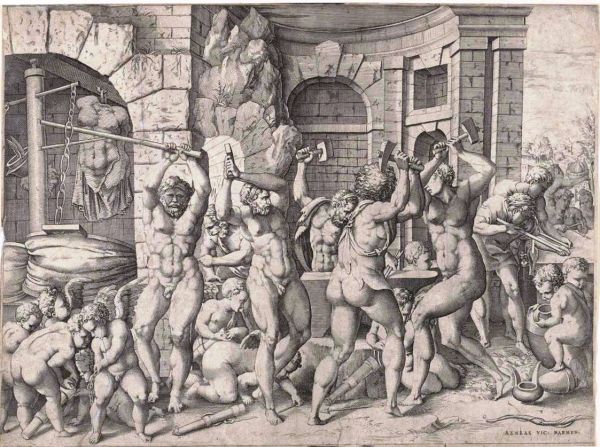
Vulcan and the Cyclopes forging arrows for the cupids 1523-1567
engraving
Gift of Dr J. Orde Poynton 1959.
Prints and Drawings Collection, Archives and Special Collections.
University of Melbourne.
1959.4072.000.000
Enea Vico’s engraving is based on a design by Italian artist Primaticcio of the School of Fontainebleau. Vulcan, god of fire, works with metalworking tools: the bellows maintain the furnace’s fire and Vulcan and the Cyclopes at an anvil forge arrows, which cupids gather for their quivers. The episode speaks to the role of metals in Europe’s material Renaissance and presents the artist as an alchemist who possesses the god-like ability to transform raw materials into finely wrought objects.

THE RENAISSANCE BOOK
The extraordinary growth in the volume and availability of printed books during this era is sometimes characterised as a ‘revolution in print.’ Matter was central to this process. Access to paper was crucial, and in 1390 Nuremberg became the location of the first permanent paper mill in northern Europe. The key driver for change lay in more efficient ways to use the printing press. Around 1452, the German printer Johann Gutenberg of Mainz developed the technology of movable metal type. Books no longer needed to be printed from painstakingly carved pieces of wood to create ‘block books’ or written out by hand in manuscripts. Demand for luxury manuscripts and embellished printed books still remained high, however, and there was a growing market for books illustrated with prints.
Some cities developed new industries around print. These included Nuremberg and Venice, a trading partner with Nuremberg and key location for Dürer’s artistic development. Humanist and clerical scholarship in Greek, Latin, and Hebrew was fostered by the Renaissance and the rise of print. Books in vernacular languages were also increasingly widely accessible to merchants and craftspeople, making the ability to turn the pages of a book a hallmark of the material Renaissance for many people.
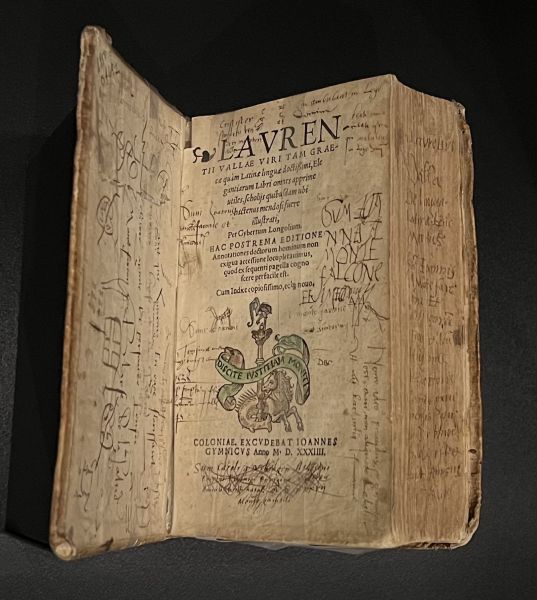
Lorenzo Valla, Elegantiae linguae latinae
(Elegances of the Latin Language) (Cologne: Johann Gymnich, 1534), title page
Rare Books, Archives and Special Collections.
UniM Bail SpC/BX 470 VALL
Valla’s manual for correct Latin usage was a classic of Renaissance humanism. This particular copy, marked by multiple users, includes a fascinating array of handwritten quotations, drawings, pen practice, scribbles, sums, crossings-out and doodles – a common fate for the Renaissance book. Here we see the names of two noblewomen: Joanna de Montfalcon and Blayse de la Palud. Alongside French, there is the start of a German hymn, and two attempts at the start of Psalm 119 in Latin.

PIETY AND PERSECUTION
Nuremberg’s many churches and chapels were replete with statues, paintings, tapestries, and precious objects, around which religious rituals and devotions were performed, some extending into civic space. Nuremberg itself became a pilgrimage destination on the feast celebrating the Imperial Relics, which included pieces of Christ’s cross, and the lance that pierced his side.
Dürer’s religious prints allowed direct emotional engagement in matters of faith. His many images of the Virgin, some located in familiar Nuremberg surrounds, were meant to stimulate devotional piety. So were the prints depicting Christ’s suffering and death, as especially found in The Small Passion and The Large Passion series, books that also included verses by Nuremberg monk and humanist, Benedict Chelidonius.
A focus on Christ’s suffering in these books, Dürer’s own writings, and many contemporary sermons, texts, and images, helped amplify false accusations, however, that the Jews were the killers of Christ. Such anti-Jewish beliefs stimulated blood libel accusations and the expulsion of Jews from many German cities and territories, including from Nuremberg in 1499.
The growing reforms and dissent related to the outbreak of the Reformation in the 1520s brought further challenges to Nuremberg; yet the city’s government and artists navigated religious change with comparatively little social upheaval.
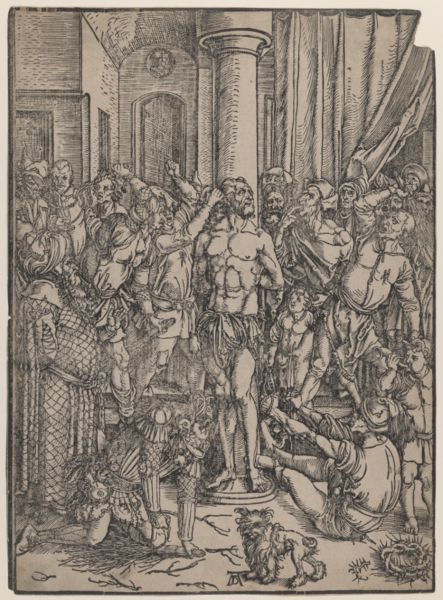
Albrecht Dürer
Germany, 1471-1528
The flagellation c.1496
from The Large Passion, 1511 woodcut
Gift of Dr J. Orde Poynton 1959.
Prints and Drawings Collection, Archives and Special Collections.
University of Melbourne.
1959.2139.000.000
The physical, mental, and emotional suffering of Christ is at the heart of late medieval and Renaissance piety. Bound against a column by a figure at lower right, Christ suffers blows from both scourge and birch-rod. An onlooker mocks him with a well-known gesture of two fingers in his mouth and a child compounds humiliation by blowing his horn. Pontius Pilate oversees punishment, a soldier prepares another birch-rod, and a crown of thorns lies ready for further derision.
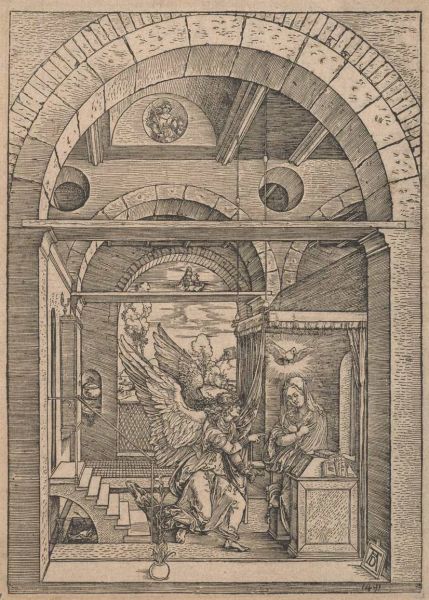
Albrecht Dürer
Germany, 1471-1528
The annunciation c.1503
from The Life of the Virgin, 1511
woodcut
Gift of Dr J. Orde Poynton 1959.
Prints and Drawings Collection, Archives and Special Collections.
University of Melbourne.
1959.5584.000.000
The angel Gabriel announces to Mary that she shall give birth to the son of God, Jesus. As the most important model for Christian piety, Mary receives the news with humility. Lily and wash basin symbolise her sexual and spiritual purity at her conception, while the figure of Judith holding the head of Holofernes above identifies the event as a victory over the Devil – shown as a badger under the stairs and chained like the Devil in Revelations 20.1-3.
All website and exhibition texts copyright exhibition curators Jenny Spinks, Matthew Champion, Shannon Gilmore-Kuziow and Charles Zika. Use without prior permission is not permitted. For queries, please contact the curators.
Featured content
-
Research
Discover the research behind the exhibition
-
Public programs
Engage in exhibition events and talks
-
Exhibition conservation
Find out more about role of conservation in the delivery of Albrecht Dürer’s Material Renaissance
-
Student experiences
Find our how students assisted in the delivery of Albrecht Dürer’s Material Renaissance
Want to know more?
For more information about this exhibition, contact the exhibition curators