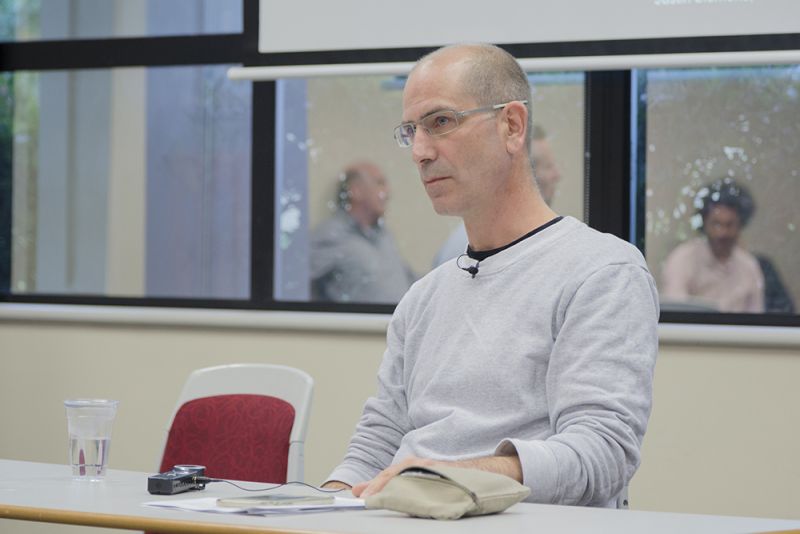
Acting in an Apocalypse, Prof. Justin Clemens
Share via
6pm-7:30pm Tuesday 23 June
Elisabeth Murdoch, G06 Lecture Theatre
University of Melbourne, Parkville Campus
Presented as part of 2026 Melbourne Critical Theory Winter School on Structure and Action: Psychoanalytic Theory Now.
Abstract
The question guiding this lecture is the following: is it possible to act ethically in an apocalypse? The word ‘apocalypse’ is used colloquially here, as roughly synonymous with what politicians, news reports and social media might call ‘urgent times,’ ‘emergency situations,’ and so on. Part of the interest of the question comes not only from a diffuse general sense that we live in apocalyptic times, but that such times put into question the very possibility of ethical action itself. The lecture will draw on four examples of discussions of action in extreme circumstances: Jacques Lacan on the tragic heroine Antigone; Mari Ruti on her own inoperable cancer; Jonathan Lear on Plenty Coups, the last chief of the Crow Indians; and Giorgio Agamben on the Muselmänner of the WWII deathcamps. These examples, which rest on a number of different genres — fiction, autobiography, history, and archival witnessing — will be used to illuminate some difficulties of thinking the possibility of ethics given extreme conditions.
Speaker bio:
Professor Justin Clemens works at the intersection of literary studies, psychoanalysis and contemporary European philosophy. He has written extensively on figures such as Sigmund Freud, Jacques Lacan, Alain Badiou, and Giorgio Agamben, as well as on themes of technology, slavery, torture, and love. Among his scholarly publications are Barron Field in New South Wales (2023), co-authored with Thomas H. Ford, What is Education? (2017), edited with A.J. Bartlett, and Psychoanalysis is an Antiphilosophy (2013). In addition to his scholarly research, he also publishes poetry and criticism.
This lecture will be delivered in person only. All are welcome, but registration is essential.